
Command and Control Traffic: Stages, Mechanics, and Interruption Points
Command and control channels often mimic standard web traffic, hiding malicious data within the headers and timing patterns of legitimate protocols rather than in obvious payloads.
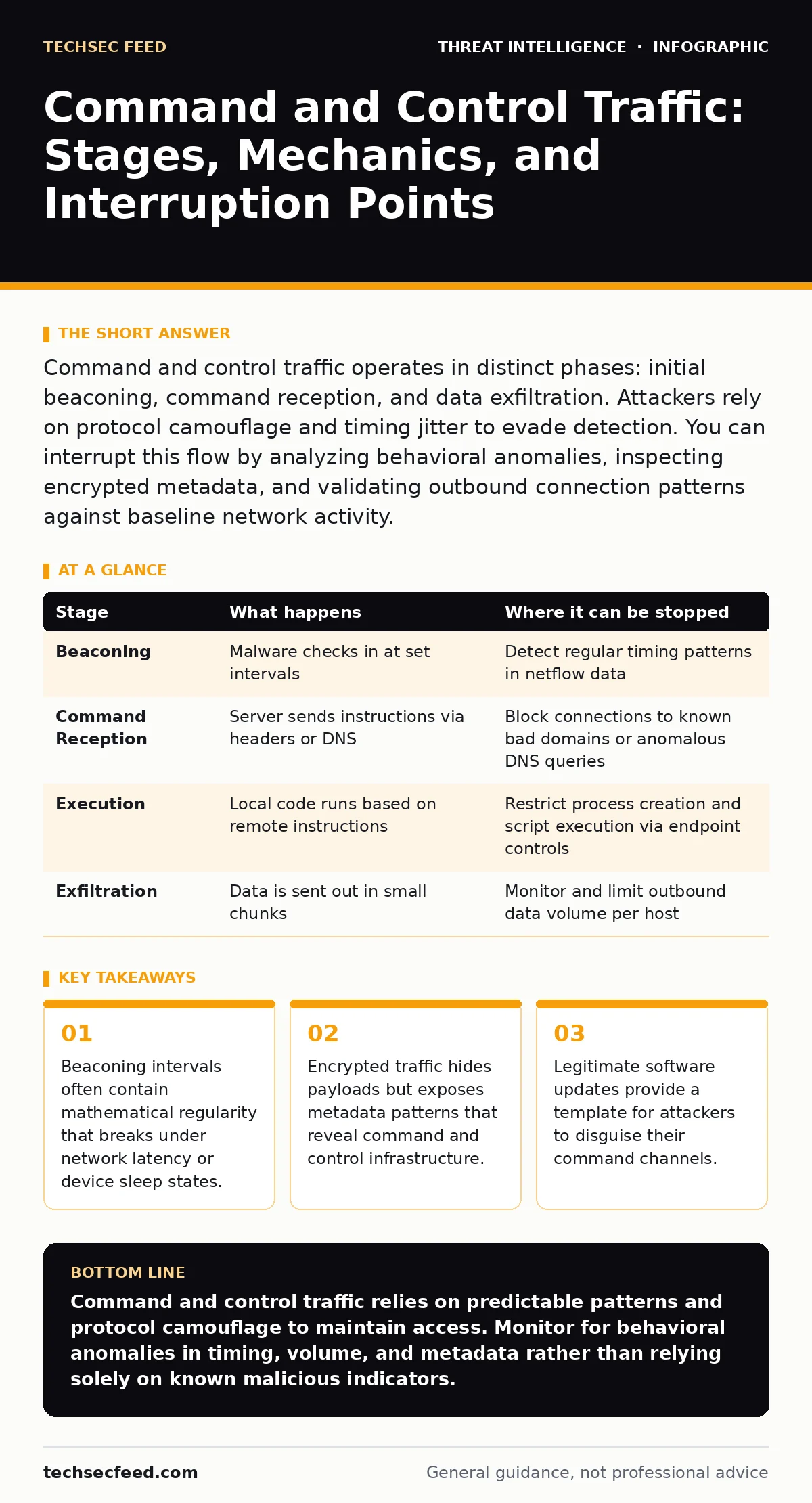
Command and control traffic operates in distinct phases: initial beaconing, command reception, and data exfiltration. Attackers rely on protocol camouflage and timing jitter to evade detection. You can interrupt this flow by analyzing behavioral anomalies, inspecting encrypted metadata, and validating outbound connection patterns against baseline network activity.
The Anatomy of Persistent Access
Remote access is not a single event but a continuous dialogue. Once an initial compromise occurs, the attacker must maintain a channel to issue instructions and retrieve data. This channel is known as command and control, or C2. The term describes the infrastructure and protocols used to manage compromised systems remotely.
The attacker relies on the asymmetry of network traffic. Inbound connections are heavily monitored, but outbound connections from internal endpoints are often permitted by default. This trust allows the compromised host to reach out to the attacker’s server. The flaw this relies on is the assumption that outbound traffic is user-initiated and benign.
Stage 1: Initial Beaconing
The first stage establishes the existence of the compromised host. The malware contacts the C2 server at regular intervals to prove it is alive. This is called beaconing. The interval might be every few minutes or every few hours, depending on the attacker’s need for stealth versus responsiveness.
The beacon usually contains minimal data. It identifies the host, reports its status, and waits for a response. If the server does not reply, the malware may retry or wait longer. This stage is critical because it creates a predictable pattern in network logs.
Stage 2: Command Reception
Once the beacon is acknowledged, the C2 server can send commands. These commands might instruct the malware to download additional tools, execute specific scripts, or capture screenshots. The command is often encoded to look like normal data.
Attackers use standard protocols for this exchange. HTTP and HTTPS are common because they blend with normal web browsing. DNS queries can also carry commands, using subdomains to encode data. This technique exploits the fact that DNS traffic is rarely inspected for content, only for resolution success.
The trade-off here is bandwidth. DNS channels are slow and limited in data size. HTTP channels are faster but generate larger logs that are easier to analyze. The attacker chooses based on the sensitivity of the command and the monitoring level of the target network.
Stage 3: Execution and Lateral Movement
The malware receives the command and executes it locally. This might involve running a PowerShell script, injecting code into a running process, or creating a new user account. The goal is to expand access or deepen persistence.
At this stage, the attacker may leverage scheduled task abuse to ensure the malware restarts after a reboot. This is a common persistence mechanism that does not require modifying system binaries. The command comes from the C2 server, but the execution is local and authorized by the compromised account’s privileges.
If the initial access is limited, the attacker may use the C2 channel to push lateral movement tools. These tools scan the internal network for other vulnerable hosts. The C2 server acts as a relay, directing the compromised host to attack its neighbors.
Stage 4: Data Staging and Exfiltration
The final stage is retrieving stolen data. Large files cannot be sent in a single command response. The malware must stage the data, often encrypting it locally before transmission. This staging prevents defenders from reading the data in memory or on disk.
Exfiltration happens over the same C2 channel. The data is broken into small chunks to mimic normal traffic patterns. This is called chunking. The malware sends these chunks in response to subsequent beacons or specific retrieval commands.
The attacker relies on the volume of legitimate outbound traffic to hide the exfiltration. A few kilobytes of stolen data lost in megabytes of cloud sync or software updates is difficult to detect. The timing of the exfiltration is often aligned with business hours to blend with normal user activity.
See also: ASN Threat Intelligence: Small Business Network Defense · TLS Handshake Explained: The Mechanics of Secure Connections
Interrupting the Flow
You can interrupt C2 traffic at any stage, but the method depends on the protocol and encryption used. For beaconing, look for regular intervals that defy natural human behavior. Network latency and device sleep cycles will disrupt perfect timing, creating anomalies.
For command reception, inspect the metadata of encrypted connections. While the content is hidden, the server certificate, domain name, and timing patterns are visible. Anomalous certificates or newly registered domains are strong indicators of C2 infrastructure.
For exfiltration, monitor data volume spikes. A sudden increase in outbound data from a single host, especially to an unfamiliar destination, warrants investigation. Correlate this with process activity to identify the source of the data.
| Stage | What happens | Where it can be stopped |
|---|---|---|
| Beaconing | Malware checks in at set intervals | Detect regular timing patterns in netflow data |
| Command Reception | Server sends instructions via headers or DNS | Block connections to known bad domains or anomalous DNS queries |
| Execution | Local code runs based on remote instructions | Restrict process creation and script execution via endpoint controls |
| Exfiltration | Data is sent out in small chunks | Monitor and limit outbound data volume per host |
The Hidden Cost of Encryption
Encryption complicates detection significantly. Many modern C2 frameworks use TLS to encrypt their traffic. This makes payload inspection impossible without terminating the connection, which raises privacy and legal concerns.
However, encryption does not hide the metadata. The length of packets, the timing between them, and the direction of traffic remain visible. Machine learning models can analyze these features to identify C2 traffic even when the content is unreadable.
Leveraging Existing Frameworks
Understanding C2 mechanics helps you map defenses to established frameworks. The MITRE ATT&CK Navigator provides a visual way to track these tactics and techniques across your environment. You can use it to identify gaps in your detection capabilities.
Information sharing through ISACs can provide early warnings about new C2 infrastructure. These groups share indicators of compromise and tactics among members. This collective intelligence helps you block threats before they reach your network.
For deeper visibility, tools like Sysmon can log process creation, network connections, and file changes. This data provides the context needed to link a suspicious network connection to a specific malicious process. Without this endpoint visibility, network alerts remain isolated events.
Beyond Traditional Indicators
Traditional indicators like IP addresses and domain names are easily changed. Attackers rotate their infrastructure frequently, rendering static blocklists ineffective. You must shift to behavioral indicators that remain constant despite infrastructure changes.
Behavioral indicators include the structure of the protocol, the timing of communications, and the sequence of actions. These patterns are harder to change because they are tied to the malware’s code logic. Analyzing these patterns requires a deeper understanding of how C2 traffic works.
Imagine a scenario where the C2 server moves to a new IP address every hour. Static defenses fail. Behavioral analysis, however, notices that the same internal host is communicating with different external IPs in the same pattern. This consistency reveals the threat.
The Role of Protocol Abuse
Attackers often abuse legitimate protocols to bypass security controls. AS-REP roasting is one example, where attackers request authentication data without a user password. This technique exploits misconfigurations in Active Directory to harvest credentials.
While AS-REP roasting is primarily a credential harvesting technique, the stolen credentials can then be used to establish C2 sessions. The attacker uses valid credentials to blend in with normal traffic. This makes detection harder because the authentication appears legitimate.
To mitigate this, enforce strict authentication policies and monitor for unusual authentication patterns. Look for requests that do not require a password or that originate from unexpected sources. Combining network monitoring with identity protection creates a layered defense.
Key takeaways
- Beaconing intervals often contain mathematical regularity that breaks under network latency or device sleep states.
- Encrypted traffic hides payloads but exposes metadata patterns that reveal command and control infrastructure.
- Legitimate software updates provide a template for attackers to disguise their command channels.
Command and control traffic relies on predictable patterns and protocol camouflage to maintain access. Monitor for behavioral anomalies in timing, volume, and metadata rather than relying solely on known malicious indicators.
Frequently asked questions
How can I detect C2 traffic if it is encrypted?
Focus on metadata analysis, including packet size, timing intervals, and destination reputation. Encrypted content hides the payload, but the structure of the communication often reveals its purpose.
What is the difference between C2 and a remote access tool?
A remote access tool is the software used to connect. C2 refers to the infrastructure and communication methods used to manage that software remotely, often hiding in plain sight.
Can I stop C2 traffic by blocking outbound internet access?
Blocking all outbound access is impractical for most organizations. Instead, restrict outbound traffic to known necessary services and monitor for connections to unexpected destinations.
How often should I update my detection rules?
Detection rules should be updated continuously based on new threat intelligence and internal observations. Static rules become obsolete quickly as attackers modify their techniques.
How this guide was produced: written by the TechSec Feed editorial team with AI assistance, checked against the public references listed below, and reviewed when the facts change. See our editorial policy or report an error.