
GraphQL Vulnerabilities: 9 Critical Questions Answered
GraphQL’s single entry point hides complex attack surfaces that traditional web scanners miss, allowing attackers to bypass standard perimeter defenses through query depth and introspection.
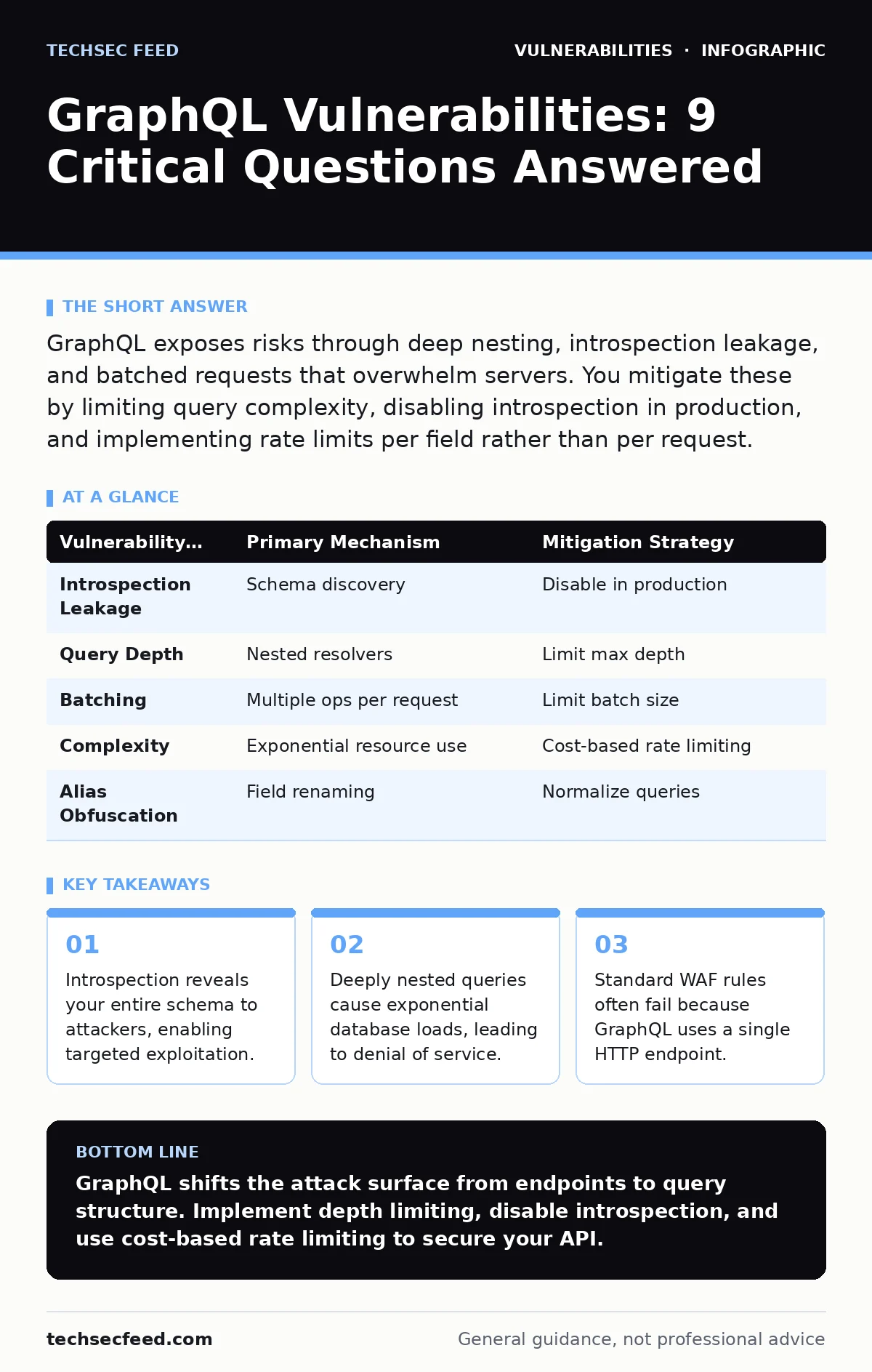
GraphQL exposes risks through deep nesting, introspection leakage, and batched requests that overwhelm servers. You mitigate these by limiting query complexity, disabling introspection in production, and implementing rate limits per field rather than per request.
Does GraphQL eliminate injection vulnerabilities?
GraphQL does not eliminate injection vulnerabilities, but it changes how they manifest. The structured nature of queries reduces the risk of traditional SQL injection, as arguments are typically typed and validated. However, logical injection remains possible if server-side resolvers trust user input without sanitization. Attackers can manipulate arguments to access unauthorized data or trigger unintended logic paths. You must validate all inputs at the resolver level, not just at the schema definition layer.
Is introspection a security risk?
Introspection is a security risk when enabled in production environments. This feature allows clients to query the schema itself, revealing every type, field, and mutation available. An attacker uses this map to identify sensitive endpoints and construct precise attacks. Disabling introspection in production forces attackers to guess the schema structure. This adds obscurity, which is not a substitute for proper authorization, but it significantly raises the barrier for initial reconnaissance.
How do attackers exploit query depth?
Attackers exploit query depth by creating nested requests that multiply database operations. A single query can request a user, their posts, each post’s comments, and each comment’s author. This creates a tree-like structure that expands exponentially with each level. The server processes each node, leading to resource exhaustion. This is a denial of service vector specific to GraphQL. You mitigate this by enforcing a maximum query depth limit, rejecting any request that exceeds a predefined threshold of nesting levels.
Can rate limiting protect GraphQL APIs?
Standard rate limiting often fails to protect GraphQL APIs effectively. Traditional limits count HTTP requests, but a single GraphQL request can contain multiple queries or mutations. An attacker sends one request with ten heavy operations, bypassing per-request limits. You need rate limiting based on query complexity or field cost. Assign a cost to each field and reject requests that exceed a total cost threshold. This ensures that expensive operations are throttled regardless of how many are bundled into one HTTP call.
What is batching and why is it dangerous?
Batching allows clients to send multiple queries in a single HTTP request. While useful for performance, this feature enables attackers to amplify their impact. An attacker sends a batch of 50 heavy queries, each triggering significant server load. The server processes them sequentially or in parallel, exhausting resources. This is known as a batch attack. You mitigate this by limiting the number of operations allowed in a single batch. Set a strict cap on the number of queries or mutations per request to prevent resource abuse.
See also: Asset Inventory Mistakes That Break Patching Workflows · Time-of-Check to Time-of-Use Bugs: Detection and Mitigation Strategies
How do I prevent data leakage through aliases?
Aliases allow clients to rename query fields, which can confuse server-side logging and monitoring. Attackers use aliases to obfuscate their requests, making it harder for security teams to detect anomalous patterns. They might rename a sensitive field to something benign, bypassing simple string-matching filters. You mitigate this by normalizing queries before processing. Strip aliases during validation and log the canonical form of the query. This ensures that security tools see the true structure of the request, regardless of client-side renaming.
Are GraphQL APIs vulnerable to DoS attacks?
GraphQL APIs are vulnerable to denial of service attacks through complex queries and large payloads. Attackers craft queries that require excessive computational resources, such as aggregating large datasets or performing complex calculations. They also send oversized payloads to overwhelm memory buffers. Unlike traditional APIs, where each endpoint has a fixed cost, GraphQL queries vary in complexity. You mitigate this by implementing query complexity analysis and payload size limits. Reject queries that exceed a calculated complexity score or a maximum byte size.
Does GraphQL bypass traditional WAF rules?
GraphQL often bypasses traditional Web Application Firewall (WAF) rules. WAFs rely on pattern matching for known attack signatures in URLs and parameters. GraphQL uses a single POST endpoint, hiding the actual operations within the request body. The structure of a GraphQL query differs from standard HTTP requests, causing many WAFs to miss malicious payloads. You mitigate this by using a WAF that understands GraphQL syntax. Configure rules to inspect the query structure, depth, and complexity rather than just looking for known exploit strings.
How do I secure mutations against abuse?
Mutations are vulnerable to abuse if they lack proper authorization and validation. Attackers can trigger expensive write operations, such as creating large files or updating many records, to degrade performance. They can also exploit logic flaws to escalate privileges. You secure mutations by enforcing strict role-based access control and validating all input data. Limit the rate of mutations per user and monitor for unusual patterns. Treat every mutation as a potential threat that requires explicit permission and resource constraints.
| Vulnerability Type | Primary Mechanism | Mitigation Strategy |
|---|---|---|
| Introspection Leakage | Schema discovery | Disable in production |
| Query Depth | Nested resolvers | Limit max depth |
| Batching | Multiple ops per request | Limit batch size |
| Complexity | Exponential resource use | Cost-based rate limiting |
| Alias Obfuscation | Field renaming | Normalize queries |
What are the hidden costs of GraphQL security?
The hidden cost of GraphQL security is the complexity of monitoring and logging. Traditional APIs log each endpoint call, making it easy to track usage. GraphQL logs a single endpoint with variable content, making it hard to identify specific data access patterns. You must invest in specialized logging solutions that parse and store query structures. This adds operational overhead but is necessary for detecting anomalies. Without detailed logging, you cannot effectively investigate security incidents or audit data access.
How does GraphQL compare to REST for security?
GraphQL offers more control over data fetching but introduces new attack vectors. REST APIs expose multiple endpoints, each with fixed inputs and outputs, making them easier to secure with traditional tools. GraphQL uses a single endpoint with dynamic queries, requiring more sophisticated security measures. You must balance the flexibility of GraphQL with strict validation and rate limiting. Neither approach is inherently more secure; they require different security strategies.
What is the impact of hardcoded secrets in GraphQL?
Hardcoded secrets in GraphQL resolvers expose sensitive credentials to attackers. If source code is leaked or introspection is enabled, attackers can discover API keys or database passwords. This leads to unauthorized access and data breaches. You mitigate this by using environment variables or secret management services. Never store credentials in the schema or resolver logic. Regularly audit your codebase for hardcoded values to prevent accidental exposure.
Key takeaways
- Introspection reveals your entire schema to attackers, enabling targeted exploitation.
- Deeply nested queries cause exponential database loads, leading to denial of service.
- Standard WAF rules often fail because GraphQL uses a single HTTP endpoint.
GraphQL shifts the attack surface from endpoints to query structure. Implement depth limiting, disable introspection, and use cost-based rate limiting to secure your API.
Frequently asked questions
Can GraphQL be used without a schema?
No, GraphQL requires a schema to define the data structure and available operations. The schema is central to the API’s functionality and security.
Does GraphQL support file uploads?
Yes, GraphQL supports file uploads through multipart requests. You must validate file types and sizes to prevent abuse.
Is GraphQL slower than REST?
GraphQL can be slower if queries are complex or poorly optimized. Proper caching and query optimization mitigate performance issues.
How do I test GraphQL security?
Use specialized testing tools that understand GraphQL syntax. Test for depth, complexity, and authorization flaws in your resolvers.
How this guide was produced: written by the TechSec Feed editorial team with AI assistance, checked against the public references listed below, and reviewed when the facts change. See our editorial policy or report an error.