
Time-of-Check to Time-of-Use Bugs: Detection and Mitigation Strategies
TOCTOU vulnerabilities persist because file system semantics allow state changes between validation and execution, making atomic operations the only reliable defense mechanism.
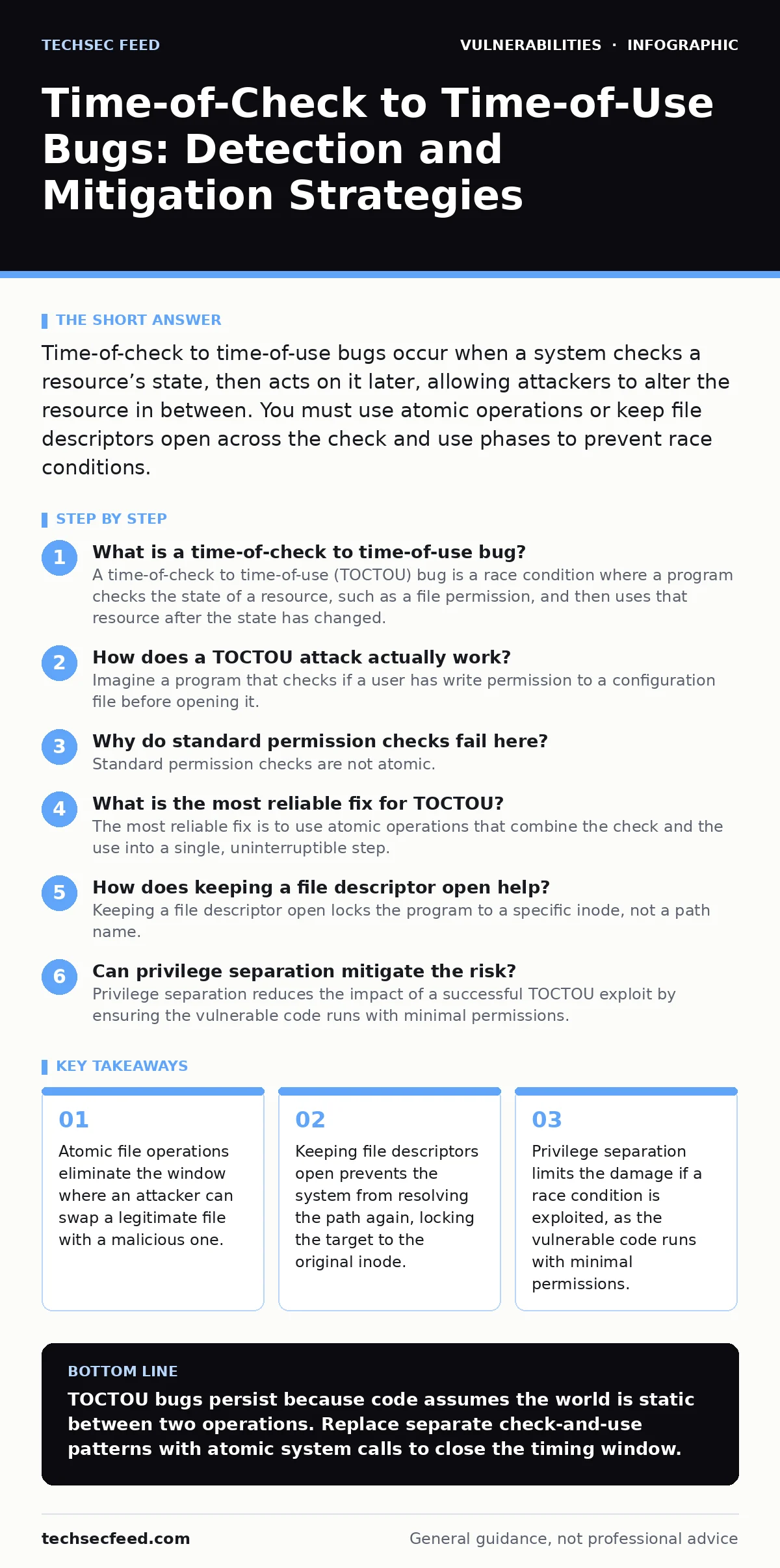
Time-of-check to time-of-use bugs occur when a system checks a resource’s state, then acts on it later, allowing attackers to alter the resource in between. You must use atomic operations or keep file descriptors open across the check and use phases to prevent race conditions.
What is a time-of-check to time-of-use bug?
A time-of-check to time-of-use (TOCTOU) bug is a race condition where a program checks the state of a resource, such as a file permission, and then uses that resource after the state has changed. The vulnerability exists because the check and the use are two separate operations with a time gap between them. An attacker can modify the resource during this gap, causing the program to act on unexpected data or permissions. This is distinct from simple logic errors because it relies on timing and concurrency rather than static code flaws.
How does a TOCTOU attack actually work?
Imagine a program that checks if a user has write permission to a configuration file before opening it. The attacker replaces the configuration file with a symbolic link to a sensitive system file, like /etc/passwd, during the microsecond between the permission check and the file open call. The program believes it is safe because the original file had correct permissions. It then opens the symbolic link, which points to the protected file, and writes garbage data to it. This breaks the system by corrupting critical data that the program should not have touched.
Why do standard permission checks fail here?
Standard permission checks are not atomic. They read the metadata of a file at one instant and return a boolean result. The operating system does not guarantee that the file remains unchanged after this check. If the code performs stat() to verify permissions and then open() to access the file, the kernel resolves the path twice. The first resolution checks permissions; the second resolution opens the file. If the path points to a different inode between those two calls, the permissions check becomes irrelevant. This is why relying on metadata before access is fundamentally flawed in multi-user systems.
What is the most reliable fix for TOCTOU?
The most reliable fix is to use atomic operations that combine the check and the use into a single, uninterruptible step. Modern operating systems provide system calls that open a file and check permissions simultaneously. For example, using open() with specific flags allows the kernel to verify access rights at the moment the file descriptor is created. This eliminates the window of opportunity for an attacker. If the file changes between your intent and the kernel’s action, the operation fails safely. This approach requires updating legacy code that separates validation from execution.
How does keeping a file descriptor open help?
Keeping a file descriptor open locks the program to a specific inode, not a path name. When you open a file, the kernel assigns a file descriptor that points directly to the underlying data structure. If you perform all necessary checks and operations using this descriptor, you ignore any changes to the file’s name or path. An attacker cannot swap the file because the program is no longer looking at the path. This method requires careful resource management to ensure descriptors are closed promptly, preventing file descriptor exhaustion. It is particularly useful for temporary files and log rotation mechanisms.
| Strategy | Effectiveness | Complexity | Risk of New Bugs |
|---|---|---|---|
| Atomic System Calls | High | Medium | Low |
| Open File Descriptors | High | High | Medium |
| Privilege Separation | Medium | High | Low |
| Retry Loops | Low | Low | High |
See also: Vulnerability Chaining: Why Isolated Flaws Become Critical Risks · Hardcoded Secrets Prevention Checklist for Secure Source Code
Can privilege separation mitigate the risk?
Privilege separation reduces the impact of a successful TOCTOU exploit by ensuring the vulnerable code runs with minimal permissions. If a web server component checks and writes to a file, it should do so as an unprivileged user. Even if an attacker tricks the component into writing to a sensitive file, the unprivileged user lacks the rights to modify that file. This does not prevent the race condition but limits the blast radius. It is a defense-in-depth measure that must be combined with proper coding practices. See our guide on attack surface for strategies to reduce the exposed components of your system.
Why do retry loops make TOCTOU worse?
Retry loops attempt to handle transient errors by repeating the check-and-use sequence. This increases the window of opportunity for an attacker. Each retry provides another chance for the attacker to intervene. If the code checks permissions, fails to open the file, waits, and checks again, the attacker can swap the file during the wait. This pattern is common in scripts that handle locked files. It creates a predictable timing window that automated tools can exploit. Avoiding retries in favor of blocking operations or proper locking mechanisms is safer.
Are memory-safe languages immune to TOCTOU?
Memory-safe languages prevent buffer overflows and use-after-free errors but do not automatically solve TOCTOU bugs. TOCTOU is a logical race condition, not a memory corruption issue. A program written in Rust or Go can still check a file’s state and then use it incorrectly if the developer writes non-atomic code. The language’s safety guarantees apply to memory access, not to the consistency of external resources across time. Developers must still use atomic library functions. For deeper insights on language design, review our article on memory-safe programming languages.
How do you test for race conditions?
Testing for race conditions requires inducing timing variations. Standard functional tests run too quickly and deterministically to trigger the bug. You need tools that can delay system calls or fork processes at random intervals to widen the race window. Fuzzing tools that target file system interactions can help. You should also review code for any assumption that the state of the world remains static between two lines of code. If the assumption exists, the code is likely vulnerable. This is similar to the challenges described in our guide on dependency updates, where timing affects security posture.
What about symbolic links and hard links?
Symbolic links and hard links are primary vectors for TOCTOU attacks. A symbolic link can change its target between the check and the use. A hard link can be removed and recreated with a different target inode. When code follows a path, it must resolve these links. If the resolution happens twice, the target can change. Using the O_NOFOLLOW flag when opening files prevents following symbolic links, mitigating this specific vector. However, it does not protect against hard links or other inode-based swaps. Understanding link semantics is critical for secure file handling.
How does this relate to other vulnerabilities?
TOCTOU bugs often enable other attacks. By tricking a privileged process into writing to a file the attacker controls, an attacker can achieve privilege escalation. This is a form of indirect command execution. While not a direct command injection, it allows the attacker to place malicious content where a privileged process will execute or interpret it.
It also intersects with integer overflow vulnerabilities if the race condition affects buffer size calculations. Understanding these overlaps helps in designing comprehensive defenses. See our analysis of iOS zero-click vulnerabilities for examples of how race conditions can bypass user interaction requirements.
Key takeaways
- Atomic file operations eliminate the window where an attacker can swap a legitimate file with a malicious one.
- Keeping file descriptors open prevents the system from resolving the path again, locking the target to the original inode.
- Privilege separation limits the damage if a race condition is exploited, as the vulnerable code runs with minimal permissions.
TOCTOU bugs persist because code assumes the world is static between two operations. Replace separate check-and-use patterns with atomic system calls to close the timing window.
Frequently asked questions
Is TOCTOU only a Linux problem?
No, TOCTOU vulnerabilities exist on any operating system that allows file system state changes between operations, including Windows and macOS.
Can antivirus software detect TOCTOU bugs?
Antivirus software scans for known malicious signatures, not logical race conditions in your code. You must fix the code logic to eliminate the bug.
Does using a database prevent TOCTOU?
Databases use transactions to ensure consistency, which prevents TOCTOU within the database engine. However, TOCTOU can still occur if your application checks external files before writing to the database.
Should I avoid temporary files entirely?
You should avoid temporary files in predictable locations. Use system-provided temporary directories with random names, or use memory-based storage if possible.
How this guide was produced: written by the TechSec Feed editorial team with AI assistance, checked against the public references listed below, and reviewed when the facts change. See our editorial policy or report an error.