
Integer Overflow Vulnerabilities Explained: Causes, Risks, and Fixes
A simple math error in code can allow attackers to bypass security controls or crash systems by wrapping numbers past their maximum limit.
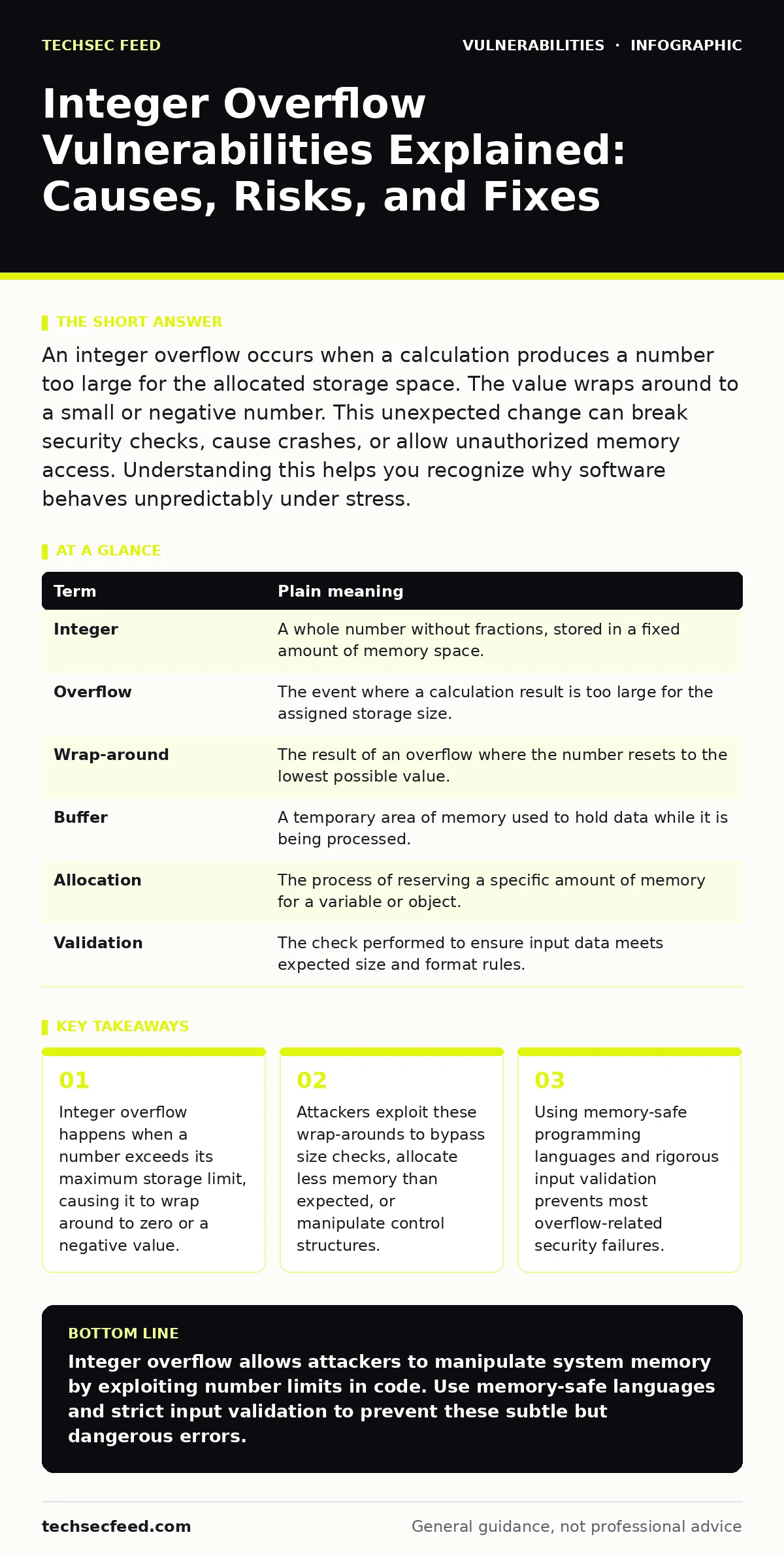
An integer overflow occurs when a calculation produces a number too large for the allocated storage space. The value wraps around to a small or negative number. This unexpected change can break security checks, cause crashes, or allow unauthorized memory access. Understanding this helps you recognize why software behaves unpredictably under stress.
The Odometer Analogy for Data Limits
Imagine a mechanical car odometer that displays only 4 digits. When the car reaches 9999 miles, the next mile clicks the display to 0000. The car has not lost distance, but the display has wrapped around to a much smaller number. Computer integers work the same way. They have a fixed amount of space. When a value exceeds that space, it wraps around. This wrapping is called an integer overflow. It is not a rounding error. It is a fundamental limit of how computers store whole numbers.
Key Terms for Overflow Mechanics
Understanding the mechanics requires knowing specific terms. These definitions clarify how data moves through system memory.
| Term | Plain meaning |
|---|---|
| Integer | A whole number without fractions, stored in a fixed amount of memory space. |
| Overflow | The event where a calculation result is too large for the assigned storage size. |
| Wrap-around | The result of an overflow where the number resets to the lowest possible value. |
| Buffer | A temporary area of memory used to hold data while it is being processed. |
| Allocation | The process of reserving a specific amount of memory for a variable or object. |
| Validation | The check performed to ensure input data meets expected size and format rules. |
How Overflows Break Security Checks
Security software often checks if a requested amount of data is safe. Suppose a server expects a file request. It checks if the requested size is smaller than the maximum allowed size. If an attacker requests a size that causes an overflow, the check might see a small, safe number. The server then approves the request. Later, when the server tries to allocate memory for the actual large size, it fails. This mismatch can crash the server. It can also allow the attacker to write data into memory areas they should not touch. This is similar to vulnerability scanning finding open doors that were thought to be locked.
The Hidden Cost of Large Numbers
Large numbers are not always dangerous. The danger comes from trusting the number without checking the context. An overflow can turn a positive number into a negative one. Some systems treat negative numbers as special flags. If a security check expects a positive size, a negative result might bypass the check entirely. This is a non-obvious consequence of binary math. The system does not see an error. It sees a valid, albeit unexpected, number. This is why simple size checks are not enough. You must also check the sign and the source of the number.
Impact on Ordinary Users
You do not need to write code to be affected. Software you use daily contains millions of lines of code. If one line has an overflow flaw, the whole application is at risk. Imagine using a photo editor. If you open a specially crafted image, the program might crash. In a worse case, the program might execute hidden instructions. This is why dependency updates are necessary. Even if your code is safe, the libraries you use might not be. Keeping software current reduces your exposure to known overflow flaws. It is a basic habit that closes many doors to attackers.
See also: EPSS Percentiles: Stop Misreading Your Vulnerability Risk Scores · CISA KEV Due Dates Explained: Compliance Mechanics and Risk
Simple Safety Habits for Prevention
You can reduce risk by adopting better development and usage habits. These steps help prevent overflow issues before they become breaches.
- Use memory-safe programming languages. These languages handle memory allocation automatically. They prevent manual errors that lead to overflows.
- Validate all input data. Check the size and type of every number that enters your system. Reject values that are too large or negative.
- Update dependencies regularly. Many overflow flaws are found in third-party libraries. Updating them patches these known issues.
Why Simple Checks Fail
A common mistake is checking the size before the calculation. Suppose you check if a number is less than the maximum limit. Then you add a small offset. The result might now exceed the limit. This is a classic failure mode. The check passed, but the final value overflowed. This is similar to how exposed admin panels might look secure but lack proper access controls. The protection is superficial. Real security requires checking the final state, not just the initial inputs. You must verify that the result of any arithmetic operation is still within safe bounds.
The Role of Modern Development
Modern development practices help mitigate these risks. Memory-safe programming languages are designed to prevent these errors. They manage memory for you. This reduces the chance of manual mistakes. However, legacy systems still use older languages. These systems require extra care. You must audit code for arithmetic operations. Look for places where numbers are added, multiplied, or shifted. These are the hotspots for overflow. Regular code reviews and static analysis tools can find these issues early. This approach is more effective than relying on runtime checks alone.
Conclusion on Integer Safety
Integer overflow is a subtle but powerful flaw. It exploits the fixed nature of computer storage. By understanding the mechanics, you can better appreciate the need for careful coding. The odometer analogy helps visualize the wrap-around effect. The key is to never trust raw numbers. Always validate, always check, and always update. This mindset applies to all software, not just security tools. It is a fundamental aspect of building reliable systems.
Key takeaways
- Integer overflow happens when a number exceeds its maximum storage limit, causing it to wrap around to zero or a negative value.
- Attackers exploit these wrap-arounds to bypass size checks, allocate less memory than expected, or manipulate control structures.
- Using memory-safe programming languages and rigorous input validation prevents most overflow-related security failures.
Integer overflow allows attackers to manipulate system memory by exploiting number limits in code. Use memory-safe languages and strict input validation to prevent these subtle but dangerous errors.
Frequently asked questions
What is the difference between integer overflow and buffer overflow?
Integer overflow is a math error where a number exceeds its storage limit. Buffer overflow is a memory error where data exceeds its allocated space. Integer overflow can cause buffer overflow.
Can integer overflow happen in web applications?
Yes, if the web application processes large numbers or counts. This is common in file uploads or data processing features. Proper input validation prevents this.
How do I find integer overflow vulnerabilities?
Use static analysis tools and code reviews. Look for arithmetic operations on external input. Fuzz testing can also reveal unexpected behavior.
Are modern languages immune to integer overflow?
No, but they handle it more safely. Memory-safe languages prevent the resulting memory corruption. They may still wrap numbers, but the impact is limited.
How this guide was produced: written by the TechSec Feed editorial team with AI assistance, checked against the public references listed below, and reviewed when the facts change. See our editorial policy or report an error.