
EPSS Percentiles: Stop Misreading Your Vulnerability Risk Scores
High EPSS scores predict exploitation likelihood over time, not immediate danger, revealing why prioritization often fails when teams ignore asset context.
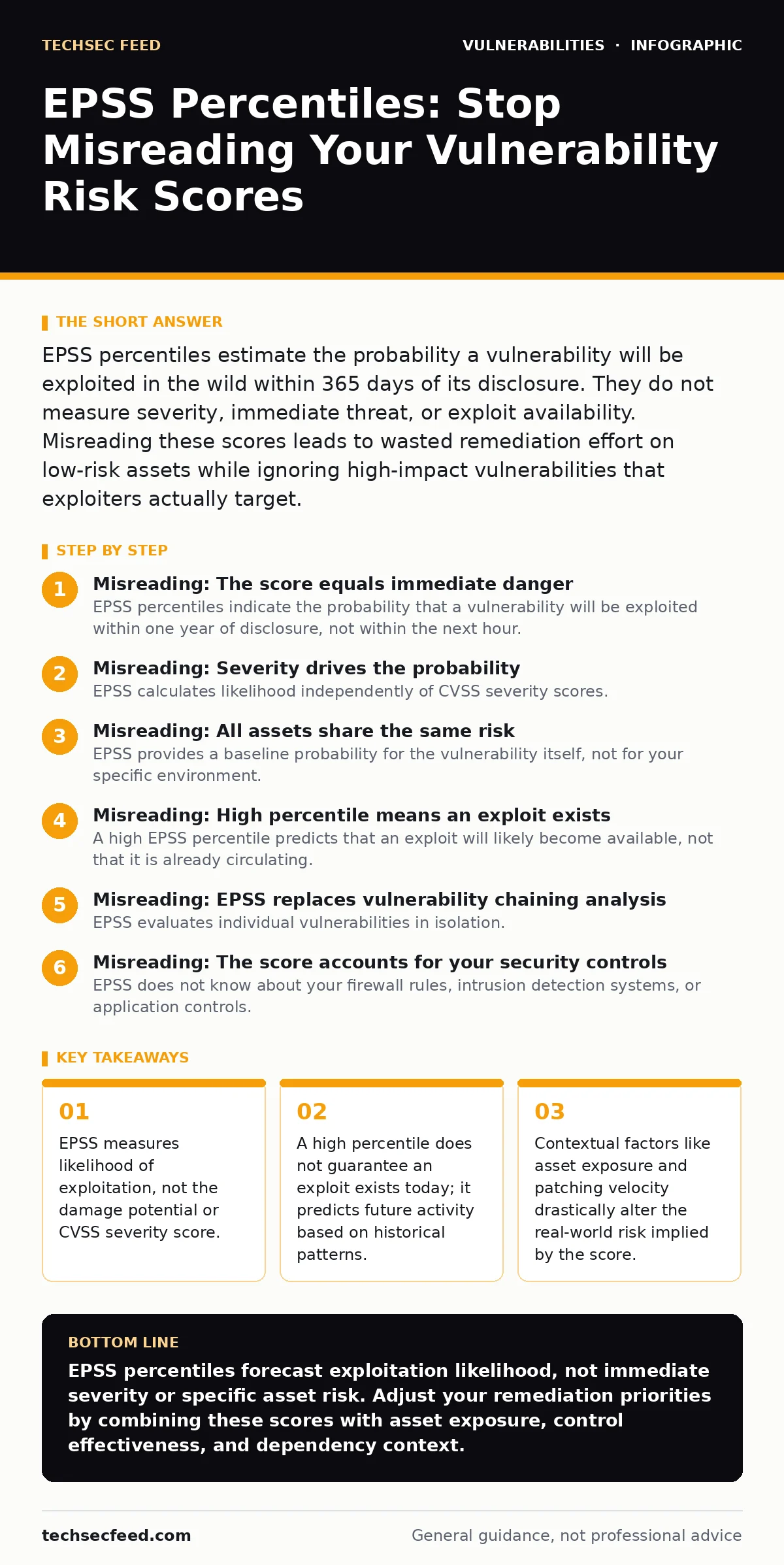
EPSS percentiles estimate the probability a vulnerability will be exploited in the wild within 365 days of its disclosure. They do not measure severity, immediate threat, or exploit availability. Misreading these scores leads to wasted remediation effort on low-risk assets while ignoring high-impact vulnerabilities that exploiters actually target.
Misreading: The score equals immediate danger
EPSS percentiles indicate the probability that a vulnerability will be exploited within one year of disclosure, not within the next hour. Teams often treat a high percentile as a declaration that an attack is imminent. This confusion leads to panic-driven patching that disrupts operations without addressing the actual threat model. The model predicts long-term trends based on historical data. It does not detect active scanning or zero-day campaigns occurring right now. You must separate predictive probability from current operational threat.
Correct reading: Treat the score as a statistical forecast. A high score means the vulnerability has characteristics that exploiters historically target quickly. It does not mean your network is currently under attack. Use this data to schedule remediation, not to trigger emergency response protocols.
Misreading: Severity drives the probability
EPSS calculates likelihood independently of CVSS severity scores. A vulnerability with a moderate CVSS score can have a higher EPSS percentile than a critical one if exploiters find it easier to weaponize. Severity measures the impact of a successful exploit. Probability measures how often exploiters choose that path. These two metrics address different questions. Relying solely on severity ignores the practical difficulty of exploitation. Some low-severity flaws are trivial to automate, making them high-probability targets.
Correct reading: Evaluate probability and severity as separate dimensions. A high-probability, low-severity vulnerability may require faster patching than a low-probability, high-severity one. Consider the effort required to exploit the flaw. If an attacker can exploit it with a simple script, the probability rises regardless of the potential damage.
Misreading: All assets share the same risk
EPSS provides a baseline probability for the vulnerability itself, not for your specific environment. The score assumes a random asset in the wild. Your internal servers, isolated development machines, and public-facing gateways face vastly different exposures. Applying the same EPSS threshold to all assets creates inefficiency. Patching an air-gapped system because of a high EPSS score wastes resources. Conversely, ignoring a high EPSS score on a public web server invites compromise.
Correct reading: Adjust the EPSS score based on asset context. Public-facing systems should use lower thresholds for action. Internal systems can tolerate higher probabilities if they are not reachable from the internet. Refer to your asset inventory for patching to map vulnerabilities to exposure levels. Context transforms a generic probability into a specific risk decision.
Misreading: High percentile means an exploit exists
A high EPSS percentile predicts that an exploit will likely become available, not that it is already circulating. The model uses features like code complexity and disclosure age to forecast future activity. Teams often search for proof-of-concept code and conclude the risk is low when none is found. This error ignores the window between prediction and realization. Exploiters may be working on the code. Waiting for confirmation often means waiting until the breach occurs.
Correct reading: Assume exploitability when the probability is high. Do not wait for public exploits to validate the threat. Use the score to prioritize testing and mitigation. If the model predicts exploitation, prepare defenses now. This approach reduces the window of exposure. It aligns remediation with the predicted timeline of attacker activity.
Misreading: EPSS replaces vulnerability chaining analysis
EPSS evaluates individual vulnerabilities in isolation. It does not account for the combined risk of multiple flaws used together. Attackers often chain a low-probability initial access vector with a high-probability privilege escalation flaw. Looking at each score separately misses the compounded threat. A single moderate-score vulnerability might be harmless alone. When combined with another, it becomes a critical path to system compromise.
Correct reading: Analyze vulnerabilities as part of a potential attack path. Identify which flaws can be combined to bypass controls. Review your vulnerability chaining documentation to understand how separate weaknesses interact. If two vulnerabilities exist on the same host, their combined risk may exceed the sum of their individual EPSS scores. Prioritize patches that break common attack chains.
See also: What is BOM Bill of Materials: The Hidden Cost of Software Transparency · GraphQL Vulnerabilities: 9 Critical Questions Answered
Misreading: The score accounts for your security controls
EPSS does not know about your firewall rules, intrusion detection systems, or application controls. It models the vulnerability in a vacuum. Your existing defenses may mitigate the risk significantly. Conversely, weak configurations may amplify it. Assuming the score reflects your actual exposure leads to complacency or overreaction. You must overlay your control effectiveness on the probability. A high EPSS score against a heavily monitored system presents less risk than a low score against an unpatched, exposed endpoint.
Correct reading: Factor in your control maturity. If you have strong network segmentation, the effective risk of a high-EPSS vulnerability decreases. If you have weak password policies or exposed admin panels, the effective risk increases. Adjust your remediation urgency based on how well your controls stop the specific attack vector predicted by the model.
Misreading: EPSS ignores software dependency context
EPSS scores are assigned to specific CVEs, not to the libraries or frameworks that contain them. Modern applications rely on complex dependency trees. A vulnerability in a deeply nested library may have a low EPSS score. However, if that library is widely used and exposed, the aggregate risk rises. Teams often fix the direct vulnerability but ignore the underlying dependency issues. This leaves similar flaws open in other components.
Correct reading: Trace vulnerabilities through your software supply chain. Understand how dependency updates affect your risk profile. A single CVE might impact multiple applications through shared libraries. Prioritize patching based on the breadth of impact within your environment, not just the individual score. Consolidating fixes across dependencies reduces the total attack surface.
Misreading: EPSS is a static truth
EPSS scores update as new data becomes available. They are not fixed values. The probability for a vulnerability may shift as exploiters demonstrate new techniques or as the community releases mitigations. Treating the score as a permanent label causes drift in your risk posture. Old scores may no longer reflect current attacker behavior. Regularly refreshing your data ensures your decisions match the current reality.
Correct reading: Treat EPSS as a dynamic metric. Re-evaluate prioritization periodically as scores change. Integrate EPSS feeds into your continuous monitoring processes. Do not make one-time decisions based on initial scores. Keep your risk assessments current with the evolving nature of exploitation trends.
Key takeaways
- EPSS measures likelihood of exploitation, not the damage potential or CVSS severity score.
- A high percentile does not guarantee an exploit exists today; it predicts future activity based on historical patterns.
- Contextual factors like asset exposure and patching velocity drastically alter the real-world risk implied by the score.
EPSS percentiles forecast exploitation likelihood, not immediate severity or specific asset risk. Adjust your remediation priorities by combining these scores with asset exposure, control effectiveness, and dependency context.
Frequently asked questions
Does a low EPSS score mean a vulnerability is safe to ignore?
No. A low score indicates a lower statistical probability of exploitation, but critical assets or weak controls may still face significant risk. Always consider the value of the asset and the impact of compromise.
How often should I update my EPSS data?
Update your data regularly, ideally daily or weekly, to reflect changes in exploitation trends and new disclosures. Stale data leads to outdated prioritization and potential security gaps.
Can I use EPSS for compliance reporting?
EPSS is a predictive tool, not a compliance standard. It can inform risk-based decisions, but compliance requirements usually mandate specific remediation timelines regardless of probability scores.
How does EPSS compare to CVSS?
CVSS measures the severity of impact if exploited. EPSS measures the likelihood of exploitation. Use both together: CVSS tells you how bad it is, EPSS tells you how likely it is to happen.
How this guide was produced: written by the TechSec Feed editorial team with AI assistance, checked against the public references listed below, and reviewed when the facts change. See our editorial policy or report an error.