CISA KEV Due Dates Explained: Compliance Mechanics and Risk
The CISA Known Exploited Vulnerabilities catalog mandates remediation within a fixed window, shifting security from theoretical risk to enforceable operational deadlines.
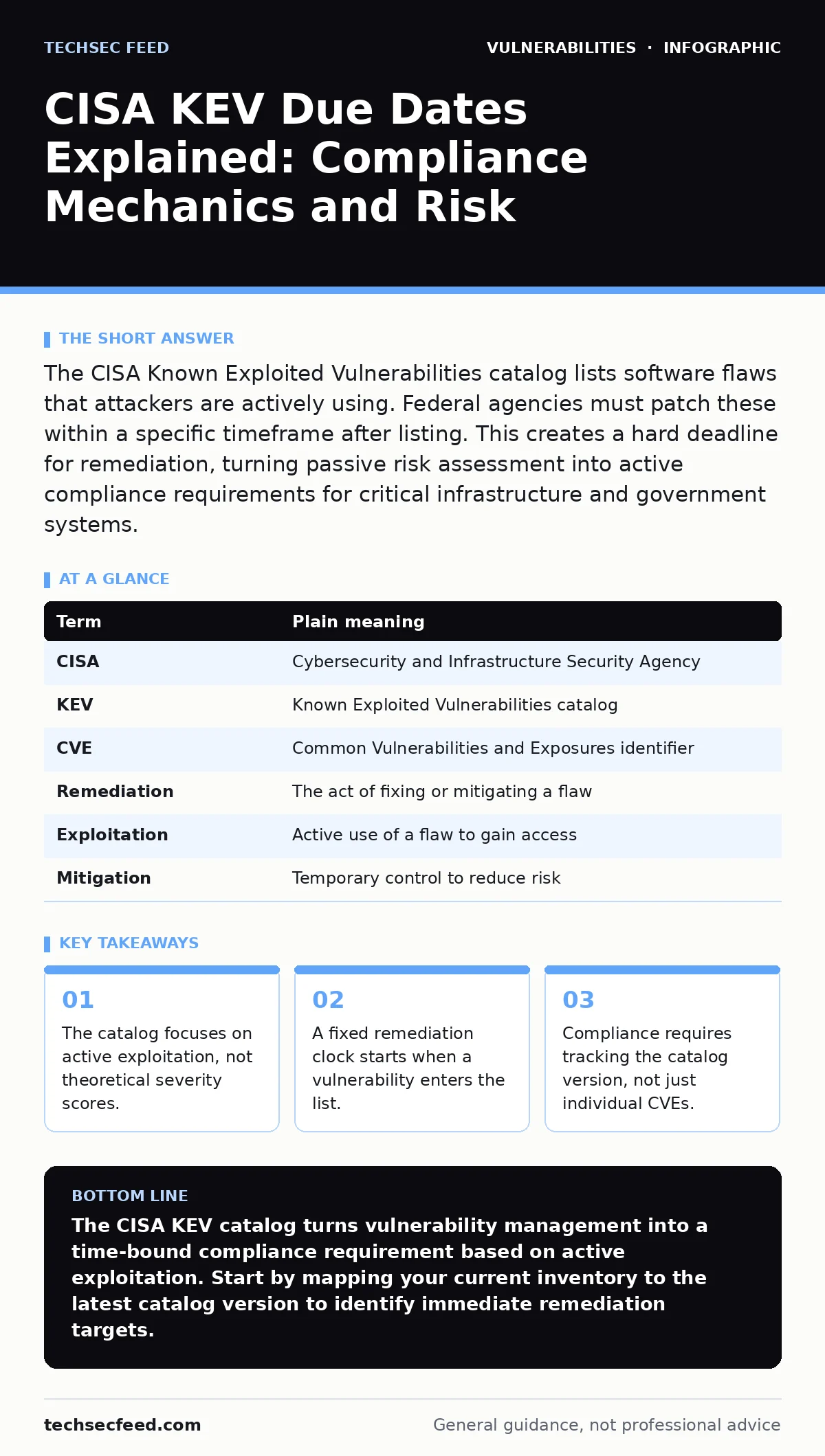
The CISA Known Exploited Vulnerabilities catalog lists software flaws that attackers are actively using. Federal agencies must patch these within a specific timeframe after listing. This creates a hard deadline for remediation, turning passive risk assessment into active compliance requirements for critical infrastructure and government systems.
The Library Book Analogy
Imagine a public library where patrons can check out books. Most books sit safely on shelves, but some have loose pages that fall out. Librarians notice people deliberately pulling these pages to cause chaos. These specific books become "known exploited." The library sets a rule: once identified, staff must repair or remove the book within 30 days. Ignoring this rule means the library admits it allows known chaos. This mirrors how the CISA Known Exploited Vulnerabilities catalog operates in digital security.
Defining the Core Terms
Understanding the mechanics requires precise definitions. The catalog does not rank vulnerabilities by likelihood of attack in a general sense. It ranks them by evidence of active use in the wild. This distinction changes how you prioritize work. You stop guessing which flaws are dangerous and start fixing the ones that are currently being used.
| Term | Plain meaning |
|---|---|
| CISA | Cybersecurity and Infrastructure Security Agency |
| KEV | Known Exploited Vulnerabilities catalog |
| CVE | Common Vulnerabilities and Exposures identifier |
| Remediation | The act of fixing or mitigating a flaw |
| Exploitation | Active use of a flaw to gain access |
| Mitigation | Temporary control to reduce risk |
The Remediation Clock
The most significant change the catalog introduces is time. Before this framework, organizations often patched at their own pace. Now, a deadline exists. When a vulnerability is added to the KEV catalog, the clock starts. Federal agencies must remediate within a set number of days. This creates a binary state: you are either compliant or you are not. There is no gray area for "planning to fix it next quarter." This pressure forces security teams to triage based on actual threat activity rather than internal convenience.
Confusion Around Severity Scores
Many teams confuse Common Vulnerability Scoring System scores with KEV status. A high score indicates potential damage, not active use. A low score does not guarantee safety. The KEV catalog ignores the score. It only cares about proof of exploitation. This means a vulnerability with a moderate score might require immediate attention if attackers are using it. Conversely, a critical score might wait if no one is exploiting it yet. This disconnect causes friction in vulnerability management programs that rely solely on scoring.
The Hidden Cost of Compliance
Implementing KEV compliance requires more than just patching. It demands inventory accuracy. You cannot fix what you cannot find. Many organizations discover they lack visibility into their entire attack surface. This leads to a scramble to identify all assets. The hidden cost is the effort required to maintain accurate asset records. Without this, you cannot prove remediation. This process often reveals legacy systems that were forgotten but still connected to the network.
See also: What is BOM Bill of Materials: The Hidden Cost of Software Transparency · GraphQL Vulnerabilities: 9 Critical Questions Answered
Practical Steps for Teams
You can start aligning with these requirements immediately. The goal is to reduce the time between catalog publication and remediation. This requires integrating the catalog into your existing workflow. Do not treat it as a separate project. Treat it as a filter for your existing patch management process.
- Subscribe to official catalog updates. Ensure your team receives notifications when new entries are added.
- Cross-reference your asset inventory. Identify which systems contain the affected software versions.
- Prioritize remediation. Schedule patches for KEV items before other vulnerabilities, regardless of score.
Related Security Context
This framework complements other security disciplines. For example, dependency updates become more urgent when a library is listed. You must update not just the application, but the underlying components. Similarly, memory-safe programming languages reduce the likelihood of certain exploitable flaws, lowering future catalog entries. Understanding integer overflow vulnerabilities helps you recognize why some flaws are easily exploited. These concepts work together to reduce overall risk.
Beyond the Catalog
The KEV catalog is a baseline, not a complete strategy. It covers known exploits. It does not cover zero-day vulnerabilities or misconfigurations. You still need strong controls for weak password policies and command injection prevention. The catalog forces you to fix the low-hanging fruit. It does not eliminate the need for broader security hygiene. Think of it as a mandatory repair list for your most exposed systems.
Final Considerations
Compliance with the KEV catalog is a continuous process. New entries appear regularly. Your inventory changes. Your risk profile evolves. You must adapt your processes to handle this flow. The goal is not just to meet the deadline. The goal is to reduce the window of opportunity for attackers. By treating the catalog as a source of truth for active threats, you align your security efforts with real-world behavior.
Key takeaways
- The catalog focuses on active exploitation, not theoretical severity scores.
- A fixed remediation clock starts when a vulnerability enters the list.
- Compliance requires tracking the catalog version, not just individual CVEs.
The CISA KEV catalog turns vulnerability management into a time-bound compliance requirement based on active exploitation. Start by mapping your current inventory to the latest catalog version to identify immediate remediation targets.
Frequently asked questions
Does the KEV catalog apply to private companies?
The mandate applies to federal agencies and their contractors. Private companies are not legally required to comply, but the catalog serves as a high-priority risk indicator for all organizations.
What happens if I miss the remediation deadline?
Federal agencies face compliance violations and potential funding restrictions. Private organizations face increased risk of breach and potential liability if negligence is proven in a legal context.
How often does the catalog update?
The catalog is updated regularly, often weekly, as new evidence of exploitation emerges. You must monitor these updates to stay current with the latest threats.
Can I mitigate instead of patch?
Mitigation is acceptable only if patching is impossible. You must document the mitigation controls and justify why patching cannot occur. This is rarely a long-term solution.
How this guide was produced: written by the TechSec Feed editorial team with AI assistance, checked against the public references listed below, and reviewed when the facts change. See our editorial policy or report an error.