
Bug Bounty Triage: How to Filter Noise and Find Real Threats
Triage transforms chaotic vulnerability reports into a prioritized workflow that prevents critical exploits from hiding behind low-severity noise.
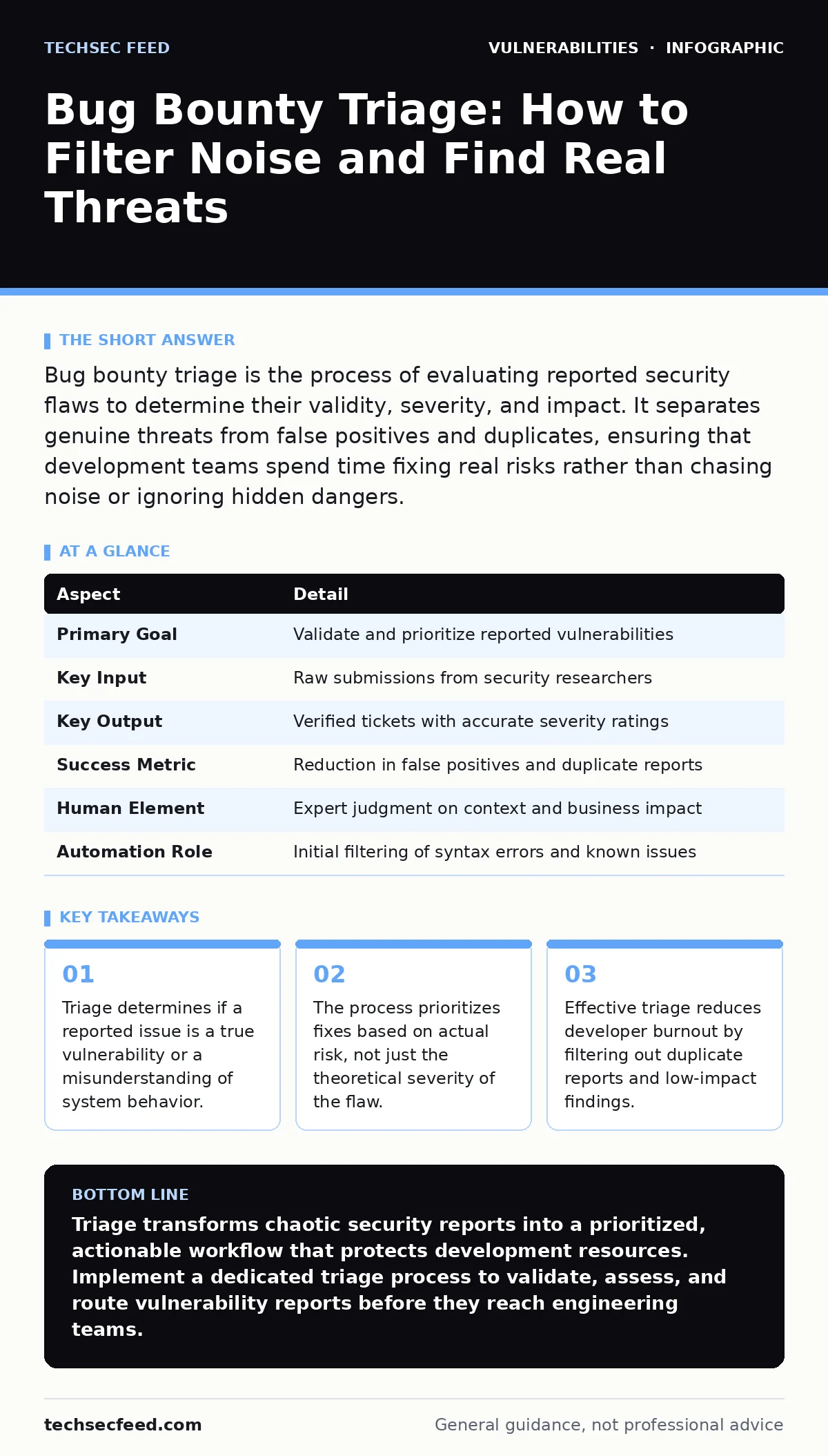
Bug bounty triage is the process of evaluating reported security flaws to determine their validity, severity, and impact. It separates genuine threats from false positives and duplicates, ensuring that development teams spend time fixing real risks rather than chasing noise or ignoring hidden dangers.
The Noise Problem in Security Reporting
Imagine a fire alarm that triggers every time someone opens a window, burns toast, or walks past a sensor. If security staff investigate every alert, they will ignore the real fire because they are exhausted from false alarms. Bug bounty programs generate similar noise. Researchers submit thousands of reports, many of which are duplicates, misunderstandings, or theoretical issues with no practical impact.
Without a filtering mechanism, development teams face a deluge of tickets. They cannot distinguish between a critical flaw and a minor configuration warning. This paralysis leads to delayed fixes for genuine threats. Triage acts as the filter. It validates reports, assigns accurate severity ratings, and routes only actionable items to the engineering team. This separation of concerns is the foundation of efficient security operations.
Defining the Triage Workflow
Bug bounty triage is the systematic review of submitted vulnerability reports. The goal is to verify the claim, reproduce the issue, and assess the business impact. It is not about fixing the bug; it is about deciding if the bug matters and how urgently it must be addressed.
The workflow typically involves three stages. First, a validator checks if the report describes a real issue. Second, a reproducer confirms the vulnerability exists in the current environment. Third, a severity assessor determines the risk level based on the context. This structure ensures that no valid report is dismissed due to poor formatting or unclear language.
| Aspect | Detail |
|---|---|
| Primary Goal | Validate and prioritize reported vulnerabilities |
| Key Input | Raw submissions from security researchers |
| Key Output | Verified tickets with accurate severity ratings |
| Success Metric | Reduction in false positives and duplicate reports |
| Human Element | Expert judgment on context and business impact |
| Automation Role | Initial filtering of syntax errors and known issues |
Why Triage Solves Developer Friction
Development teams hate context switching. Every interrupting ticket forces them to stop their current work, understand the new issue, and then resume. This friction reduces overall productivity and morale.
Triage absorbs this friction. By handling the initial investigation, the triage team shields developers from noise. Developers receive only confirmed, high-priority issues that require their specific expertise. This allows them to focus on engineering solutions rather than investigating security claims.
This separation also improves the quality of fixes. When a developer receives a well-documented, verified report, they can write a proper patch. When they receive a vague, unverified report, they may apply a quick workaround that leaves the underlying issue open. Triage ensures the input quality matches the output expectation.
The Anatomy of a Triage Decision
A triage decision rests on three pillars. Validity asks if the issue is real. Severity asks how bad it is. Impact asks who is affected. These questions must be answered independently. A bug can be valid and severe but have low impact if it affects an internal tool with no external access. Conversely, a minor bug can have high impact if it affects a core authentication mechanism.
Validity is the easiest to determine. Can the triage team reproduce the steps? If the researcher provided clear steps and the team can trigger the same error, the bug is valid. If the error disappears or behaves differently, the report needs clarification.
Severity requires understanding the code. A simple cross-site scripting issue might be low severity if the site uses strict content security policies. The same issue might be critical if the site allows users to inject scripts that steal session tokens. Context changes the rating.
Impact depends on the asset. A vulnerability in a public-facing login page affects every user. A vulnerability in a debug endpoint that is disabled in production affects no one. Triage must map the bug to the asset inventory. This mapping prevents wasted effort on non-production issues.
Where Triage Fits in Defense
Triage does not replace other security measures. It sits alongside vulnerability scanning and penetration testing. Scanners find known issues automatically. Penetration testers simulate attacks manually. Bug bounty programs find unknown issues via external researchers. Triage manages the output of all these sources.
Without triage, the outputs merge into an unmanageable stream. With triage, each source feeds into a standardized pipeline. The scanner findings are validated against the asset inventory for patching. The penetration test results are reviewed for logical flaws that scanners miss. The bounty reports are checked for creativity and depth.
This integration ensures no stone is left unturned. It also prevents duplication. If a scanner finds an exposed admin panel, and a researcher reports it, triage marks the researcher's report as a duplicate.
See also: What is BOM Bill of Materials: The Hidden Cost of Software Transparency · GraphQL Vulnerabilities: 9 Critical Questions Answered
Common Misconceptions About Triage
Many organizations believe triage is just a validation step. They think if the bug is real, it goes to developers. This view ignores the severity assessment. A valid bug with negligible impact should not consume development resources. Triage must weigh the business risk, not just the technical flaw.
Another misconception is that automation can replace human triage. Tools can flag syntax errors or known patterns. They cannot understand context. A report about integer overflow vulnerabilities might look scary to a script. A human triager knows the integer is used only for internal logging, not memory allocation. The script would escalate it; the human would deprioritize it.
Some teams think triage slows down the process. Adding a step seems inefficient. In reality, triage speeds up resolution. By clarifying ambiguous reports and providing detailed reproduction steps, triage reduces the back-and-forth between researchers and developers. The initial delay is outweighed by the faster, more accurate fixes.
Integrating with Technical Depth
Triage requires technical depth. A triager must understand common attack vectors to evaluate reports accurately. For instance, a report about command injection requires knowledge of shell escaping and privilege levels. If the triager does not understand the mechanics, they may dismiss a complex exploit as impossible.
This depth also helps in communicating with researchers. Researchers often use shorthand or assume knowledge. A skilled triager can ask the right questions to clarify the report. They can suggest additional testing steps to prove the impact. This collaboration improves the quality of the report and the final fix.
Triage also informs broader security strategies. Patterns in reports reveal weaknesses in design or training. If many reports involve weak password policies, the organization may need to enforce stronger requirements. If command injection reports are frequent, developers may need better input validation libraries. Triage data drives long-term improvements.
Managing the Human Factor
Bug bounty programs involve humans on both sides. Researchers want recognition and payment. Developers want clarity and minimal disruption. Triage manages this relationship. It ensures researchers are treated fairly, with clear feedback on rejected reports. It ensures developers receive high-quality tickets.
Rejection is part of triage. Not every report is valid. Some are duplicates. Some are out of scope. Some are misunderstandings. Triagers must communicate these rejections clearly and respectfully. A vague rejection frustrates researchers and reduces future submissions. A detailed explanation helps researchers improve their skills and maintain engagement.
This human management is as important as the technical validation. A well-run triage process builds trust. Researchers feel heard. Developers feel supported. The organization gets better security. Neglecting the human side leads to burnout and disengagement on all sides.
Key takeaways
- Triage determines if a reported issue is a true vulnerability or a misunderstanding of system behavior.
- The process prioritizes fixes based on actual risk, not just the theoretical severity of the flaw.
- Effective triage reduces developer burnout by filtering out duplicate reports and low-impact findings.
Triage transforms chaotic security reports into a prioritized, actionable workflow that protects development resources. Implement a dedicated triage process to validate, assess, and route vulnerability reports before they reach engineering teams.
Frequently asked questions
How do I distinguish a false positive from a valid bug?
Attempt to reproduce the reported steps in a controlled environment. If the error cannot be triggered or the impact is theoretical rather than practical, it is likely a false positive or a misunderstanding of normal system behavior.
Should triage be automated or manual?
Use automation for initial filtering of syntax and known patterns. Human review is required for severity assessment and context validation. Automation cannot understand business impact or complex logical flaws.
What happens if a researcher disputes a triage decision?
Provide a detailed explanation of why the report was rejected or downgraded. Offer specific feedback on what was missing or incorrect. Maintain open communication to preserve the researcher's trust and willingness to participate.
How does triage handle duplicate reports?
Maintain a database of known issues and active tickets. When a new report matches an existing issue, mark it as a duplicate. Acknowledge the researcher's effort, but do not route the duplicate to development for a second fix.
How this guide was produced: written by the TechSec Feed editorial team with AI assistance, checked against the public references listed below, and reviewed when the facts change. See our editorial policy or report an error.