
What is BOM Bill of Materials: The Hidden Cost of Software Transparency
A software bill of materials exposes every third-party component in your application, revealing that your security posture depends on code you did not write and cannot fully verify.
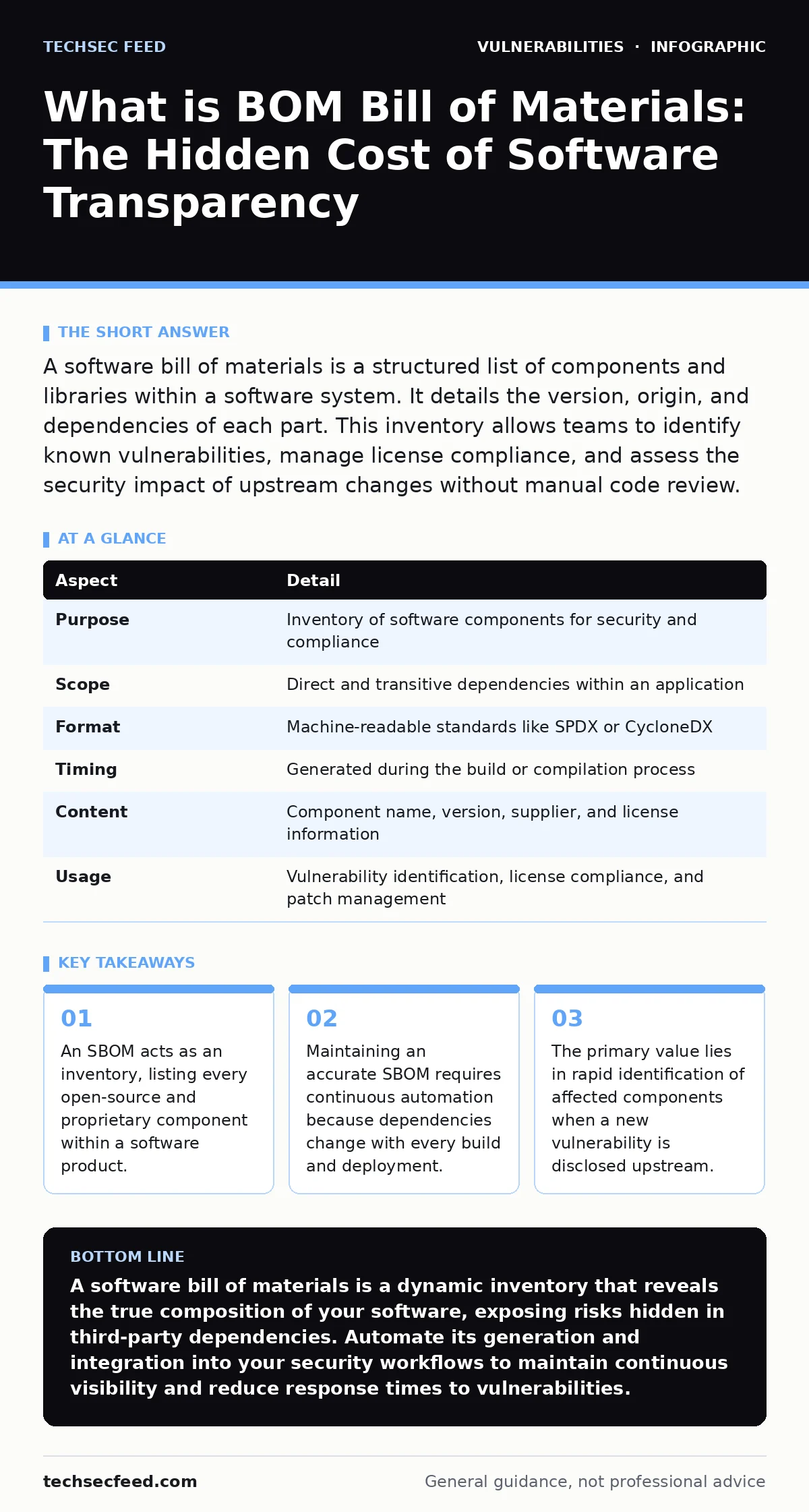
A software bill of materials is a structured list of components and libraries within a software system. It details the version, origin, and dependencies of each part. This inventory allows teams to identify known vulnerabilities, manage license compliance, and assess the security impact of upstream changes without manual code review.
What is BOM Bill of Materials
A software bill of materials is a formal record containing the details and supply chain hierarchy of the various components used to build software. It functions as an inventory list, similar to a list of ingredients in a food product or a parts list for a car. This document identifies every library, framework, and module included in the final application. It specifies the version number, supplier, and relationship between components.
Understanding what is BOM bill of materials starts with recognizing that modern software is rarely written from scratch. Developers assemble applications using thousands of existing packages. The SBOM captures this assembly process in a machine-readable format. This transparency allows security teams to see exactly what code runs in their environments. It shifts the focus from trusting the final binary to verifying every constituent part.
How an SBOM Works in Practice
The creation of an SBOM relies on automated tools that analyze source code, build scripts, and container images. These tools parse package manifests and lock files to extract component metadata. The data is then formatted into a standard schema, such as SPDX or CycloneDX. These standards ensure that different tools can read and process the information consistently. The SBOM is generated at build time, capturing the state of the software at that specific moment.
It includes direct dependencies, which are libraries the developer explicitly imports. It also includes transitive dependencies, which are libraries required by those direct dependencies. This recursive mapping reveals the full depth of the software supply chain. The resulting document serves as a baseline for security analysis. It enables automated matching against vulnerability databases like the National Vulnerability Database. This matching process identifies which known flaws affect the specific versions in use.
| Aspect | Detail |
|---|---|
| Purpose | Inventory of software components for security and compliance |
| Scope | Direct and transitive dependencies within an application |
| Format | Machine-readable standards like SPDX or CycloneDX |
| Timing | Generated during the build or compilation process |
| Content | Component name, version, supplier, and license information |
| Usage | Vulnerability identification, license compliance, and patch management |
Who Is Affected by SBOM Requirements
The requirement for software transparency impacts every organization that consumes or produces software. Development teams must integrate SBOM generation into their continuous integration pipelines. This adds a step to the build process that must not fail silently. Security operations teams use the SBOM to prioritize patching efforts. They no longer guess which applications might be affected by a new CVE. Legal and compliance teams rely on the SBOM to manage license obligations.
Open-source licenses often have specific requirements for distribution and attribution. The SBOM provides the evidence needed to prove compliance. Procurement teams use SBOMs to assess the risk of third-party vendors. They can demand proof that vendor software does not contain prohibited components. This shifts the burden of proof to the software creator. The entire software supply chain becomes more accountable for the quality and security of its components.
What People Usually Get Wrong
Many teams treat the SBOM as a one-time document generated for compliance audits. This view fails to recognize that software is dynamic. Dependencies change with every update, feature addition, or refactoring effort. An SBOM that is accurate today may be obsolete tomorrow. Another common mistake is assuming that an SBOM provides complete security. It lists components but does not analyze their code for logic flaws or custom vulnerabilities.
It only identifies known issues associated with specific versions. Teams also often ignore transitive dependencies, focusing only on direct imports. This creates blind spots where vulnerable libraries hide deep within the dependency tree. The assumption that open-source components are inherently safe is also dangerous. These components may have inactive maintainers or known unresolved issues. The SBOM exposes these risks but does not mitigate them automatically.
The Hidden Costs of Maintenance
Implementing SBOM processes introduces operational overhead that teams often underestimate. The primary cost is the maintenance of the tooling and the integration into build pipelines. Build times may increase as tools scan and catalog components. Storage requirements grow as historical SBOMs are retained for audit trails. The complexity of transitive dependencies can lead to "dependency hell," where updating one component breaks another.
Resolving these conflicts requires significant developer time. There is also the cost of false positives in vulnerability scanning. An SBOM may flag a vulnerability that does not affect the specific configuration of the application. Triage teams must manually verify each alert to avoid wasting resources on irrelevant patches. This manual verification scales poorly with the number of applications. Organizations must balance the granularity of the SBOM with the operational cost of maintaining it.
See also: Bug Bounty Triage: How to Filter Noise and Find Real Threats · GraphQL Vulnerabilities: 9 Critical Questions Answered
Integration with Security Operations
The SBOM becomes most valuable when integrated into existing security workflows. It feeds data into vulnerability management platforms and software composition analysis tools. This integration allows for real-time risk assessment during the development lifecycle. When a new vulnerability is published, the system can instantly query the SBOM inventory. It identifies which applications contain the affected component and version.
This reduces the mean time to detection and response. The SBOM also supports incident response efforts. During a breach, responders can use the SBOM to determine the scope of the compromise. They can identify which other systems share the same vulnerable component. This prevents lateral movement by attackers exploiting the same flaw elsewhere. The SBOM turns passive inventory data into active defense intelligence. It enables proactive patching rather than reactive firefighting.
Strategic Steps for Implementation
Start by selecting a standard format that aligns with your organization's tooling ecosystem. SPDX and CycloneDX are the most widely adopted standards. Choose the one that your security platforms support natively. Next, automate the generation process within your build systems. Ensure that the SBOM is created for every release candidate and production build. Store the SBOM alongside the binary artifact for traceability. Regularly scan the SBOM against vulnerability databases to identify risks.
Prioritize patching based on the severity of the vulnerability and the exposure of the component. Do not rely solely on automated scans; include manual review for critical applications. Train development teams on the importance of keeping dependencies updated. Encourage the use of memory-safe programming languages where possible to reduce the attack surface. Regularly review the SBOM process for accuracy and completeness. Adjust the granularity of the inventory based on the sensitivity of the application.
Beyond the Inventory
The SBOM is a foundational element of a broader security strategy. It does not replace secure coding practices or rigorous testing. It complements them by providing visibility into the supply chain. Organizations should combine SBOMs with vulnerability scanning to identify known flaws. They should also consider dependency updates as a continuous process, not a periodic task. Understanding the attack surface includes knowing every external component that interacts with your code.
This awareness helps in designing more resilient architectures. For instance, isolating components with high-risk dependencies can limit the impact of a compromise. The SBOM also informs decisions about which components to maintain internally versus consume externally. This strategic choice affects long-term security and maintenance costs. By treating the SBOM as a living document, teams can build more transparent and secure software ecosystems.
Key takeaways
- An SBOM acts as an inventory, listing every open-source and proprietary component within a software product.
- Maintaining an accurate SBOM requires continuous automation because dependencies change with every build and deployment.
- The primary value lies in rapid identification of affected components when a new vulnerability is disclosed upstream.
A software bill of materials is a dynamic inventory that reveals the true composition of your software, exposing risks hidden in third-party dependencies. Automate its generation and integration into your security workflows to maintain continuous visibility and reduce response times to vulnerabilities.
Frequently asked questions
Does an SBOM automatically fix vulnerabilities?
No, an SBOM only identifies components and their versions. It does not patch code or fix flaws. It provides the data needed to prioritize and execute manual or automated patching processes.
How often should an SBOM be updated?
An SBOM should be regenerated with every build or release candidate. Software dependencies change frequently, so a static document quickly becomes inaccurate and misleading for security assessments.
Can an SBOM detect zero-day vulnerabilities?
No, an SBOM relies on known vulnerability databases. It cannot detect unknown flaws or zero-day exploits. It only identifies components that have already been assigned a CVE or similar identifier.
Is an SBOM the same as a license compliance report?
No, while an SBOM contains license information, it is primarily a security and inventory tool. A license compliance report focuses on legal obligations and restrictions, whereas an SBOM focuses on component identification and risk.
How this guide was produced: written by the TechSec Feed editorial team with AI assistance, checked against the public references listed below, and reviewed when the facts change. See our editorial policy or report an error.