
Attack Surface Analysis: Map Hidden Entry Points Before Exploitation
Attack surface analysis reveals that the most dangerous entry points are often legitimate services you cannot disable rather than obvious vulnerabilities in your code.
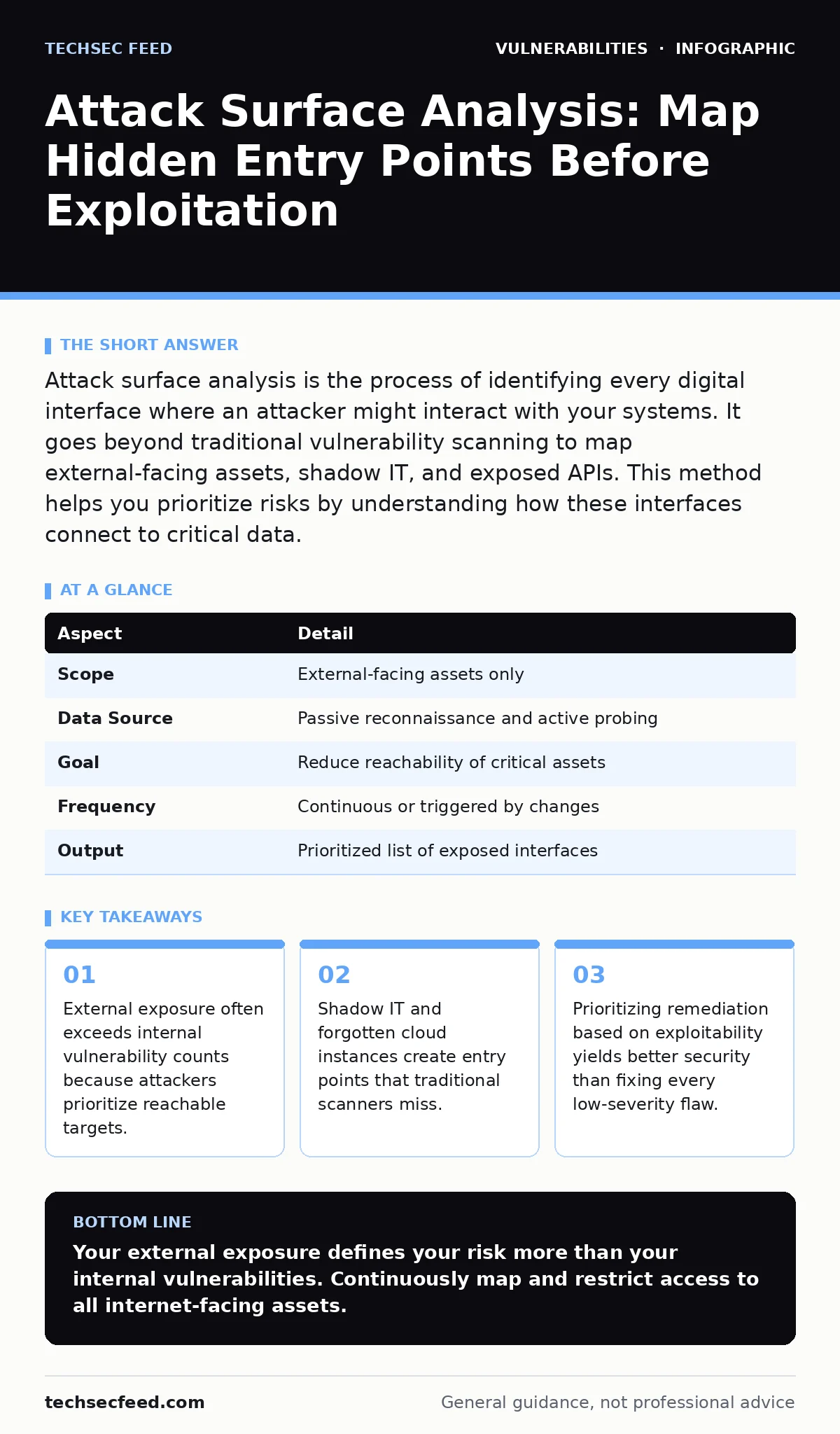
Attack surface analysis is the process of identifying every digital interface where an attacker might interact with your systems. It goes beyond traditional vulnerability scanning to map external-facing assets, shadow IT, and exposed APIs. This method helps you prioritize risks by understanding how these interfaces connect to critical data.
Understanding Attack Surface Analysis
Attack surface analysis is the systematic identification and evaluation of all points where an unauthorized user could try to enter or extract data from an information system. It differs from vulnerability assessment by focusing on accessibility and context rather than just known software flaws. You cannot secure what you cannot see, so the first step is mapping every interface.
Imagine a high-rise building. The vulnerability assessment checks if the locks on the doors are strong. Attack surface analysis maps every door, window, ventilation shaft, and service entrance, then determines which ones open to the public street. A broken lock on a basement door is less risky than an unlocked fire escape facing a crowded plaza.
| Aspect | Detail |
|---|---|
| Scope | External-facing assets only |
| Data Source | Passive reconnaissance and active probing |
| Goal | Reduce reachability of critical assets |
| Frequency | Continuous or triggered by changes |
| Output | Prioritized list of exposed interfaces |
How Attack Surface Analysis Works
The process begins with passive discovery. You gather data without interacting with the target systems. This includes checking Domain Name System records, whois databases, and search engine indexes. This step reveals subdomains, old certificates, and cloud storage buckets that may have been forgotten. Passive methods leave no trace on the target network.
Next comes active verification. You probe the discovered assets to confirm they are live and accessible. This step identifies open ports, running services, and exposed APIs. Unlike a full penetration test, this phase does not attempt to exploit vulnerabilities. It simply confirms that the door is open and visible from the outside.
The final stage is correlation. You link the exposed assets to their internal criticality. An exposed test server containing dummy data is less risky than an exposed admin panel for your primary database. This context allows you to prioritize remediation efforts effectively.
Who Is Affected by Exposure
Every organization with a digital presence has an attack surface. Small businesses often suffer the most because they lack dedicated security teams to monitor their external footprint. A single exposed port can lead to a complete system compromise. Large enterprises face complexity issues. Thousands of assets, multiple cloud providers, and legacy systems create a maze of potential entry points.
Third-party vendors extend your attack surface. If a supplier’s system is compromised, attackers may use it as a bridge to reach your network. You must consider these dependencies as part of your own perimeter. The concept of trust boundaries shifts from your firewall to your supply chain.
What To Do About It
Start by establishing a baseline. Identify all internet-facing assets. Use automated tools to scan for open ports and services. Compare this list against your official asset inventory. Any asset not on the inventory is shadow IT and requires immediate investigation. Shadow IT often lacks proper security controls and patches.
Implement strict access controls. Use network segmentation to isolate critical systems. Even if an attacker reaches an external interface, segmentation prevents lateral movement. Rate limiting and IP whitelisting add layers of defense. These measures reduce the window of opportunity for automated attacks.
What People Usually Get Wrong
Many teams equate attack surface management with vulnerability scanning. Vulnerability scanning checks for known flaws in software. Attack surface analysis checks for exposure. You can have zero known vulnerabilities but still be compromised if you expose a sensitive API to the public internet. Fixing a buffer overflow is useless if the service is not reachable.
Another common mistake is focusing only on technology. Human factors create entry points. Misconfigured cloud storage buckets are a frequent cause of data leaks. These are not software bugs but configuration errors. Training staff on secure configuration practices is as important as patching servers.
Ignoring the difference between availability and exploitability leads to wasted effort. A publicly accessible web server with a low-severity issue is less risky than a hidden service with a critical flaw that attackers are actively exploiting. Prioritize based on actual threat models, not just severity scores.
See also: GraphQL Vulnerabilities: 9 Critical Questions Answered · Asset Inventory Mistakes That Break Patching Workflows
Integrating With Other Controls
Attack surface analysis complements other security practices. It feeds into vulnerability scanning by providing a focused list of targets. Instead of scanning the entire internet, you scan only your exposed assets. This increases efficiency and reduces noise.
It also informs your incident response plans. Knowing your external footprint helps you detect anomalies faster. If traffic spikes to an asset you know should be isolated, you can investigate immediately. This integration creates a cohesive security posture.
Consider how weak password policies interact with exposed services. An exposed login page with weak credentials is a direct path into your network. Attack surface analysis identifies the exposed page; password policies protect the authentication mechanism. Both are necessary for defense.
Continuous Monitoring Requirements
Static analysis is insufficient. Your attack surface changes constantly. New deployments, cloud instances, and API endpoints appear daily. Automated monitoring tools provide real-time visibility. These tools alert you to new assets or changes in configuration.
Regular audits ensure compliance and security standards. Compare your current state against your baseline. Identify drift and unauthorized changes. This continuous process turns security from a periodic project into an ongoing operation.
Dependency updates affect your attack surface. New libraries may introduce new APIs or endpoints. Reviewing these changes as part of your deployment pipeline prevents accidental exposure. Shift left in your development process to catch exposure early.
Beyond Traditional Perimeters
The traditional perimeter of a firewall is obsolete. Cloud services, mobile apps, and remote work extend your boundaries. Attack surface analysis must account for these distributed environments. Identity becomes the new perimeter. Controlling who can access what is more effective than controlling where traffic comes from.
SQL injection and command injection remain prevalent threats. These exploits target exposed interfaces. Ensuring your external applications are hardened against these attacks is critical. Use parameterized queries and input validation. These practices reduce the risk of exploitation even if the interface is exposed.
Memory-safe programming languages reduce the risk of certain vulnerabilities. While not a substitute for exposure management, they lower the likelihood of successful exploitation. Combining secure coding with rigorous attack surface analysis provides layered defense.
Key takeaways
- External exposure often exceeds internal vulnerability counts because attackers prioritize reachable targets.
- Shadow IT and forgotten cloud instances create entry points that traditional scanners miss.
- Prioritizing remediation based on exploitability yields better security than fixing every low-severity flaw.
Your external exposure defines your risk more than your internal vulnerabilities. Continuously map and restrict access to all internet-facing assets.
Frequently asked questions
How often should I perform attack surface analysis?
Perform automated monitoring continuously. Conduct manual reviews quarterly or after significant infrastructure changes.
Is attack surface analysis the same as penetration testing?
No. Penetration testing attempts to exploit vulnerabilities. Attack surface analysis identifies and maps exposed interfaces without exploitation.
Can I automate attack surface analysis completely?
Automation handles discovery and monitoring. Human analysis is required for prioritization and contextual risk assessment.
What tools are used for attack surface analysis?
Use passive reconnaissance tools, port scanners, and web application scanners. Integrate these with your asset management system.
How this guide was produced: written by the TechSec Feed editorial team with AI assistance, checked against the public references listed below, and reviewed when the facts change. See our editorial policy or report an error.