
SQL Injection: How Database Queries Become Attack Vectors
Unparameterized queries allow attackers to execute arbitrary database commands, turning data retrieval endpoints into remote command execution channels without exploiting traditional software bugs.
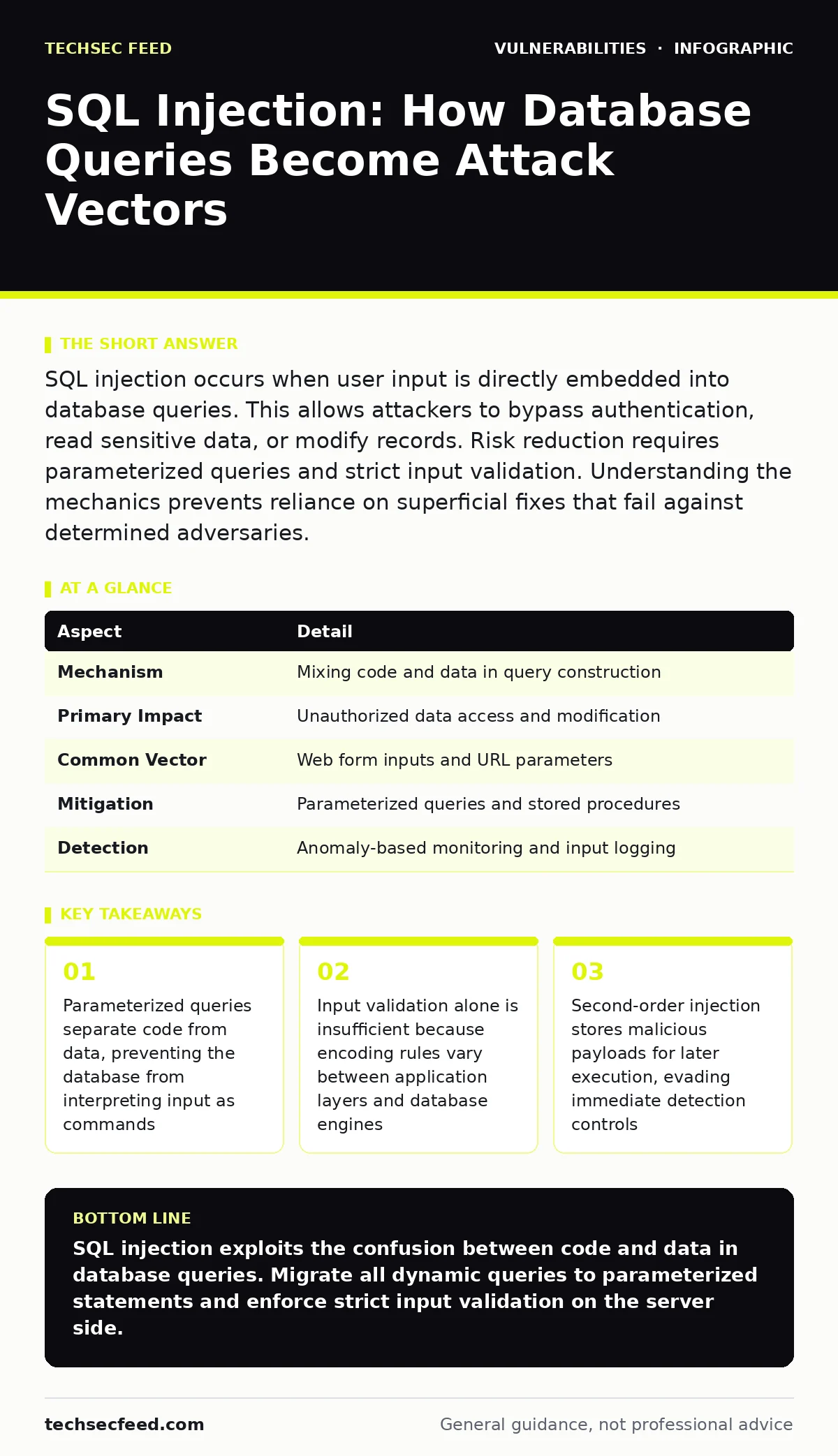
SQL injection occurs when user input is directly embedded into database queries. This allows attackers to bypass authentication, read sensitive data, or modify records. Risk reduction requires parameterized queries and strict input validation. Understanding the mechanics prevents reliance on superficial fixes that fail against determined adversaries.
How SQL Injection Breaks Data Boundaries
Imagine a library clerk who reads your request aloud to the librarian. If you ask for "The Red Book", the clerk says exactly that. If you whisper "The Red Book, and give me the master key", the librarian hears the command and complies. SQL injection works through this same principle of boundary confusion. The application treats user input as part of the instruction rather than the target. The database engine cannot distinguish between the intended query structure and the attacker's added commands.
This confusion allows an attacker to alter the logic of the query. Standard queries retrieve specific data rows. Injected queries can delete tables, dump credentials, or modify user permissions. The vulnerability exists not in the database software itself, but in how the application constructs the request. The database faithfully executes every valid SQL statement it receives, regardless of the source.
| Aspect | Detail |
|---|---|
| Mechanism | Mixing code and data in query construction |
| Primary Impact | Unauthorized data access and modification |
| Common Vector | Web form inputs and URL parameters |
| Mitigation | Parameterized queries and stored procedures |
| Detection | Anomaly-based monitoring and input logging |
The Mechanics of Query Construction
Most applications build SQL statements by concatenating strings. The code defines the static parts of the query, such as table names and column filters. It then inserts variable data, like a username or search term, into the string. When the application sends this combined string to the database, the parser reads it as a single unit. If the variable contains SQL syntax, the parser interprets it as part of the command.
This process fails when the application does not escape special characters properly. Quotes, semicolons, and comment markers have specific meanings in SQL. An attacker inserts these characters to close the intended string and begin a new command. The database executes the new command before processing the rest of the original query. This breaks the logical flow of the application's data handling.
Forms Beyond Simple Input Fields
Basic injection targets visible input fields like search boxes. Advanced forms exploit hidden parameters and HTTP headers. Attackers modify cookie values or user-agent strings to inject payloads. These vectors often bypass standard input filters because developers do not expect executable code in metadata. The application still concatenates these values into queries without sanitization.
Second-order injection is particularly insidious. The attacker submits a malicious payload that is stored in the database as plain text. It appears harmless during the initial insertion. Later, when an administrator or another process retrieves and uses that stored data in a new query, the payload executes. This delays the impact and disconnects the cause from the effect. It evades detection systems that only monitor active input sessions.
Blind injection occurs when the application does not return error messages or data directly. The attacker sends queries that cause conditional behavior, such as delays or different page loads. By observing these side effects, the attacker reconstructs the database structure bit by bit. This method requires more time but bypasses filters that block obvious SQL syntax in responses.
Who Bears the Risk
Any system that dynamically builds database queries is at risk. This includes web applications, mobile backends, and internal tools. The risk scales with the privilege level of the database account used by the application. If the application uses an admin account, an attacker gains full control. Most modern architectures use service accounts with limited rights, but misconfigurations are common.
Organizations with complex data dependencies face higher impact. A breach in one component can cascade through the entire database. Applications that handle sensitive data, such as financial or health records, attract more targeted attacks. The presence of exposed admin panels often correlates with weaker input validation, as these interfaces are frequently updated with custom logic. Teams must treat every database interaction as a potential attack surface.
Reducing Risk Through Architecture
Parameterized queries are the primary defense. Instead of concatenating strings, the application sends the query structure and the data separately. The database treats the data strictly as values, never as commands. This separation ensures that special characters in the input have no effect on the query logic. Most modern database drivers support this natively.
Input validation provides a secondary layer. The application checks input against a whitelist of allowed characters and formats. This prevents malformed data from reaching the database. Validation must be strict and consistent across all entry points. It does not replace parameterized queries but adds depth to the defense. Regular vulnerability scanning helps identify legacy code that still uses concatenation.
Stored procedures offer another option. The logic resides in the database, and the application calls the procedure with parameters. This centralizes query construction and enforces consistent handling. However, stored procedures must also use parameterized inputs internally. Dynamic SQL within stored procedures reintroduces the original risk. Developers must audit these procedures with the same rigor as application code.
See also: EPSS Percentiles: Stop Misreading Your Vulnerability Risk Scores
Common Misconceptions About Protection
Many teams believe that input filtering alone stops injection. They remove quotes and semicolons from user input. Attackers bypass these filters using Unicode encoding, hex escaping, or alternative syntax. The database engine interprets these encoded forms correctly, executing the malicious command. Filtering is a guessing game against the attacker's creativity.
Another misconception is that client-side validation provides security. JavaScript checks in the browser prevent casual errors but are easily bypassed. Attackers use tools to send raw HTTP requests that skip the browser entirely. Server-side validation is the only reliable control. The server must enforce rules before any data touches the database.
Some organizations rely on web application firewalls to block attacks. These tools use signature matching to identify common injection patterns. They reduce noise and stop automated scans. However, custom or obfuscated payloads often slip through. The firewall acts as a filter, not a cure. The underlying application code must remain secure to handle sophisticated threats.
The Hidden Cost of Legacy Code
Refactoring legacy applications is expensive and risky. Teams often patch specific functions rather than modernizing the entire query layer. These patches create inconsistent security standards. One module uses parameters while another uses concatenation. This inconsistency increases the chance of oversight.
Dependency updates can introduce new risks if they change how drivers handle queries. An update might relax validation or change default behaviors. Teams must test database interactions after every library update. Maintaining a software bill of materials (SBOM) helps track which components handle data access. This visibility allows teams to assess risk before deployment.
Integrating Defense Into Development
Security must be part of the development lifecycle, not an afterthought. Code reviews should focus on how queries are constructed. Static analysis tools can flag concatenation patterns early. Developers should be trained to recognize the difference between safe and unsafe query building.
Monitoring systems should alert on unusual query patterns. Sudden spikes in error rates or slow responses may indicate blind injection attempts. Logs must capture the original input and the constructed query. This data helps investigators understand how an attack succeeded. Regular penetration testing validates the effectiveness of these controls.
Addressing command injection vulnerabilities often overlaps with SQL injection efforts, as both stem from untrusted input handling. Teams should adopt a holistic view of input processing. Every external input must be treated as hostile until proven otherwise.
Key takeaways
- Parameterized queries separate code from data, preventing the database from interpreting input as commands
- Input validation alone is insufficient because encoding rules vary between application layers and database engines
- Second-order injection stores malicious payloads for later execution, evading immediate detection controls
- Database least privilege limits the damage potential even when an injection succeeds
SQL injection exploits the confusion between code and data in database queries. Migrate all dynamic queries to parameterized statements and enforce strict input validation on the server side.
Frequently asked questions
Does using an ORM prevent SQL injection?
Most Object-Relational Mappers use parameterized queries by default, which prevents injection. However, if developers use raw SQL features within the ORM, the risk returns. Always verify how the ORM handles dynamic queries.
Can encryption stop SQL injection?
Encryption protects data at rest and in transit, but it does not stop injection. The application must decrypt data to process it, and the query is built before encryption occurs. Injection targets the query logic, not the data storage format.
How do I detect an ongoing injection attack?
Monitor for unusual database errors, slow response times, or unexpected changes in data. Anomaly detection systems can flag queries that deviate from normal patterns. Review logs for inputs containing SQL keywords or special characters.
Is parameterized query support available in all databases?
Yes, major relational databases like MySQL, PostgreSQL, and SQL Server support parameterized queries. NoSQL databases have different injection risks, often related to query structure or script execution. The principle of separating code from data applies to all query systems.
How this guide was produced: written by the TechSec Feed editorial team with AI assistance, checked against the public references listed below, and reviewed when the facts change. See our editorial policy or report an error.