How Weak Password Policies Enable Account Takeover
Weak policies fail because they allow predictable patterns that attackers can generate and test faster than systems can detect the intrusion.
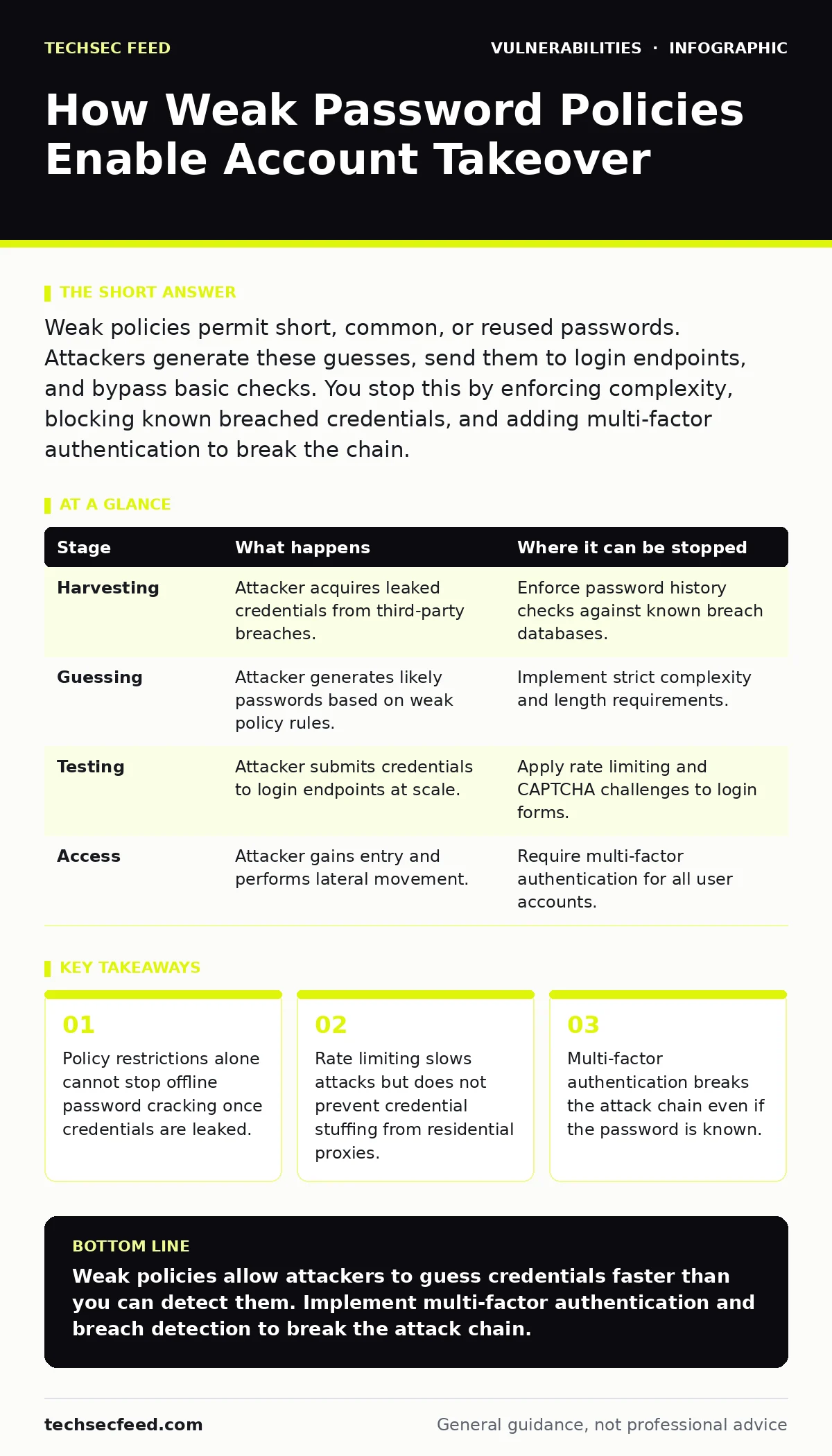
Weak policies permit short, common, or reused passwords. Attackers generate these guesses, send them to login endpoints, and bypass basic checks. You stop this by enforcing complexity, blocking known breached credentials, and adding multi-factor authentication to break the chain.
The Foundation of Credential Weakness
Password policies define the rules for creating and changing authentication secrets. When these rules are weak, they create a predictable search space for attackers. A policy that allows four-character passwords or common dictionary words reduces the effort required to guess a valid credential. This is not a software bug but a design choice that lowers the barrier to entry for unauthorized access.
The flaw relies on human behavior. Users prefer memorable strings. Weak policies encourage the use of names, dates, or simple patterns. Attackers exploit this predictability. They do not need to hack your server to find these passwords. They need only to know what users are likely to choose.
Stage 1: Credential Harvesting
Attackers begin by acquiring large lists of usernames and passwords. They do not always breach your specific organization. Often, they purchase data from previous breaches of other services. This is known as credential stuffing. Users frequently reuse passwords across multiple sites. A password leaked from a social media site may also protect your internal systems.
This stage relies on the lack of password uniqueness. If your policy does not check against known breached databases, you accept old passwords as valid. The attacker assumes that a subset of the purchased list will work on your platform. They are not trying to crack your encryption. They are trying to find a match.
| Stage | What happens | Where it can be stopped |
|---|---|---|
| Harvesting | Attacker acquires leaked credentials from third-party breaches. | Enforce password history checks against known breach databases. |
| Guessing | Attacker generates likely passwords based on weak policy rules. | Implement strict complexity and length requirements. |
| Testing | Attacker submits credentials to login endpoints at scale. | Apply rate limiting and CAPTCHA challenges to login forms. |
| Access | Attacker gains entry and performs lateral movement. | Require multi-factor authentication for all user accounts. |
Stage 2: Pattern Generation
Once the attacker has a list of usernames, they generate potential passwords. If your policy requires only six characters and one number, the combination space is small. Attackers use wordlists containing common substitutions, such as replacing 'a' with '@' or 'o' with '0'. They also append years or simple numbers to dictionary words.
This stage exploits the gap between policy and security. A policy that mandates a special character is often satisfied by appending a single symbol to a common word. This does not increase entropy significantly. The attacker knows this. They build their wordlists to reflect these common user behaviors. The weakness is in the assumption that complexity rules equate to strength.
Stage 3: Automated Testing
The attacker sends the generated credentials to your login endpoint. They use automated tools to submit thousands of attempts per minute. They often rotate through a pool of IP addresses to avoid detection. This makes the traffic look like normal user activity from different geographic locations.
Your system receives these requests and checks them against the stored password hashes. If the hash matches, the system grants access. The attacker relies on your system not distinguishing between a legitimate user typing slowly and a bot sending rapid requests. Without proper controls, the system processes each request individually.
Stage 4: Bypassing Detection
Many organizations rely on account lockout policies to stop brute-force attacks. However, attackers adapt. They slow down their attempts to fall below the lockout threshold. They might try one password per username per hour. This distributed approach avoids triggering alarms while still testing thousands of accounts over time.
This stage relies on the trade-off between security and usability. Aggressive lockout policies frustrate legitimate users, leading to support tickets. Attackers exploit this hesitation. They know that organizations are unlikely to lock accounts permanently after a few failures. They use this patience to their advantage.
See also: EPSS Percentiles: Stop Misreading Your Vulnerability Risk Scores · CISA KEV Due Dates Explained: Compliance Mechanics and Risk
Stage 5: Account Access
Once a valid credential pair is found, the attacker logs in. They now have the same access rights as the legitimate user. They may change the password to lock out the real user. They may also add their own credentials to the account. This ensures persistent access even if the original password is changed.
The attacker may also look for sensitive data or administrative functions. If the user has elevated privileges, the damage increases. The attacker relies on the principle of least privilege not being enforced. A standard user account should not have the ability to modify security settings or export data.
Interrupting the Attack Chain
You can interrupt this process at multiple points. The most effective method is to add a second factor. Multi-factor authentication requires something the user has, such as a hardware key or phone, in addition to something they know. This breaks the chain even if the password is compromised.
Another method is to monitor for impossible travel. If a user logs in from two distant locations in a short time, the system should flag this. Behavioral analytics can detect patterns that differ from normal user activity. These controls add friction for attackers while minimizing impact on legitimate users.
Beyond Password Policy
Password policies are a baseline, not a solution. You must integrate them with broader security practices. Configuration hardening ensures that login endpoints are protected from abuse. Vulnerability management programs identify and patch flaws that could expose credentials.
Secure software development lifecycle practices help build applications that handle authentication securely. This includes proper hashing algorithms and secure storage. Dependency updates ensure that the components handling login logic are not vulnerable to known exploits.
The Hidden Cost of Weakness
The cost of a weak password policy is not just the initial breach. It is the time spent investigating, the damage to reputation, and the regulatory scrutiny. You must balance security with user experience. Too many restrictions lead to password fatigue. Users write down passwords or use simple patterns.
This paradox is the core challenge. You need strong passwords, but users resist them. The solution lies in shifting the burden from memory to technology. Use password managers to generate and store complex strings. Use multi-factor authentication to reduce reliance on passwords alone. This approach addresses the human element of security.
Final Considerations
Weak password policies create a predictable environment for attackers. They exploit human habits and technical gaps. By understanding the stages of the attack, you can implement targeted defenses. Rate limiting, breach detection, and multi-factor authentication are key controls.
Remember that no single measure provides complete protection. You must layer defenses. Each layer adds friction for the attacker. This increases the cost and effort required to succeed. Make the attack harder than it is worth.
Key takeaways
- Policy restrictions alone cannot stop offline password cracking once credentials are leaked.
- Rate limiting slows attacks but does not prevent credential stuffing from residential proxies.
- Multi-factor authentication breaks the attack chain even if the password is known.
Weak policies allow attackers to guess credentials faster than you can detect them. Implement multi-factor authentication and breach detection to break the attack chain.
Frequently asked questions
Does increasing password length always prevent brute-force attacks?
Longer passwords increase the number of possible combinations, making offline cracking harder. However, they do not stop online attacks if the user chooses a common pattern.
How do attackers avoid IP-based blocking?
Attackers use residential proxy networks that route traffic through legitimate home internet connections. This makes the traffic appear to come from real users in different locations.
Is it safe to reuse passwords if they are complex?
No. If a password is leaked from one site, attackers will try it on others. Complexity does not mitigate the risk of credential stuffing from third-party breaches.
Can multi-factor authentication be bypassed?
Some forms of MFA, like SMS, can be intercepted via SIM swapping. Hardware security keys are more resistant to bypass but require user adoption and management.
How this guide was produced: written by the TechSec Feed editorial team with AI assistance, checked against the public references listed below, and reviewed when the facts change. See our editorial policy or report an error.