
Vulnerability Chaining: Why Isolated Flaws Become Critical Risks
Vulnerability chaining reveals how minor, unrelated flaws combine to bypass defenses that would stop any single issue on its own.
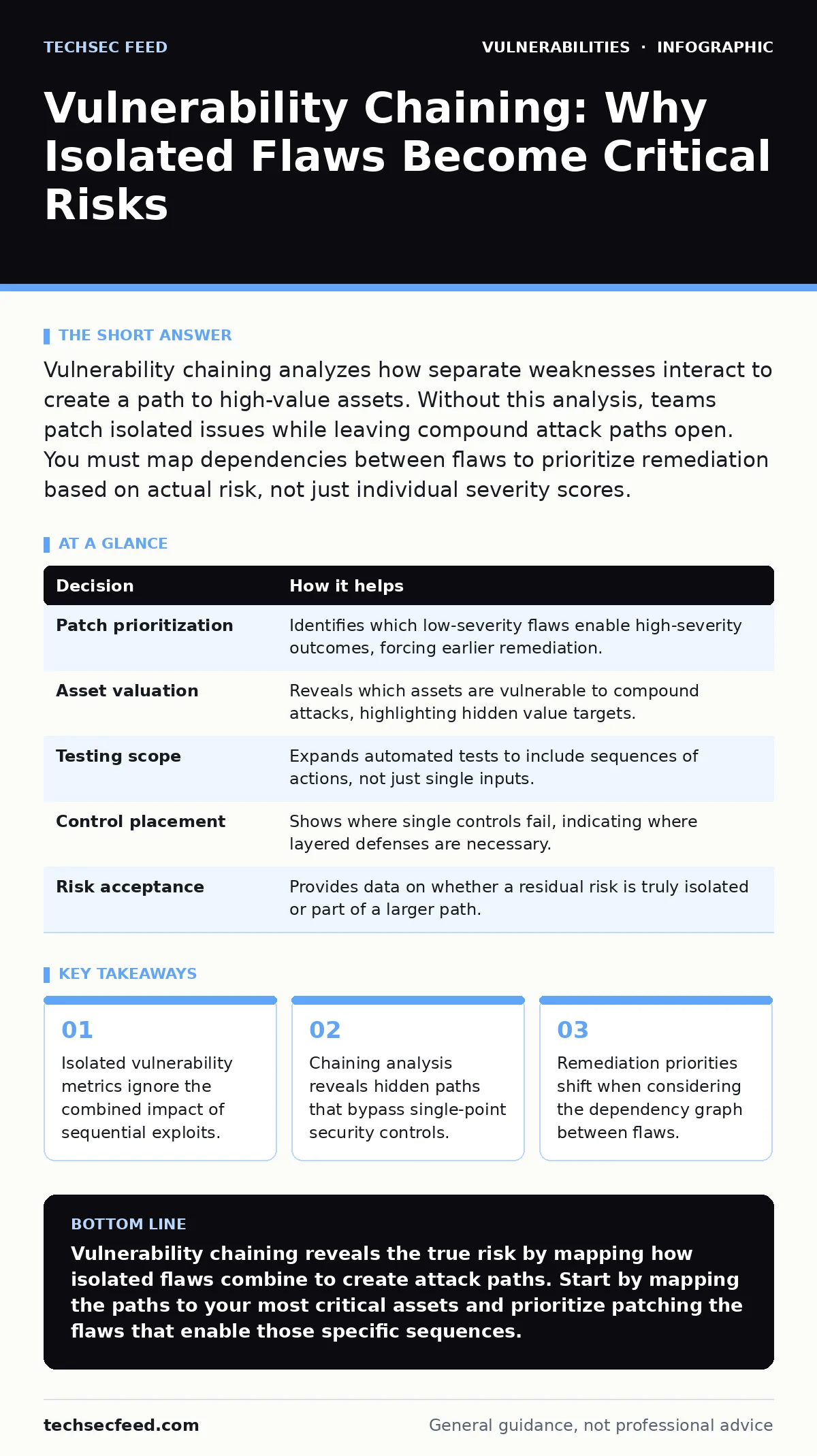
Vulnerability chaining analyzes how separate weaknesses interact to create a path to high-value assets. Without this analysis, teams patch isolated issues while leaving compound attack paths open. You must map dependencies between flaws to prioritize remediation based on actual risk, not just individual severity scores.
The Illusion of Isolated Severity
Security tools often report flaws as independent entities. A scanner finds a missing header. Another tool flags an outdated library. The report lists them separately with individual severity scores. This approach creates a false sense of safety. It assumes that fixing one item reduces overall risk by a fixed amount. In reality, flaws rarely exist in a vacuum. They sit within a complex web of dependencies. An attacker does not need to exploit the highest severity flaw. They need to find a sequence that leads to their goal.
A low-severity information disclosure might reveal an internal IP address. That address allows an attacker to target a service that has a medium-severity authentication bypass. Together, these two flaws provide full administrative access. Individually, neither flaw is catastrophic. Combined, they break the security model. This phenomenon is vulnerability chaining. It requires looking at the system as a whole rather than a list of parts. You must evaluate how flaws interact to determine true risk.
Contrast in Operational Reality
Imagine two teams facing the same environment. Team A receives a scan report with 50 findings. They patch the top 10 items by score. They believe they have reduced risk significantly. Team B takes the same report and maps the dependencies. They find that 5 of the top 10 items are irrelevant to the current architecture. They also find that 3 lower-score items form a chain to the database. Team B patches those 3 items. Team A still has a path to the database.
This difference changes how resources are allocated. Team A spends time on low-impact fixes. Team B spends time on high-impact paths. The decision to chain vulnerabilities informs where engineering effort goes. It prevents waste on noise. It focuses effort on the actual routes an attacker would take.
Decisions Informed by Chaining Analysis
Vulnerability chaining changes several key operational decisions. It moves the focus from quantity to topology. You stop asking how many flaws exist. You start asking which flaws connect to critical assets. This shift alters prioritization, resource allocation, and architecture design.
| Decision | How it helps |
|---|---|
| Patch prioritization | Identifies which low-severity flaws enable high-severity outcomes, forcing earlier remediation. |
| Asset valuation | Reveals which assets are vulnerable to compound attacks, highlighting hidden value targets. |
| Testing scope | Expands automated tests to include sequences of actions, not just single inputs. |
| Control placement | Shows where single controls fail, indicating where layered defenses are necessary. |
| Risk acceptance | Provides data on whether a residual risk is truly isolated or part of a larger path. |
Without this analysis, teams default to CVSS scores. Common Vulnerability Scoring System scores are static. They do not change based on your environment. Chaining analysis is dynamic. It reflects your specific configuration. It answers the question of what happens next, not just what is broken.
What Goes Wrong Without Context
When teams ignore chaining, they create blind spots. They assume that fixing a flaw removes the risk. This assumption fails when multiple paths exist. An attacker can pivot from one component to another. If you patch the initial entry point, they use a different entry. If you patch the pivot point, they use a different method. The system remains vulnerable to the same outcome through a different sequence.
This leads to alert fatigue. Teams receive notifications for every new flaw. They treat each as an emergency. They burn out trying to keep up with a moving target. The noise drowns out the signal. The signal is the path to the crown jewels. Without chaining, you cannot see the path. You only see the individual steps. You react to symptoms rather than the disease. The disease is the interconnected nature of the software supply chain.
Integrating Related Security Practices
Vulnerability chaining does not replace other practices. It depends on them. You cannot chain what you cannot see. An accurate asset inventory for patching provides the map. If you do not know what components you run, you cannot know how they interact. Similarly, vulnerability scanning provides the raw data. The scanner finds the nodes. Chaining analysis draws the lines between them.
You also need visibility into code and configuration. Hardcoded secrets in source code often serve as the final step in a chain. An attacker exploits a flaw to read code, finds a secret, and uses it to access a service. Without checking for secrets, the chain remains incomplete. Integer overflow vulnerabilities might seem like obscure coding errors. In a chained attack, they can be used to bypass memory protections and execute arbitrary code. These specific flaws become powerful when combined with others.
Attack surface management defines the boundaries. Chaining analysis operates within those boundaries. If the attack surface is large, the number of possible chains grows exponentially. Reducing the surface reduces the complexity of the chain analysis. Weak password policies might seem unrelated to technical flaws. They often serve as the weak link in a chain where technical exploitation is difficult. The attacker uses a technical flaw to reset a password, then uses weak policies to set a new one. The chain bypasses the technical difficulty.
See also: Canary Tokens Checklist for Detecting Early Intrusion Attempts · GraphQL Vulnerabilities: 9 Critical Questions Answered
How Teams Execute the Analysis
Teams use chaining analysis by building dependency graphs. They start with critical assets. They work backward to find what can reach those assets. They identify all flaws that facilitate each step. This is a manual process for complex systems. Automation helps with simple cases. Tools can suggest likely chains based on common patterns. Human analysts verify these suggestions.
The process involves 3 steps. First, identify the critical data or function. Second, list all components that touch that data. Third, map the flaws in those components. Look for overlaps. If a flaw in Component A allows access to Component B, and Component B has a flaw that allows data exfiltration, you have a chain. You prioritize fixing the flaw in Component A. Fixing Component B alone does not stop the initial access.
Suppose a web server has a file upload flaw. It allows an attacker to place a malicious file. The server also has a flaw that allows reading any file on the disk. Alone, the upload flaw is limited. Alone, the read flaw is limited. Together, the attacker uploads a script and reads the database credentials. The chain enables the breach. The team must break the chain at the weakest point. Often, this is the initial entry.
Managing the Hidden Costs
Chaining analysis has a cost. It requires more time than simple scoring. It requires deeper knowledge of the system. Teams must invest in training. Analysts must understand application logic, not just scanner output. This investment pays off in reduced breach risk. It also reduces the cost of incident response. Preventing a breach is cheaper than containing one.
There is a trade-off between speed and accuracy. Simple scoring is fast. Chaining analysis is slow. You must balance the two. Use simple scoring for low-risk assets. Use chaining analysis for high-risk assets. Do not try to do both for everything. Focus on the crown jewels. The rest can wait. This selective approach keeps the workload manageable. It ensures that the most critical paths are covered.
The Role of Supply Chain Visibility
Modern applications rely on many third-party components. Software bill of materials (SBOM) provides a list of these components. It is the foundation for chaining analysis in complex environments. Without an SBOM, you do not know what libraries you use. You cannot know what flaws they contain. You cannot map the dependencies between them. The SBOM turns a black box into a white box. It allows you to see the internal structure.
Citrix NetScaler vulnerabilities are an example of how supply chain issues propagate. A flaw in the underlying platform affects all instances. If you do not have an SBOM, you might not know which instances are affected. Chaining analysis helps you determine which instances are reachable. It helps you prioritize which instances to patch first. The ones with open paths to internal networks are highest risk. The ones isolated in DMZs are lower risk. The SBOM gives you the data. Chaining gives you the context.
Key takeaways
- Isolated vulnerability metrics ignore the combined impact of sequential exploits.
- Chaining analysis reveals hidden paths that bypass single-point security controls.
- Remediation priorities shift when considering the dependency graph between flaws.
Vulnerability chaining reveals the true risk by mapping how isolated flaws combine to create attack paths. Start by mapping the paths to your most critical assets and prioritize patching the flaws that enable those specific sequences.
Frequently asked questions
How does vulnerability chaining differ from standard risk scoring?
Standard scoring evaluates flaws in isolation based on generic metrics. Chaining evaluates how flaws interact within your specific environment to create compound risks that bypass individual controls.
Can automated tools fully replace manual chaining analysis?
No. Automated tools can suggest potential chains based on common patterns. Human analysts must verify these paths to ensure the connectivity and logic hold true in your specific architecture.
What is the first step in implementing a chaining strategy?
Identify your most critical assets. Define what constitutes a breach for those assets. Then map the components that interact with them to identify potential entry points and pivot paths.
Does chaining analysis require a software bill of materials?
It is highly beneficial. An SBOM provides the necessary visibility into third-party components. Without it, you cannot accurately map the dependencies between internal code and external libraries.
How this guide was produced: written by the TechSec Feed editorial team with AI assistance, checked against the public references listed below, and reviewed when the facts change. See our editorial policy or report an error.