
Canary Tokens Checklist for Detecting Early Intrusion Attempts
Canary tokens generate noise to mask true alerts, requiring a dedicated filtering strategy to prevent security teams from ignoring real threats.
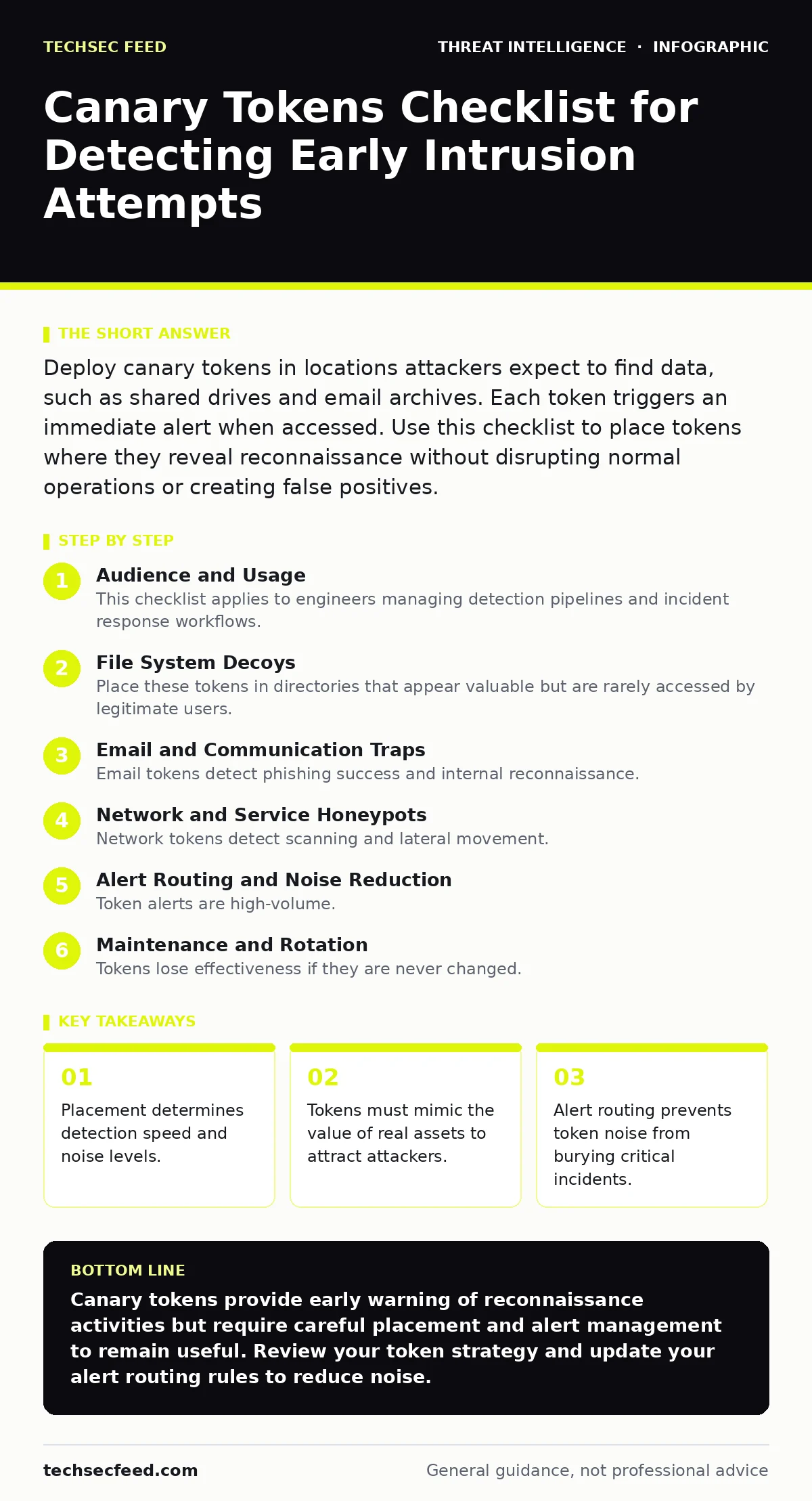
Deploy canary tokens in locations attackers expect to find data, such as shared drives and email archives. Each token triggers an immediate alert when accessed. Use this checklist to place tokens where they reveal reconnaissance without disrupting normal operations or creating false positives.
Audience and Usage
This checklist applies to engineers managing detection pipelines and incident response workflows. You use it to audit your current honeypot strategy and identify gaps in coverage. The goal is not to catch every attacker, but to catch the ones who perform basic reconnaissance.
File System Decoys
Place these tokens in directories that appear valuable but are rarely accessed by legitimate users. The file name must look like a legitimate credential store or proprietary document.
- Fake credential files: Mimic formats like
passwords.txtorconfig.inito catch credential harvesting. - Legacy database exports: Create empty CSV files named after old projects to detect data exfiltration attempts.
- Source code repositories: Place tokens in gitignored directories to catch attackers browsing for API keys.
- Shared drive roots: Position tokens in top-level shared folders where attackers look for quick wins.
- Temporary directories: Place tokens in temp folders to detect malware dropping payloads.
These items matter because attackers often search for high-value files by name. A correctly named token triggers an alert before they reach real data. The trade-off is storage space and the risk of accidental access by internal users.
Email and Communication Traps
Email tokens detect phishing success and internal reconnaissance. They must look like legitimate correspondence to avoid immediate deletion by the recipient.
- Unique email addresses: Generate one-time-use addresses for external contacts to detect credential stuffing.
- Fake invoice attachments: Embed tokens in PDFs that mimic vendor invoices to catch malware execution.
- Calendar invite traps: Create events with sensitive titles to detect calendar scraping tools.
- Slack or Teams channels: Create private channels with sensitive names to detect lateral movement in chat platforms.
- DNS-based email traps: Use unique subdomains in email signatures to detect DNS lookups by scanners.
These items matter because email is a primary entry point. Detecting the open or click proves the initial compromise. The hidden cost is the administrative overhead of managing these addresses and channels.
Network and Service Honeypots
Network tokens detect scanning and lateral movement. They must respond to protocol requests to mimic real services without providing actual functionality.
- Fake API endpoints: Create endpoints that return 200 OK but log the request IP.
- Database port listeners: Open ports that mimic SQL or NoSQL databases to catch port scanning.
- SSH keys with traps: Distribute fake SSH keys that trigger alerts upon use.
- Windows event log tokens: Use Sysmon to monitor for specific process creations linked to token access.
- HTTP headers with traps: Include unique headers in web responses to detect automated crawling.
These items matter because they reveal the attacker's intent and tools. A fake API endpoint shows they are looking for data via web services. The edge case is when legitimate scripts hit these endpoints, causing false positives.
Alert Routing and Noise Reduction
Token alerts are high-volume. Without proper routing, they drown out critical signals. You must separate token noise from real incidents.
- Dedicated alert channel: Route all token alerts to a separate Slack or Teams channel.
- Automated triage scripts: Use scripts to group alerts by source IP and time.
- Whitelist internal scanners: Exclude known internal tools from triggering alerts.
- Integration with SIEM: Forward token logs to your Security Information and Event Management system.
- Response playbooks: Define clear steps for investigating token alerts.
These items matter because security teams ignore noisy alerts. A dedicated channel ensures visibility without cluttering main operations. The trade-off is the effort to maintain the routing rules.
See also: Polymorphic Malware: How Code Mutation Evades Static Detection · Command and Control Traffic: Stages, Mechanics, and Interruption Points
Maintenance and Rotation
Tokens lose effectiveness if they are never changed. Attackers learn to ignore static decoys.
- Regular rotation schedule: Change file names and locations every few months.
- Decoy content updates: Update fake documents to match current business projects.
- Log retention policy: Keep token logs for forensic analysis.
- False positive review: Regularly review alerts to reduce noise.
- Coverage audit: Ensure tokens cover new assets and services.
These items matter because stale tokens provide a false sense of security. Rotating them keeps the detection fresh. The hidden cost is the ongoing labor to update the decoys.
Key takeaways
- Placement determines detection speed and noise levels.
- Tokens must mimic the value of real assets to attract attackers.
- Alert routing prevents token noise from burying critical incidents.
Canary tokens provide early warning of reconnaissance activities but require careful placement and alert management to remain useful. Review your token strategy and update your alert routing rules to reduce noise.
Frequently asked questions
How do I distinguish a token alert from a real breach?
Token alerts indicate interaction with a decoy. Correlate the source IP and user with other logs to determine if it is a false positive or a real intrusion.
Can attackers detect canary tokens?
Sophisticated attackers may identify tokens by their behavior or file properties. Rotate tokens and mimic real file metadata to reduce detection.
What is the best location for a canary token?
Place tokens where attackers expect to find value, such as shared drives, email archives, and code repositories. Avoid critical system directories.
Do canary tokens prevent data theft?
No. Tokens only alert you to unauthorized access. They do not block attackers. You must respond to alerts to mitigate the threat.
How this guide was produced: written by the TechSec Feed editorial team with AI assistance, checked against the public references listed below, and reviewed when the facts change. See our editorial policy or report an error.