
How the Attack Lifecycle Works: Mapping Stages to Defense Points
Understanding attack phases reveals that detection often fails because teams monitor for tools rather than the underlying behavioral changes in system state.
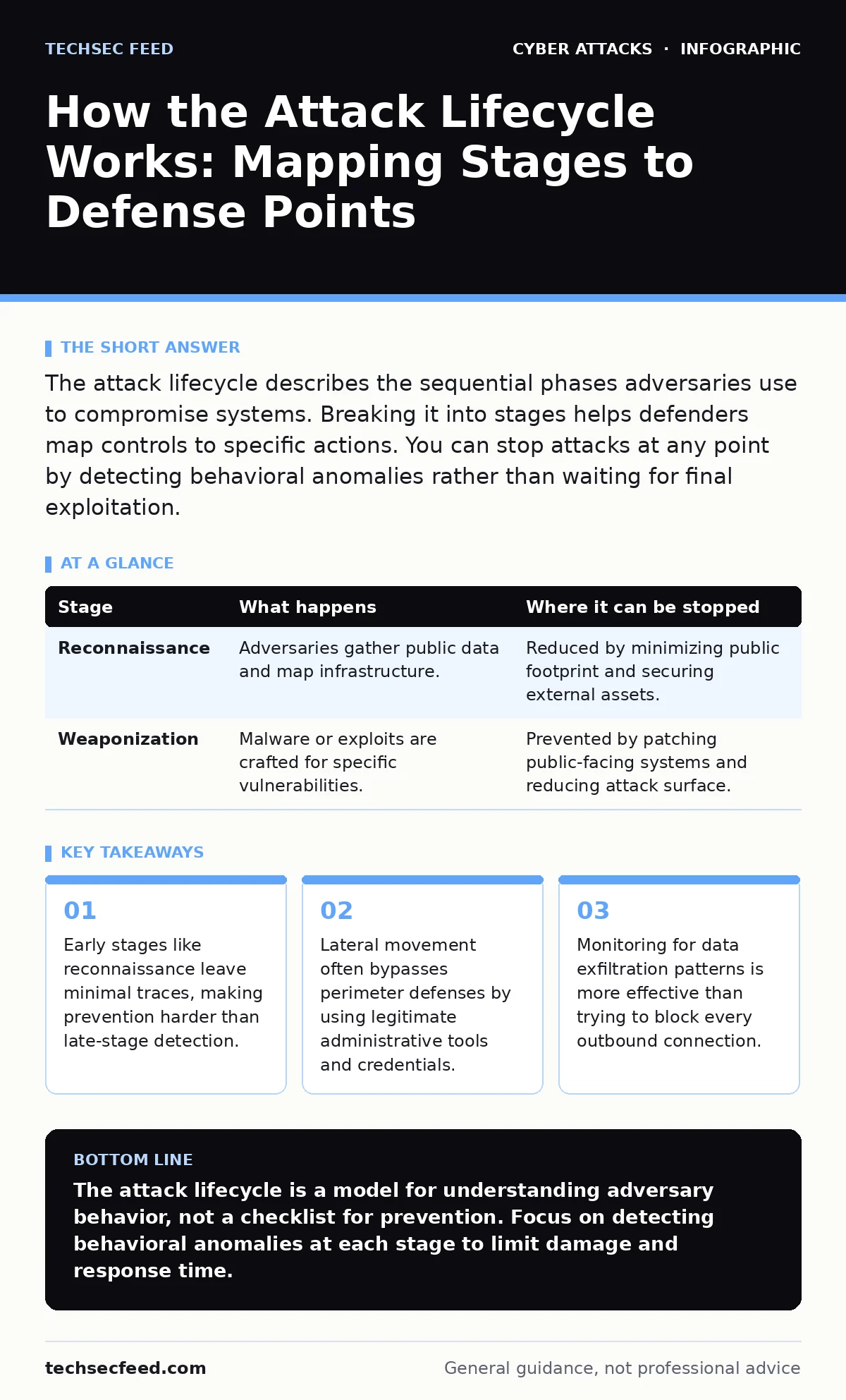
The attack lifecycle describes the sequential phases adversaries use to compromise systems. Breaking it into stages helps defenders map controls to specific actions. You can stop attacks at any point by detecting behavioral anomalies rather than waiting for final exploitation.
The Structure of Adversarial Progression
The attack lifecycle models how adversaries move from initial contact to achieving their objectives. This framework breaks down complex intrusions into discrete, observable stages. Understanding these stages allows defenders to place controls where they matter most. It shifts the focus from preventing entry to limiting damage after entry occurs.
Adversaries rarely follow a linear path. They may loop back to earlier stages to gather more information or try different techniques. They often pause between stages to avoid detection. This variability means static defenses based on single indicators fail quickly. You must design monitoring to catch the intent behind the action, not just the tool used.
Stage 1: Reconnaissance and Weaponization
Reconnaissance involves gathering information about the target. Adversaries look for employee names, email formats, and public-facing infrastructure. They use this data to craft tailored attacks. Weaponization is the creation of the exploit or malware. This stage happens entirely outside your environment.
You cannot stop reconnaissance on the open internet. You can reduce its value by minimizing your digital footprint. Hiding administrative interfaces and limiting public directory exposure reduces the data available to attackers. This makes weaponization harder because the adversary has fewer targets to exploit.
| Stage | What happens | Where it can be stopped |
|---|---|---|
| Reconnaissance | Adversaries gather public data and map infrastructure. | Reduced by minimizing public footprint and securing external assets. |
| Weaponization | Malware or exploits are crafted for specific vulnerabilities. | Prevented by patching public-facing systems and reducing attack surface. |
Stage 2: Delivery and Initial Execution
Delivery is the method used to get the weapon into the target environment. Common methods include email attachments, malicious links, or compromised websites. Once delivered, the adversary must execute the code. Initial execution often uses scripts or legitimate system tools to run the payload.
Email remains a primary delivery vector. Phishing attacks trick users into clicking links or opening files. Spear phishing targets specific individuals with highly relevant content. Social engineering red flags often appear in urgency or unexpected requests. Users should verify unexpected requests through alternate channels.
Imagine an employee receives an invoice with a macro-enabled document. Opening the document triggers the initial execution. The code runs in the background. It may download additional tools or establish communication with the adversary. This stage is where endpoint detection and response systems often trigger alerts.
Stage 3: Installation and Persistence
Installation ensures the adversary maintains access. They may install backdoors, create new user accounts, or modify system registries. Persistence mechanisms allow them to return after reboots or disconnects. This stage is critical because it establishes long-term control.
Adversaries often mimic legitimate processes to hide. They may use scheduled tasks or service accounts. Detecting this requires baseline monitoring. You must know what normal process creation looks like on your systems. Any deviation from the baseline warrants investigation.
Stage 4: Command and Control
Command and control (C2) is the communication channel between the adversary and the compromised system. The adversary sends instructions and receives data. This traffic often mimics legitimate protocols like HTTPS or DNS. Detecting C2 requires analyzing traffic patterns, not just content.
Adversaries use domain generation algorithms to create random domains. This makes blacklisting ineffective. You must look for beaconing behavior. Regular, periodic connections to unknown destinations indicate C2 activity. Network segmentation limits the value of this channel by isolating compromised segments.
See also: Polymorphic Malware: How Code Mutation Evades Static Detection · Command and Control Traffic: Stages, Mechanics, and Interruption Points
Stage 5: Actions on Objectives
This final stage involves the adversary achieving their goal. This could be data theft, ransomware encryption, or sabotage. Data exfiltration often happens slowly to avoid detection. Adversaries compress and encrypt data before sending it out.
Formjacking involves injecting malicious code into web forms to steal payment data. This happens at the application layer. SYN flood attacks overwhelm servers to disrupt service. These are different objectives but part of the same lifecycle.
| Stage | What happens | Where it can be stopped |
|---|---|---|
| C2 | Adversaries communicate with compromised systems. | Detected by analyzing traffic patterns and beaconing behavior. |
| Actions | Adversaries steal data, encrypt files, or disrupt services. | Limited by data loss prevention and network segmentation. |
Applying the Lifecycle to Defense
Using the lifecycle helps you map controls to specific stages. You cannot stop every attack at the perimeter. You must assume breach and detect activity inside. Each stage offers opportunities for detection and response.
Focus on behavioral analytics rather than signature-based detection. Signatures fail against new or modified malware. Behavioral analytics look for unusual actions, such as a web server executing a script. This approach catches novel attacks.
Reducing the Impact of Intrusions
Even with strong defenses, intrusions will occur. The goal is to limit the damage. Network segmentation prevents lateral movement. Identity and access management reduces the impact of stolen credentials.
Password spraying attacks try common passwords across many accounts. Multi-factor authentication stops these attempts. Man-in-the-middle attacks intercept communications. Encrypting data in transit and at rest protects it.
You must regularly test your defenses. Phishing simulations help users recognize social engineering. They reinforce training and measure awareness. This reduces the success rate of delivery attempts.
Key takeaways
- Early stages like reconnaissance leave minimal traces, making prevention harder than late-stage detection.
- Lateral movement often bypasses perimeter defenses by using legitimate administrative tools and credentials.
- Monitoring for data exfiltration patterns is more effective than trying to block every outbound connection.
The attack lifecycle is a model for understanding adversary behavior, not a checklist for prevention. Focus on detecting behavioral anomalies at each stage to limit damage and response time.
Frequently asked questions
How do I detect lateral movement in my network?
Monitor for unusual internal connections, especially between workstations and servers. Look for administrators logging in at odd hours or from unexpected locations.
What is the difference between reconnaissance and weaponization?
Reconnaissance is gathering information about the target. Weaponization is creating the specific exploit or malware using that information to target vulnerabilities.
Can I stop all attacks at the delivery stage?
No. Adversaries use multiple delivery methods. Some bypass email filters via social engineering or compromised legitimate sites. You must detect activity after delivery.
Why is persistence difficult to detect?
Adversaries use legitimate system tools and mimic normal processes. They often create accounts or tasks that look like standard administrative actions, blending in with normal activity.
How this guide was produced: written by the TechSec Feed editorial team with AI assistance, checked against the public references listed below, and reviewed when the facts change. See our editorial policy or report an error.