
Detect Nation-State Cyber Attacks: Signals, Tools and Blind Spots
Nation-state actors blend into background noise by mimicking administrative tasks, making standard alerting useless without behavioral context.
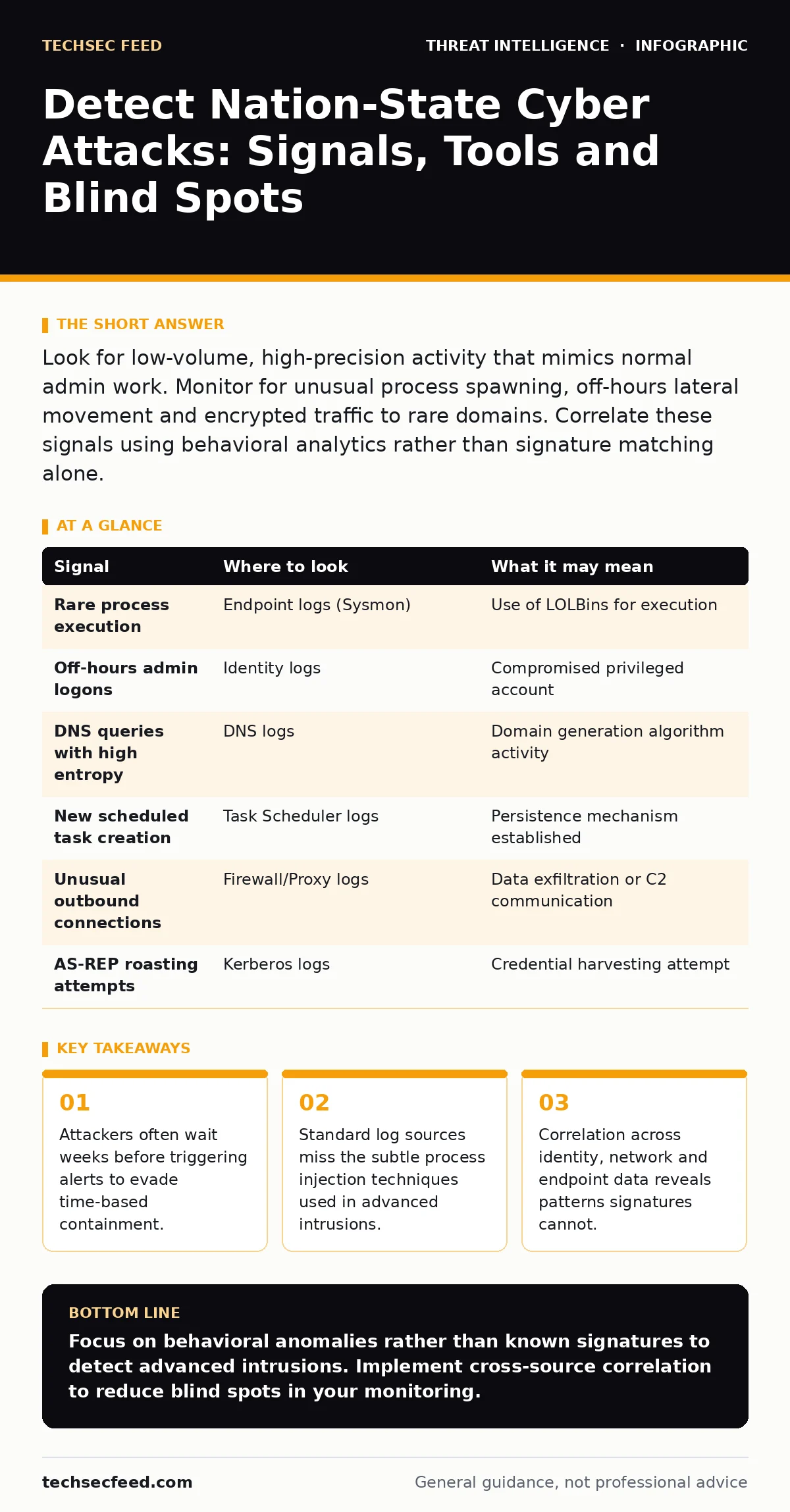
Look for low-volume, high-precision activity that mimics normal admin work. Monitor for unusual process spawning, off-hours lateral movement and encrypted traffic to rare domains. Correlate these signals using behavioral analytics rather than signature matching alone.
The Architecture of Stealth
Nation-state operators prioritize persistence and deniability over speed. They do not rush to exfiltrate data. Instead, they move laterally through the environment using legitimate credentials and standard protocols. This approach makes their activity look like routine maintenance. You must adjust your detection strategy to focus on behavior rather than malicious artifacts. Signatures fail here because the tools used are often legitimate system utilities. The enemy is not a virus; it is a compromised account acting strangely.
Endpoint Process Anomalies
Standard endpoint protection logs record every process start. However, nation-state actors use living-off-the-land binaries (LOLBins) to execute code. These are tools already present on the system, such as PowerShell or Windows Management Instrumentation. To detect this, you need detailed process creation logging. Sysmon provides the necessary depth for this. It records command-line arguments and parent-child relationships. Look for a standard binary launching an unexpected child process. For example, a web server process spawning a command shell is highly suspicious. This indicates a breach of the application boundary.
Identity and Lateral Movement
Attackers move between systems to find valuable data. They often abuse scheduled tasks to maintain persistence. This technique is covered in our guide on scheduled task abuse. When monitoring for this, look for new task creation or modification. Pay attention to tasks that run at irregular intervals. Also, monitor for logons from multiple geographic locations in a short timeframe. This indicates credential theft and reuse. Identity logs are critical here. Standard access logs may not show the source IP of the lateral movement. You must correlate identity events with network connection logs.
Network Traffic Patterns
Command and control traffic often hides within encrypted channels. Attackers use domain generation algorithms to create random-looking domains. They may also use legitimate cloud services for data exfiltration. Our guide on command and control traffic explains how to identify these patterns. Look for DNS queries with high entropy. This means the domain names are long and random. Also, monitor for beaconing. This is regular communication at fixed intervals. It is a hallmark of implant malware. Traditional firewalls may allow this traffic if it uses standard ports. You need deep packet inspection to see the payload structure.
Table of Detection Signals
| Signal | Where to look | What it may mean |
|---|---|---|
| Rare process execution | Endpoint logs (Sysmon) | Use of LOLBins for execution |
| Off-hours admin logons | Identity logs | Compromised privileged account |
| DNS queries with high entropy | DNS logs | Domain generation algorithm activity |
| New scheduled task creation | Task Scheduler logs | Persistence mechanism established |
| Unusual outbound connections | Firewall/Proxy logs | Data exfiltration or C2 communication |
| AS-REP roasting attempts | Kerberos logs | Credential harvesting attempt |
See also: Polymorphic Malware: How Code Mutation Evades Static Detection · Command and Control Traffic: Stages, Mechanics, and Interruption Points
Common Blind Spots
Many detection efforts focus on the perimeter. This leaves the internal network vulnerable. Attackers operate inside the trusted zone. They use protocols that are rarely inspected. For example, AS-REP roasting allows attackers to hash passwords without triggering typical authentication alerts. This technique is not always covered in standard monitoring.
Another blind spot is cloud service abuse. Attackers use legitimate cloud APIs to move data. This traffic looks like normal business activity. You must monitor API usage patterns for anomalies. Also, consider the human element. Social engineering remains a primary entry vector. Monitoring email alone is insufficient. You need to track user behavior changes after login.
The Role of Intelligence
Threat intelligence helps you understand attacker tactics. It provides context for your alerts. ISACs share sector-specific threat data. This can help you identify emerging techniques. However, raw intelligence is not actionable. You must map it to your environment. Use frameworks like the MITRE ATT&CK Navigator to visualize coverage. This helps you identify gaps in your detection logic. Do not rely solely on commercial feeds. They may not cover niche tactics used by specific groups. Combine multiple sources for a complete picture.
Tooling and Implementation
You need tools that provide visibility across the stack. Endpoint detection and response (EDR) solutions are standard. They provide process and file activity logs. Network detection and response (NDR) tools analyze traffic patterns. They identify anomalies in network behavior. Security information and event management (SIEM) platforms correlate these data sources.
They allow you to create complex detection rules. You can use Snort and Suricata rules for network signature matching. However, these are less effective against fileless attacks. Behavioral analytics are more effective. They look for deviations from the norm. Implementing this requires baseline data. You need to know what normal looks like.
Continuous Improvement
Detection is not a one-time setup. Attackers adapt their tactics. You must update your detection logic regularly. Review false positives and negatives. Adjust your thresholds based on findings. Conduct purple team exercises. These simulate attacks to test your detection capabilities. Use canary tokens to detect unauthorized access to sensitive data. These are decoy files that trigger alerts when accessed. This helps you validate your monitoring. Document your findings and share them internally. Build a feedback loop between security and IT operations. This ensures that detection improvements are sustainable.
Key takeaways
- Attackers often wait weeks before triggering alerts to evade time-based containment.
- Standard log sources miss the subtle process injection techniques used in advanced intrusions.
- Correlation across identity, network and endpoint data reveals patterns signatures cannot.
Focus on behavioral anomalies rather than known signatures to detect advanced intrusions. Implement cross-source correlation to reduce blind spots in your monitoring.
Frequently asked questions
How long do nation-state actors typically remain undetected?
They can remain undetected for months or years. This depends on the organization's monitoring capabilities and the attacker's caution.
Are free tools sufficient for detecting these attacks?
Free tools provide visibility but lack automated correlation. You need manual effort to analyze the data effectively.
What is the most common entry point for these attacks?
Compromised credentials are the most common entry point. Attackers often steal valid login details.
How do I differentiate between a false positive and a real attack?
Correlate multiple signals. A single anomaly may be benign. Multiple anomalies occurring together increase the likelihood of an attack.
How this guide was produced: written by the TechSec Feed editorial team with AI assistance, checked against the public references listed below, and reviewed when the facts change. See our editorial policy or report an error.