
Polymorphic Malware: How Code Mutation Evades Static Detection
Polymorphic malware changes its external code structure with every infection while keeping its core function identical, rendering signature-based scanning ineffective.
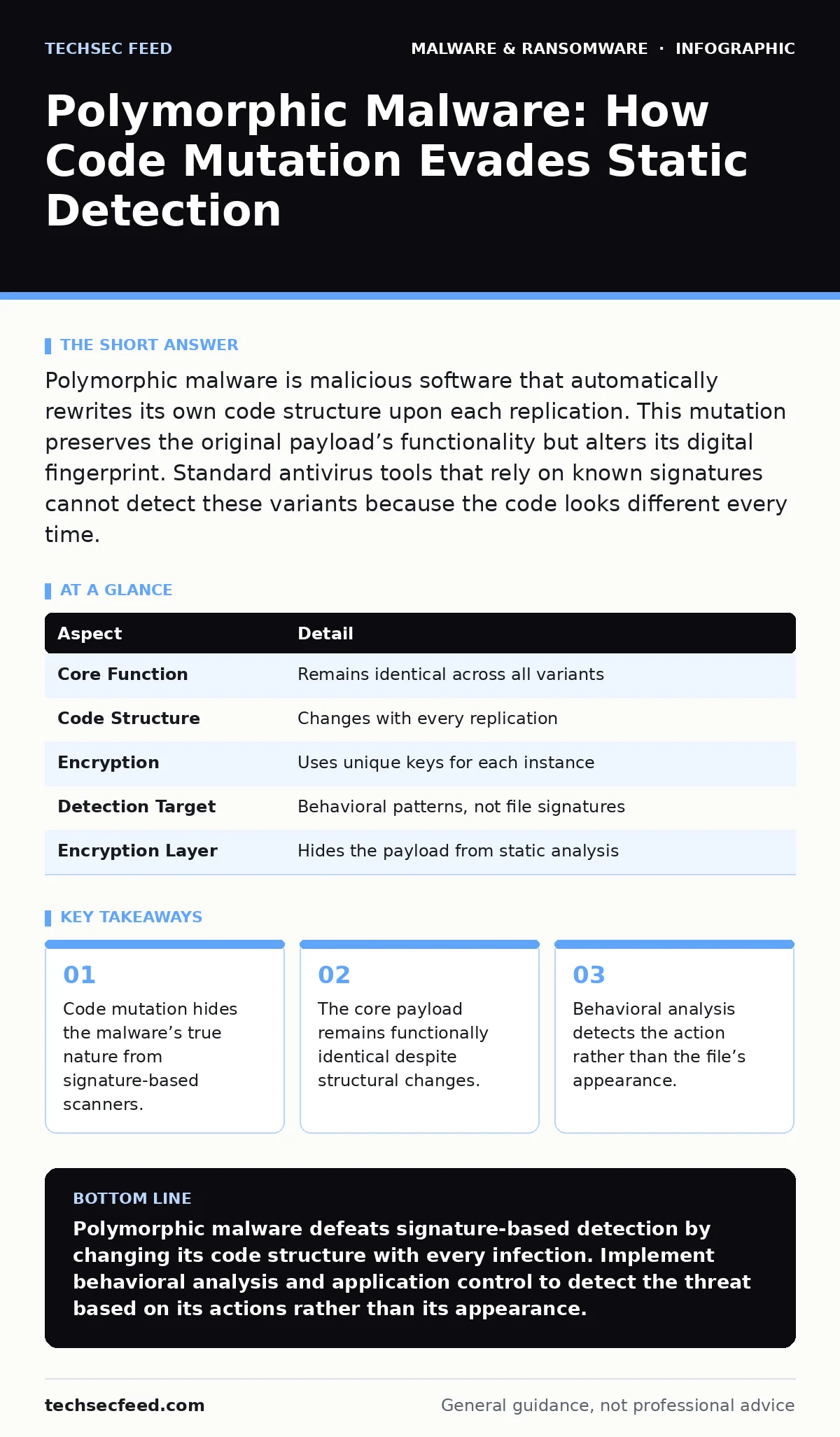
Polymorphic malware is malicious software that automatically rewrites its own code structure upon each replication. This mutation preserves the original payload’s functionality but alters its digital fingerprint. Standard antivirus tools that rely on known signatures cannot detect these variants because the code looks different every time.
The Chameleon Mechanism
Imagine a burglar who changes their appearance, clothing, and gait before entering every single house. They remain the same person inside, but to a camera system looking for a specific face, they appear as a stranger each time. Polymorphic malware operates on this exact principle. It alters its external code structure while preserving its internal logic.
This technology relies on a crypter. A crypter is a program that encrypts the malicious payload and wraps it in a unique decryption routine. Each time the malware replicates, the crypter generates new encryption keys and modifies the decryption code. The resulting file has a different digital signature than the original.
Why Signatures Fail
Traditional antivirus software depends on signatures. A signature is a unique string of bytes that identifies a specific piece of malware. If a scanner finds that string, it flags the file. This method works well for static threats that do not change. Polymorphic malware breaks this model by ensuring no two infections share the same byte sequence.
The mutation process is automated and rapid. The malware does not need human intervention to change its appearance. It generates random code variations that are functionally equivalent. To a static scanner, every variant looks like a new, unknown file.
| Aspect | Detail |
|---|---|
| Core Function | Remains identical across all variants |
| Code Structure | Changes with every replication |
| Encryption | Uses unique keys for each instance |
| Detection Target | Behavioral patterns, not file signatures |
| Encryption Layer | Hides the payload from static analysis |
The Hidden Cost of Mutation
The primary advantage of polymorphism is evasion. However, there is a hidden trade-off. The decryption routine adds overhead to the malware. It must decrypt itself before it can execute. This introduces a slight delay in execution time.
This delay creates a window for detection. Behavioral analysis tools monitor how a process acts rather than what it looks like. If a program decrypts itself and then attempts to access sensitive system areas, the behavior raises an alert. The mutation hides the identity, but it cannot hide the intent.
Security teams often overlook the resource cost of mutation. The crypter consumes CPU cycles. In high-volume environments, this can cause minor performance degradation. It is a small cost to the attacker for the benefit of evasion, but it is a measurable footprint.
Common Forms and Vectors
Polymorphic malware is not a standalone type of threat. It is a technique applied to other malware families. You will rarely find "polymorphic malware" as a final category. Instead, it is a feature of worms, trojans, and ransomware.
Worms are the most common carriers. Worms replicate automatically across networks. Polymorphism allows a worm to bypass email filters and network scanners that check attachments. Each recipient gets a unique variant, preventing the scanner from building a signature quickly enough to block the spread.
Ransomware also uses this technique. By mutating the encryption routine, ransomware can evade initial detection on the endpoint. This allows it to begin encrypting files before security software identifies the threat. The mutation does not change the ransom demand, but it changes the delivery method.
What People Usually Get Wrong
A common misconception is that polymorphic malware is the same as metamorphic malware. Metamorphic malware rewrites its entire code, including the payload logic, while preserving functionality. Polymorphic malware only changes the wrapper and encryption keys. The inner payload remains static.
Another error is assuming that updating signatures solves the problem. Signature updates are reactive. They require a sample to be collected, analyzed, and distributed. Polymorphism generates infinite variants. It is impossible to sign every possible mutation. You cannot keep up with a generator that creates unique code on the fly.
See also: Command and Control Traffic: Stages, Mechanics, and Interruption Points · Canary Tokens Checklist for Detecting Early Intrusion Attempts
Reducing the Risk Surface
You cannot stop polymorphic malware by looking at what it is. You must look at what it does. Application control is the most effective defense. It allows only approved executables to run. If a mutated file is not on the allow list, it cannot execute, regardless of its structure.
Memory analysis provides another layer of defense. Polymorphic malware must decrypt itself into memory to run. Tools that monitor memory for suspicious decryption activities can catch the malware in action. This bypasses the file system entirely.
Implement script blocking. Many polymorphic payloads are delivered via scripts. Blocking unnecessary script execution prevents the initial delivery mechanism from working. You can find more details on configuring these restrictions in our guide on script blocking.
The Persistence Problem
Once polymorphic malware executes, it establishes persistence. It modifies system settings to ensure it runs on startup. This stage does not involve mutation. The persistence mechanism is often static.
Security teams should focus on monitoring for changes to registry keys and startup folders. These changes are easier to detect than the initial infection. If a process modifies system configuration unexpectedly, it is likely malicious.
For mobile environments, the principles remain similar. However, the attack surface differs. Mobile operating systems sandbox applications, making it harder for malware to access system-wide settings. If you suspect an infection on a mobile device, consult our guide on removing malware from an Android phone or removing malware from a Mac for platform-specific steps.
Strategic Defense Layers
Defense requires depth. No single tool stops polymorphic malware. You need a combination of prevention, detection, and response. Network segmentation limits the spread. If a worm infects one segment, it cannot easily reach others.
Endpoint Detection and Response (EDR) tools are critical. They record process activity and can roll back changes if a threat is identified. This capability is vital for ransomware incidents.
Do not ignore the human element. Phishing remains a primary delivery vector. Training users to recognize suspicious links reduces the initial infection rate. For broader software risks, be aware that malware in pirated software often uses these advanced evasion techniques.
Final Considerations
Polymorphic malware is a persistent challenge because it exploits the limitations of static analysis. It forces security teams to shift from identity-based detection to behavior-based detection. This shift requires more sophisticated tools and greater visibility into system operations.
The technology is not new, but it remains effective. Attackers continue to refine crypters to avoid behavioral detection. The cat-and-mouse game continues. Your defense must be adaptive, not static.
For organizations using artificial intelligence in security, consider the implications of automated threat generation. The NIST AI Risk Management Framework provides guidance on managing these complex risk environments. Fine-tuning your detection models requires careful balance to avoid false positives.
Avoid falling for scareware that promises instant protection against all variants. No tool is perfect. Layered security is the only realistic approach.
Key takeaways
- Code mutation hides the malware’s true nature from signature-based scanners.
- The core payload remains functionally identical despite structural changes.
- Behavioral analysis detects the action rather than the file’s appearance.
- Static file attributes like size and hash change with every generation.
Polymorphic malware defeats signature-based detection by changing its code structure with every infection. Implement behavioral analysis and application control to detect the threat based on its actions rather than its appearance.
Frequently asked questions
Can traditional antivirus software detect polymorphic malware?
Traditional antivirus software that relies solely on static signatures will likely fail to detect polymorphic malware. The code structure changes with every instance, making signature matching impossible. Behavioral analysis is required for detection.
What is the difference between polymorphic and metamorphic malware?
Polymorphic malware changes its encryption and wrapper code but keeps the inner payload static. Metamorphic malware rewrites the entire code, including the payload logic, while maintaining the same function. Metamorphic malware is more complex and harder to analyze.
How do I know if my system is infected with polymorphic malware?
Look for unusual system behavior, such as high CPU usage during idle times or unexpected network connections. Behavioral monitoring tools will alert you to suspicious decryption activities or unauthorized system modifications. Static file checks will not reveal the infection.
Is polymorphic malware more dangerous than standard malware?
It is more difficult to detect, which allows it to spread faster and cause more damage before being identified. The danger lies in the extended dwell time. Once detected, the remediation process is similar to standard malware removal.
How this guide was produced: written by the TechSec Feed editorial team with AI assistance, checked against the public references listed below, and reviewed when the facts change. See our editorial policy or report an error.