
Spotting SYN Flood Attacks: Signs, Hidden Metrics, and Response
SYN floods hide in plain sight because they exploit the handshake protocol, leaving servers waiting for connections that never finish.
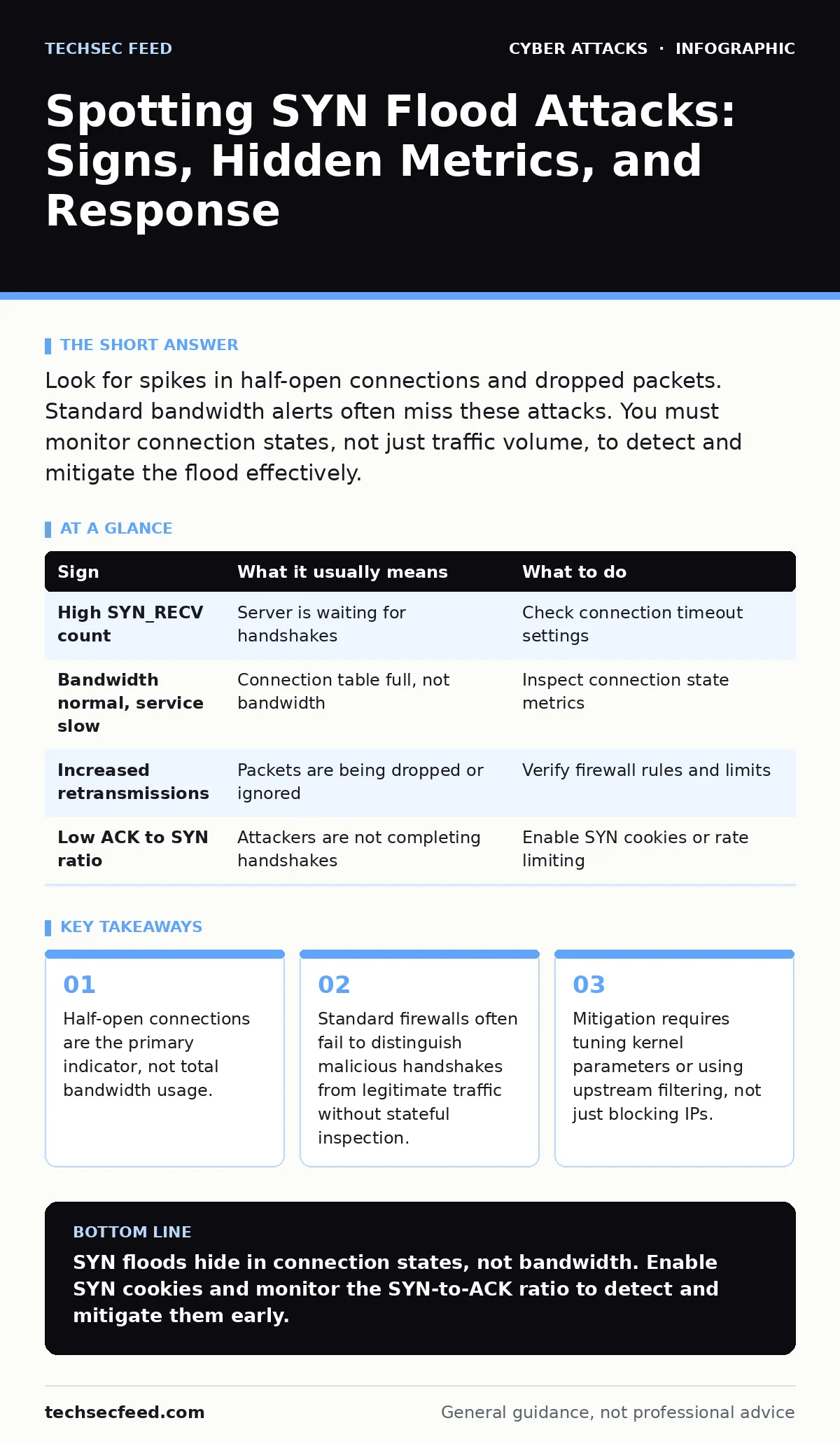
Look for spikes in half-open connections and dropped packets. Standard bandwidth alerts often miss these attacks. You must monitor connection states, not just traffic volume, to detect and mitigate the flood effectively.
The Illusion of Normal Traffic
SYN flood attacks exploit the three-way handshake mechanism used by TCP connections. A client sends a SYN packet to initiate a link. The server replies with SYN-ACK and waits for the final ACK. Attackers send thousands of SYN packets but never send the final ACK. The server keeps these half-open connections open, wasting memory and CPU cycles.
You might see normal bandwidth usage while the service slows to a halt. This is because the attack consumes connection slots, not network capacity. The server appears busy, but it is actually idle, waiting for responses that will never arrive. This distinction is critical for diagnosis. If you only monitor bandwidth, you will miss the attack entirely.
First Signs: The Obvious Symptoms
The first sign is usually a sudden drop in service availability. Users report slow load times or timeouts. New connections fail while existing ones remain active. This happens because the server’s backlog queue fills with half-open connections. The queue has a finite size. Once full, the server rejects new legitimate requests.
You will see high numbers of connections in the SYN_RECV state. This state indicates the server has sent a SYN-ACK but has not received the final ACK. Monitoring tools that track connection states will show a spike here. Standard load balancers may also report health check failures. These signs are loud but often attributed to other causes, like application bugs or database locks.
Hidden Signs: What You Miss
The signs that are easy to miss are subtle metric shifts. Look for an increase in retransmissions without corresponding data transfer. The server sends SYN-ACKs, gets no reply, and retries. This creates internal network noise. Your internal switches may show increased error counters or dropped packets due to buffer overflows.
Another hidden sign is the ratio of SYN packets to ACK packets. In normal traffic, these numbers are roughly equal. In a flood, SYNs vastly outnumber ACKs. This ratio shift is a strong indicator of malicious intent. You must inspect packet headers to see this. Most dashboard tools do not display this ratio by default. You need to configure your monitoring stack to track it.
| Sign | What it usually means | What to do |
|---|---|---|
| High SYN_RECV count | Server is waiting for handshakes | Check connection timeout settings |
| Bandwidth normal, service slow | Connection table full, not bandwidth | Inspect connection state metrics |
| Increased retransmissions | Packets are being dropped or ignored | Verify firewall rules and limits |
| Low ACK to SYN ratio | Attackers are not completing handshakes | Enable SYN cookies or rate limiting |
The Cost of Standard Firewalls
Standard firewalls often struggle with SYN floods. They inspect packets based on headers. If the header looks valid, the firewall passes it. The attack packets look valid. They have correct source addresses, though often spoofed. The firewall cannot easily distinguish a malicious SYN from a legitimate one without deep state tracking.
This creates a blind spot. You might block the source IP, but the attacker uses spoofed addresses. Blocking one IP does little. The attack comes from thousands of sources. This is why upstream filtering is often necessary. Your local firewall is the last line of defense, not the first. Understanding this limitation prevents wasted effort on IP blacklisting.
Immediate Mitigation Steps
When you detect a flood, act quickly to preserve capacity. First, enable SYN cookies. This mechanism allows the server to accept connections without allocating memory for the handshake. It cryptographically encodes the state in the packet itself. If the final ACK arrives with the correct cookie, the connection is established. This prevents the queue from filling.
Second, reduce the TCP timeout value. This forces the server to close half-open connections faster. The default timeout is often too long for attack scenarios. Reducing it frees up slots for legitimate users. This is a temporary measure. It helps stabilize the service while you implement longer-term fixes. Do not set the timeout too low, as it may drop legitimate slow connections.
See also: ASN Threat Intelligence: Small Business Network Defense · TLS Handshake Explained: The Mechanics of Secure Connections
Long-Term Defense Strategies
Long-term defense requires architectural changes. Move your public-facing services behind a Web Application Firewall or a Cloud-based DDoS mitigation service. These services absorb the flood before it reaches your servers. They have the capacity to handle massive traffic spikes. Your internal network remains protected.
Also, implement rate limiting at the network edge. Limit the number of new connections per second from a single IP. This stops a single source from overwhelming the handshake process. Combine this with geographic filtering if your service does not need global access. These layers of defense reduce the impact of any single attack vector.
Related Threat Vectors
SYN floods are often part of a larger attack strategy. Attackers may combine them with other methods to overwhelm resources. For instance, they might launch nation-state cyber attacks that include multiple layers of disruption. Understanding the broader context helps in response planning.
Sometimes, the flood is a smokescreen. While you focus on the network layer, attackers might attempt man-in-the-middle attacks on specific sessions. Or they could use the chaos to launch social engineering red flags campaigns, tricking staff into granting access. Always consider the possibility of a multi-vector attack. Do not assume the network noise is the only threat.
Key takeaways
- Half-open connections are the primary indicator, not total bandwidth usage.
- Standard firewalls often fail to distinguish malicious handshakes from legitimate traffic without stateful inspection.
- Mitigation requires tuning kernel parameters or using upstream filtering, not just blocking IPs.
SYN floods hide in connection states, not bandwidth. Enable SYN cookies and monitor the SYN-to-ACK ratio to detect and mitigate them early.
Frequently asked questions
Does a VPN protect against SYN floods?
No, a VPN encrypts traffic but does not filter connection states. The flood still reaches the server endpoint, consuming resources.
Can spoofing be stopped completely?
No, source address spoofing is inherent to IP routing. You can mitigate it with BCP38 filtering at the network edge, but it cannot be fully eliminated.
Why do my bandwidth alerts not trigger?
SYN floods consume connection table entries, not bandwidth. They use minimal data per packet, so total traffic volume remains low.
Is rate limiting enough to stop a large flood?
Rate limiting helps against single-source attacks. Distributed floods from many IPs may bypass simple rate limits, requiring upstream filtering.
How this guide was produced: written by the TechSec Feed editorial team with AI assistance, checked against the public references listed below, and reviewed when the facts change. See our editorial policy or report an error.