Social Engineering Red Flags: 8 Signs of Manipulative Attacks
Attackers exploit psychological urgency and authority to bypass technical controls, making human behavior the primary vector for successful intrusions.
Social engineering succeeds by manipulating trust and urgency rather than exploiting software bugs. You detect these attacks by verifying identity through secondary channels, checking sender domains for subtle misspellings, and refusing to act on requests that demand immediate action without prior context.
What is the primary mechanism behind social engineering attacks?
Social engineering relies on psychological manipulation rather than technical exploitation to gain unauthorized access or information. Attackers exploit cognitive biases such as obedience to authority, reciprocity, and scarcity to compel victims into action. This approach bypasses firewalls and encryption because the target voluntarily provides access or credentials. Understanding that the human element is the target allows you to focus on behavioral detection rather than just technical signatures.
Which emotional triggers should you look for in suspicious messages?
Urgency and fear are the most common emotional triggers used to disable critical thinking. Imagine receiving a message stating your account will be locked in 10 minutes unless you verify your details immediately. This time pressure prevents you from checking the sender’s identity or consulting security policies. Legitimate organizations rarely demand immediate action through unsolicited communications. You should treat any request that creates panic or a tight deadline as a potential social engineering attempt until verified.
How can you detect subtle domain spoofing in email addresses?
Domain spoofing involves using addresses that look identical to legitimate ones but contain minor variations. Attackers often use homograph attacks, replacing characters with visually similar ones from different character sets, or adding prefixes and suffixes to trusted domains. You must examine the full email address, not just the display name. For example, a support email from a bank might appear as "[email protected]" but actually be "[email protected]". Checking the actual domain against known official addresses is a necessary step in every verification process.
Why does authority override technical verification in many cases?
The perception of authority causes individuals to skip standard verification procedures. Suppose an email appears to come from the CEO requesting an urgent wire transfer. The sender’s title triggers a psychological response to comply, overriding the lack of prior context or unusual request format. This dynamic is central to many business email compromise scenarios. You must establish a protocol where financial or sensitive requests are always verified through a separate, pre-established channel, regardless of the sender’s apparent rank.
What role does reciprocity play in phishing attempts?
Reciprocity exploits the social norm of returning favors. Attackers may send a small gift, a useful document, or a flattering message to create a sense of obligation. Once this psychological debt is established, they request something in return, such as clicking a link or providing information. This tactic is often seen in spear phishing campaigns where the attacker builds a relationship over time. You should remain skeptical of unsolicited benefits, as they often precede a request that compromises your security posture.
See also: What is Formjacking: How Hidden Scripts Steal Payment Data
How do attackers use curiosity to bypass security filters?
Curiosity drives users to open attachments or click links without examining the content. Subject lines promising exclusive information, leaked data, or intriguing news stories trigger this response. This behavior is exploited in callback phishing, where the attacker initiates contact to engage the target’s interest before delivering the payload. You should treat unsolicited attachments with suspicion, regardless of how compelling the subject line appears. Verifying the source and content before interaction is a fundamental defense against curiosity-driven attacks.
What are the signs of a vishing attack over the phone?
Vishing, or voice phishing, often involves callers claiming to be from IT support, law enforcement, or financial institutions. They may use caller ID spoofing to display a legitimate number. The caller will typically request remote access to your device or ask for sensitive information like passwords or verification codes. They create a scenario of imminent threat, such as a compromised account, to force quick compliance. You should never provide credentials or grant remote access to unsolicited callers. Hang up and call the organization using a verified number from their official website.
How can you identify pretexting in social engineering scenarios?
Pretexting involves creating a fabricated scenario to justify the request for information. The attacker builds a believable narrative, such as being a new employee, a consultant, or a vendor, to establish trust. They may gather background information from public sources to make the story convincing. This technique is often used to extract sensitive data from employees who believe they are helping a colleague or authorized party. You should verify the identity and authorization of anyone requesting internal information, especially if the request is unusual or lacks formal documentation.
Why are technical controls insufficient against social engineering?
Technical controls like firewalls and antivirus software cannot detect psychological manipulation. These tools focus on network traffic and file signatures, ignoring the intent behind human actions. An attacker can use a legitimate, trusted platform to deliver a malicious message, bypassing technical filters entirely. This limitation highlights the need for continuous training and awareness. You must combine technical defenses with behavioral monitoring and verification protocols to effectively counter social engineering. This layered approach addresses both the technical and human aspects of security.
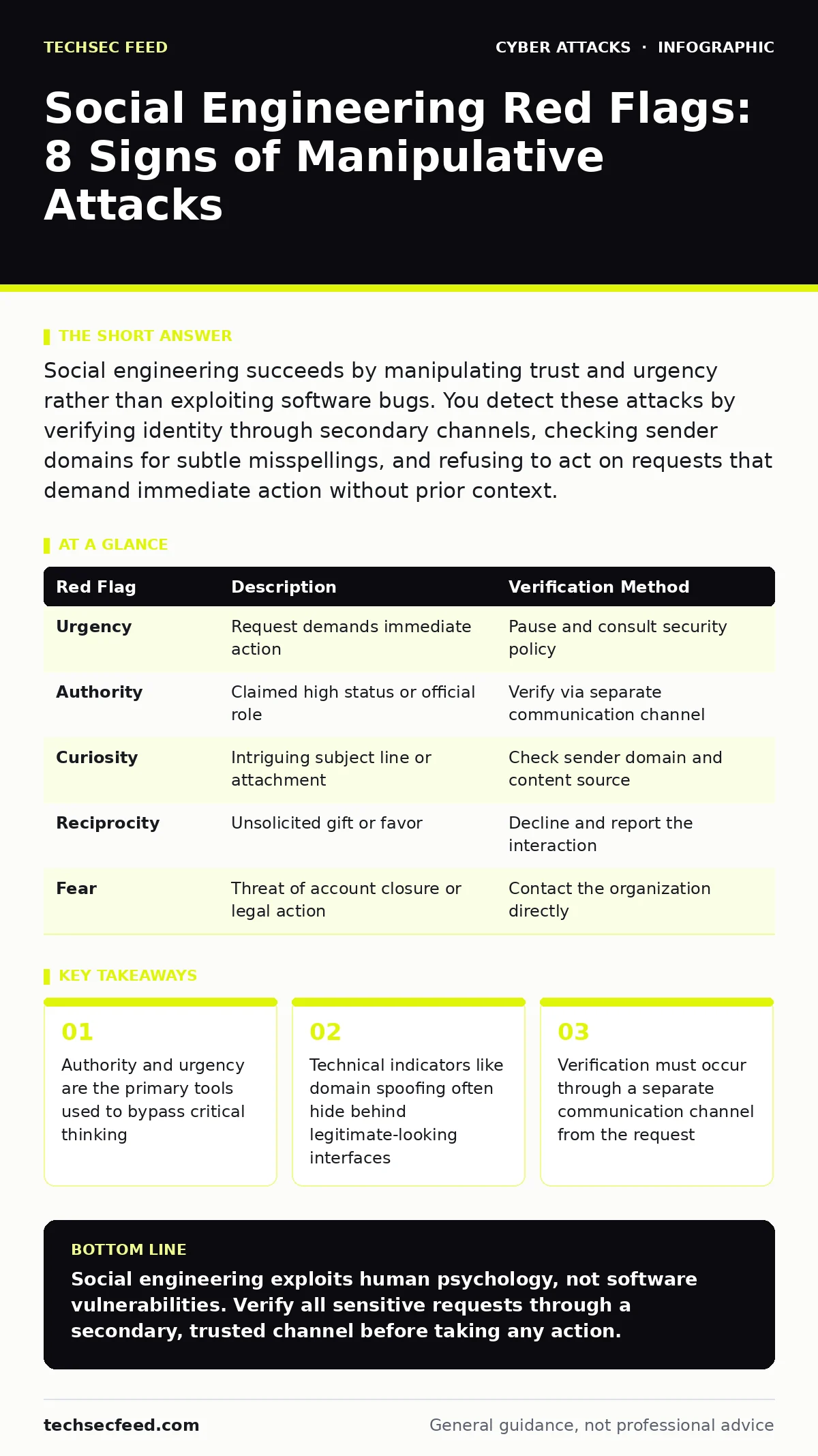
| Red Flag | Description | Verification Method |
|---|---|---|
| Urgency | Request demands immediate action | Pause and consult security policy |
| Authority | Claimed high status or official role | Verify via separate communication channel |
| Curiosity | Intriguing subject line or attachment | Check sender domain and content source |
| Reciprocity | Unsolicited gift or favor | Decline and report the interaction |
| Fear | Threat of account closure or legal action | Contact the organization directly |
How do attackers adapt to increased security awareness?
Attackers continuously refine their tactics to mimic legitimate communications more closely. They use advanced phishing simulations to test their messages against security filters and human responses. This evolution means that static detection methods become less effective over time. You must stay informed about current trends and update your verification processes accordingly. Regularly reviewing and updating your security protocols ensures they remain effective against new techniques. This proactive approach reduces the window of opportunity for attackers.
What is the impact of social engineering on the attack lifecycle?
Social engineering is often the initial step in the attack lifecycle, providing the entry point for further exploitation. Once access is gained, attackers can move laterally within the network, exfiltrate data, or deploy malware. This initial success depends on bypassing human defenses rather than technical ones. Understanding this role helps you prioritize detection and response efforts. You should monitor for unusual activity that may indicate a successful social engineering attempt, such as unauthorized access attempts or data transfers.
How can you build resilience against social engineering?
Resilience is built through continuous education, clear policies, and a culture of verification. Employees should be trained to recognize red flags and understand the psychological tactics used by attackers. Regular phishing simulations help reinforce these lessons and identify areas for improvement. You should encourage a culture where questioning requests is viewed as a security strength, not a hindrance. This mindset shift reduces the likelihood of successful attacks and strengthens your overall security posture.
Key takeaways
- Authority and urgency are the primary tools used to bypass critical thinking
- Technical indicators like domain spoofing often hide behind legitimate-looking interfaces
- Verification must occur through a separate communication channel from the request
- Behavioral baselines help identify anomalies that automated tools miss
Social engineering exploits human psychology, not software vulnerabilities. Verify all sensitive requests through a secondary, trusted channel before taking any action.
Frequently asked questions
How do I report a suspected social engineering attempt?
Report it to your security team immediately using your organization’s established incident reporting process. Include all details, such as the sender’s address, the message content, and any actions you took.
Can social engineering attacks target mobile devices?
Yes, attackers use SMS, phone calls, and mobile apps to target users on mobile devices. The principles of detection and verification remain the same as for desktop environments.
What is the difference between phishing and spear phishing?
Phishing is a broad, untargeted attack, while spear phishing is a targeted attack directed at a specific individual or organization, often using personalized information.
How often should I update my security awareness training?
Regular updates are necessary to address new tactics and reinforce best practices. Many organizations conduct quarterly training sessions and continuous awareness campaigns.
How this guide was produced: written by the TechSec Feed editorial team with AI assistance, checked against the public references listed below, and reviewed when the facts change. See our editorial policy or report an error.