Phishing Simulations: 6 Misunderstandings That Wreck Your Program
Simulations that punish users create blind spots in your security posture and encourage deceptive reporting rather than genuine vigilance.
Phishing simulations fail when they treat security as a compliance checkbox rather than a behavioral feedback loop. Misunderstanding the goal leads to metric manipulation, user distrust, and false confidence. Effective programs focus on reducing click rates through context-aware training, not on catching users off guard with impossible-to-detect tricks.
Misreading: Click rates are the primary success metric
Correct reading: Click rates measure failure, not success. A low click rate can indicate that users are disengaged, that the simulation was too obvious, or that users are simply not looking at the email content. Focusing solely on clicks ignores the critical behavior of reporting suspicious messages. You want users to report, not just ignore. High reporting rates demonstrate that your users are acting as an active layer of defense. If you only track clicks, you miss the users who recognize the threat but do not know how to report it. This creates a blind spot where dangerous emails sit unread in inboxes.
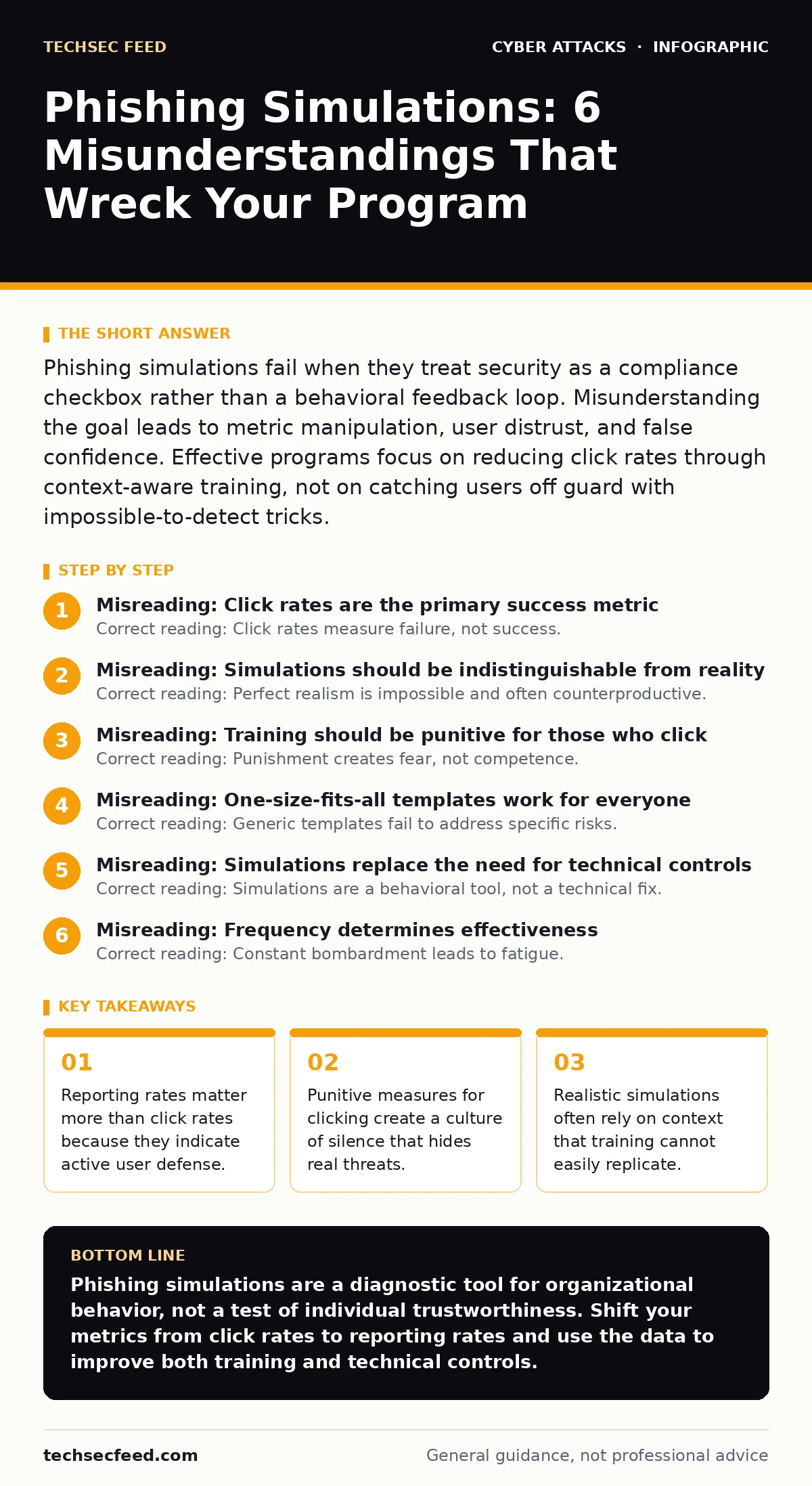
Misreading: Simulations should be indistinguishable from reality
Correct reading: Perfect realism is impossible and often counterproductive. Real attackers exploit specific context, timing, and personal data that simulations cannot ethically or technically replicate. Attempting to create "perfect" fake emails often leads to simulations that are technically flawed or legally risky. Users who cannot distinguish the simulation from a real attack may become desensitized to actual threats. The goal is to teach recognition of common indicators, not to trick users with insider information. Overly complex simulations frustrate users and teach them that security is a game of guesswork rather than pattern recognition.
Misreading: Training should be punitive for those who click
Correct reading: Punishment creates fear, not competence. When users face disciplinary action for clicking a simulated link, they stop reporting suspicious emails to avoid being accused of negligence. This silence is dangerous. It allows real phishing attempts to spread unchecked because users are afraid to admit they did not spot the warning signs. Security is a team effort. Treating users as adversaries rather than partners erodes trust. Constructive feedback that explains why the email was suspicious helps users build mental models for future detection. Positive reinforcement for reporting builds a culture of shared responsibility.
Misreading: One-size-fits-all templates work for everyone
Correct reading: Generic templates fail to address specific risks. Different roles face different threats. Finance staff encounter invoice fraud, while engineers face supply chain attacks. A generic "password reset" simulation does not prepare a developer for a compromised GitHub repository notification.
Tailoring simulations to the specific workflows and tools of each department increases relevance and retention. Users pay more attention to scenarios that mirror their daily tasks. Context-aware training connects abstract security concepts to concrete operational realities. This approach reduces the noise and helps users focus on the signals that actually matter to their work.
Misreading: Simulations replace the need for technical controls
Correct reading: Simulations are a behavioral tool, not a technical fix. No amount of training will stop an attacker who exploits a zero-day vulnerability in your email gateway. Technical controls like SPF, DKim, and DMARC records are necessary to validate sender identity. Simulations assume these controls are in place and focus on the human element that remains. Relying on training alone is a strategic error. You must layer behavioral resilience with automated filtering and encryption. The two approaches complement each other. Technical controls reduce the volume of threats, while training improves the detection rate of what slips through.
See also: What is Formjacking: How Hidden Scripts Steal Payment Data · Password Spraying vs Stuffing: Mechanics, Detection, and Defense
Misreading: Frequency determines effectiveness
Correct reading: Constant bombardment leads to fatigue. Sending simulations too frequently causes users to become cynical or to develop risky habits, such as ignoring all email content. Quality outweighs quantity. A well-designed, infrequent simulation that provides detailed feedback is more effective than daily trivial tests. Users need time to process lessons and adjust their behavior. Rushing through cycles of simulation and training prevents deep learning. Space out your simulations to allow for reflection and improvement. Focus on progressive complexity rather than sheer volume. This respects the user's cognitive load and produces more sustainable security habits.
Misreading: Simulations measure individual competence
Correct reading: Simulations measure organizational resilience, not individual worth. Security failures are rarely the result of a single user error. They are usually the result of systemic weaknesses in processes, tools, and communication. Blaming individuals ignores the broader context.
A user may click a link because the legitimate system they use daily looks identical to the fake one. This is a design problem, not a user problem. Analyze simulation results to identify patterns in how your systems and communications create confusion. Fix the root cause in your infrastructure or branding guidelines. This shifts the focus from blaming people to improving the environment they work in.
Misreading: Success means zero clicks
Correct reading: Zero clicks is an unrealistic and potentially misleading goal. It may indicate that users are not engaging with email content at all, or that the simulation was too easy. A healthy program accepts that some clicks will occur and focuses on reducing the time to detection and reporting. The metric that matters is the reduction in successful attacks, not the elimination of all clicks. Aim for continuous improvement. Track trends over time rather than absolute numbers. This approach acknowledges the evolving nature of threats and the human element of security. It encourages a growth mindset rather than a perfectionist one.
Key takeaways
- Reporting rates matter more than click rates because they indicate active user defense.
- Punitive measures for clicking create a culture of silence that hides real threats.
- Realistic simulations often rely on context that training cannot easily replicate.
Phishing simulations are a diagnostic tool for organizational behavior, not a test of individual trustworthiness. Shift your metrics from click rates to reporting rates and use the data to improve both training and technical controls.
Frequently asked questions
How often should we run phishing simulations?
Run simulations quarterly or bi-annually to avoid fatigue. Focus on quality and relevance rather than frequency. Ensure each simulation is followed by targeted training.
Should we tell users when a simulation is coming?
No, advance notice defeats the purpose of testing genuine reaction. However, you should provide immediate feedback after the simulation to explain the indicators.
What if our click rates are high despite training?
Review your technical controls and email branding. High click rates may indicate that legitimate emails are confusing or that filtering is too weak. Address systemic issues first.
Can simulations help with spear phishing?
Simulations can teach general skepticism, but they cannot replicate the specific context of spear phishing. Focus on training users to verify unexpected requests through secondary channels.
How this guide was produced: written by the TechSec Feed editorial team with AI assistance, checked against the public references listed below, and reviewed when the facts change. See our editorial policy or report an error.