
Password Spraying vs Stuffing: Mechanics, Detection, and Defense
Password spraying avoids account lockout by using common passwords across many accounts, while stuffing relies on breached credential lists to guess unique combinations.
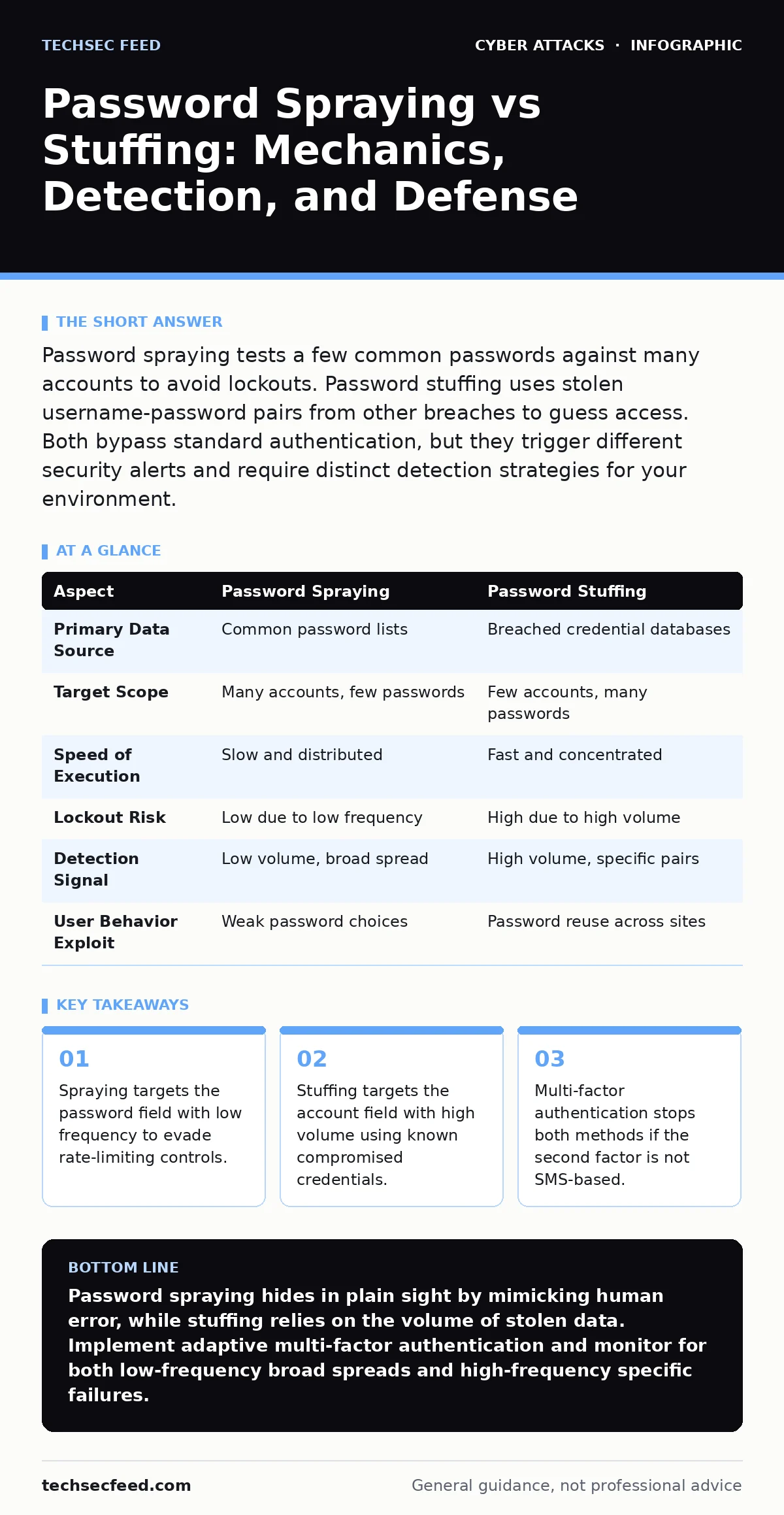
Password spraying tests a few common passwords against many accounts to avoid lockouts. Password stuffing uses stolen username-password pairs from other breaches to guess access. Both bypass standard authentication, but they trigger different security alerts and require distinct detection strategies for your environment.
The core difference between password spraying and stuffing
Password spraying and password stuffing are both automated attacks against identity systems, but they invert the variables of brute force. Password spraying uses a small set of common passwords, such as "Summer2023" or "Welcome1", and attempts them against a large number of user accounts. This approach stays below the threshold that triggers account lockout policies. Password stuffing does the opposite. It uses a large list of usernames and their associated passwords, stolen from previous data breaches on other websites. It attempts these specific pairs against your system. The attacker hopes users reused their credentials.
How password spraying works
Imagine an attacker who knows your organization uses complex password policies. They cannot guess your specific password, but they know people often use the same password everywhere. The attacker selects 10 common passwords. They write a script that tries the first password on 1,000 accounts, waits an hour, then tries the second password on the same 1,000 accounts. This slow pace mimics human behavior. Most intrusion detection systems look for 50 failed logins from one IP address in 5 minutes. Spraying distributes these attempts over hours or days. It also often rotates IP addresses to avoid IP-based bans. The attack succeeds if even one user has a weak password.
How password stuffing works
Password stuffing relies on the human habit of password reuse. Attackers purchase or steal databases from other sites. These databases contain millions of username and password pairs. The attacker filters this list for emails that match your domain. They then feed these pairs into your login portal. If a user used "Password123" on a shopping site and the same on your corporate portal, the attacker gains access. This method is faster than spraying. It generates massive numbers of failed login attempts in a short time. Security systems often flag this as a distributed denial-of-service attack against the authentication service. The volume is the tell.
Comparison of attack mechanics
| Aspect | Password Spraying | Password Stuffing |
|---|---|---|
| Primary Data Source | Common password lists | Breached credential databases |
| Target Scope | Many accounts, few passwords | Few accounts, many passwords |
| Speed of Execution | Slow and distributed | Fast and concentrated |
| Lockout Risk | Low due to low frequency | High due to high volume |
| Detection Signal | Low volume, broad spread | High volume, specific pairs |
| User Behavior Exploit | Weak password choices | Password reuse across sites |
When to expect each attack
Choose the first when you suspect low-and-slow intrusion attempts. Spraying often occurs after an attacker has mapped your active user directory. They may use public sources or previous phishing campaigns to get valid usernames. If you see scattered failed logins from different locations using the same password, suspect spraying. This method is common against cloud services where account lockout policies are strict. It is also common when attackers know your password complexity requirements are high. They do not guess random strings; they guess the exceptions.
Choose the second when you see sudden spikes in authentication traffic. Stuffing attacks are often launched shortly after a major breach is publicized. Attackers rush to use the new data before users change their passwords. If your logs show hundreds of failures for a single account in minutes, it is likely stuffing. This method is less effective if you enforce unique passwords per site. It also fails if you have multi-factor authentication enabled for all users. The attacker needs the second factor, which they do not have.
See also: How the Attack Lifecycle Works: Mapping Stages to Defense Points · Phishing Simulations: 6 Misunderstandings That Wreck Your Program
Where the defenses overlap
Both attacks fail when you remove the password as the primary trust signal. Multi-factor authentication adds a second check that the attacker cannot guess or steal from a breach. If the second factor is a hardware token or an app-based code, both spraying and stuffing stop. SMS-based codes are vulnerable to SIM swapping, a different attack vector. You should also monitor for impossible travel. If a user logs in from London and then from New York five minutes later, block the session. This catches both methods.
Detection and response strategies
Your detection strategy must account for the different signals. For spraying, look for the same password used across many accounts. Set alerts for 3 failed logins with the same password from different users. For stuffing, look for high failure rates per account. Set alerts for 10 failed logins on a single account in 15 minutes. Do not rely solely on IP reputation. Attackers use residential proxies that look like normal users. You must analyze the behavior, not just the source.
Both attacks highlight the risk of password reuse. You cannot stop reuse with policy alone. You must detect it. Use a breach monitoring service to check if your users' credentials appear in known leaks. If a match is found, force a password reset. This removes the data the attacker needs for stuffing. It also reduces the chance that a common password is still in use, mitigating spraying.
Related threats to consider
Identity attacks often combine with other methods. Phishing can harvest credentials directly, making stuffing unnecessary. Social engineering red flags help users identify these attempts before they enter their data. Man-in-the-middle attacks can intercept passwords during login if the connection is not secure. Always verify the certificate chain. Formjacking scripts can steal data from payment forms, adding another layer of risk. Callback phishing may trick users into revealing multi-factor codes. Understanding these vectors helps you build a defense that covers more than just the login page.
Key takeaways
- Spraying targets the password field with low frequency to evade rate-limiting controls.
- Stuffing targets the account field with high volume using known compromised credentials.
- Multi-factor authentication stops both methods if the second factor is not SMS-based.
Password spraying hides in plain sight by mimicking human error, while stuffing relies on the volume of stolen data. Implement adaptive multi-factor authentication and monitor for both low-frequency broad spreads and high-frequency specific failures.
Frequently asked questions
Does multi-factor authentication stop password spraying?
Yes, if the second factor is not SMS. The attacker has the password but cannot generate the dynamic code required for the second step.
How do I distinguish spraying from a normal user forgetting their password?
Normal users forget passwords on their own account. Spraying shows the same wrong password being tried by many different users in a short period.
Can I use CAPTCHA to stop these attacks?
CAPTCHAs slow down automated scripts but do not stop them. Advanced bots can solve CAPTCHAs. They also degrade the user experience for legitimate staff.
Should I lock accounts after 3 failed attempts?
Locking after 3 attempts stops stuffing but aids spraying. Attackers can lock out your staff by guessing wrong passwords. Use progressive delays instead.
How this guide was produced: written by the TechSec Feed editorial team with AI assistance, checked against the public references listed below, and reviewed when the facts change. See our editorial policy or report an error.