
Generative AI Defined: Mechanics, Origins, and Operational Reality
Generative AI constructs new content by predicting statistical patterns, not by understanding meaning or retrieving facts from a database.
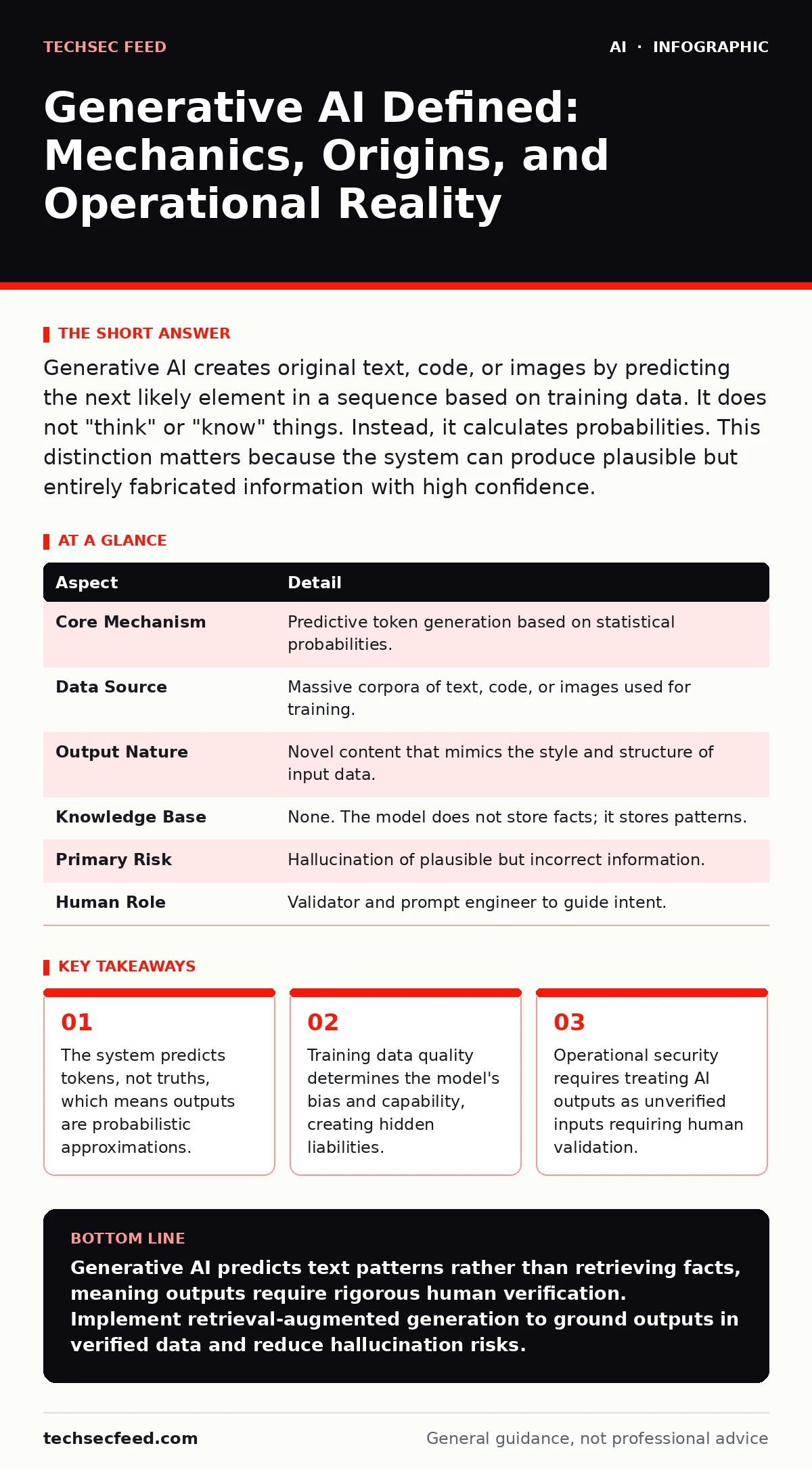
Generative AI creates original text, code, or images by predicting the next likely element in a sequence based on training data. It does not "think" or "know" things. Instead, it calculates probabilities. This distinction matters because the system can produce plausible but entirely fabricated information with high confidence.
The Statistical Engine Behind the Hype
Imagine a typist who has read every book in a library but understands none of them. This typist can continue any sentence with remarkable fluency because they have memorized the statistical likelihood of which word follows which. This is the core mechanism of generative AI. It is not a database retrieval system. It is a pattern-matching engine that predicts the next token, or smallest unit of text, in a sequence.
The term "generative" distinguishes this approach from discriminative AI. Discriminant models classify existing data, such as flagging an email as spam or not. Generative models create new data points that resemble the training set. The output is novel, but the source is derivative. The system does not access a knowledge base to find an answer. It synthesizes an answer based on the weights it learned during training.
This distinction is often overlooked in casual conversation. People assume the model "knows" the capital of France. It does not. It knows that the token "Paris" frequently follows the token sequence "capital of France" in its training corpus. When you ask it a question, it is performing a complex calculation of likelihood, not a lookup.
Where the Term Comes From in Practice
The phrase emerged from the field of machine learning, specifically from generative adversarial networks and variational autoencoders. These early architectures pitted two neural networks against each other. One network generated fake data, while the other tried to distinguish the fake from the real. The competition improved the quality of the generated output.
Modern large language models use a different architecture called transformers. They rely on attention mechanisms to weigh the importance of different words in a sentence. Despite the architectural shift, the term "generative" stuck because the output remains new content. The industry adopted the label to separate these creative models from analytical ones.
This historical context explains why the technology behaves the way it does. The model was designed to maximize the probability of generating text that looks human, not to maximize factual accuracy. The objective function rewards fluency and coherence. It does not reward truth. This is a fundamental design choice, not a bug.
At a Glance: How Generative AI Works
| Aspect | Detail |
|---|---|
| Core Mechanism | Predictive token generation based on statistical probabilities. |
| Data Source | Massive corpora of text, code, or images used for training. |
| Output Nature | Novel content that mimics the style and structure of input data. |
| Knowledge Base | None. The model does not store facts; it stores patterns. |
| Primary Risk | Hallucination of plausible but incorrect information. |
| Human Role | Validator and prompt engineer to guide intent. |
Daily Operational Use Cases
In daily operations, you use this technology to draft communications, summarize documents, or generate code snippets. The value proposition is speed and volume. You can produce a first draft of a policy document in seconds. You can translate technical specifications into plain language instantly.
However, the speed creates a bottleneck in verification. Because the output looks authoritative, reviewers may skip critical checks. This is a dangerous trade-off. The model can introduce subtle errors in logic or compliance that a tired human might miss. You must treat every output as a raw material, not a finished product.
Suppose you ask the system to write a security incident response plan. It will produce a structured document with standard sections. It will look professional. But it may omit specific regulatory requirements relevant to your industry. It may suggest tools that no longer exist. The structure is correct, but the substance may be hollow.
What People Usually Get Wrong
The most persistent misconception is that the model has intent. It does not. It has no beliefs, no desires, and no understanding of the consequences of its output. When it refuses to answer a question, it is not being cautious. It is following safety filters applied during post-training. These filters are separate from the generative mechanism.
Another error is assuming the model is current. The training data has a cutoff. The model does not know about events that happened after its training phase ended. It can simulate knowledge of recent events by predicting likely updates, but these are fabrications. This is why AI hallucinations occur. The model fills gaps in its knowledge with statistically probable text.
People also mistake the model for a search engine. A search engine retrieves existing documents. Generative AI creates new ones. If you need a verified fact, a search engine is the correct tool. If you need a creative variation or a summary, the AI is the correct tool. Confusing the two leads to reliance on unverified data.
See also: Machine Learning for Fraud Detection: How It Works and What It Misses · Large Language Models vs Machine Learning: Core Differences Explained
The Hidden Costs of Adoption
Adopting this technology introduces hidden operational costs. One is the erosion of critical thinking. When you outsource drafting to the model, you may lose the ability to spot logical flaws. The model can reinforce your biases by mirroring the patterns in your prompts. This creates an echo chamber effect.
Another cost is data leakage. When you input sensitive information into a public model, you may be contributing to its training data. This is a significant risk for proprietary information. You must understand the data handling policies of the provider. This is why AI usage policies at work are necessary. They define what data can enter the system and what cannot.
There is also the risk of data poisoning attacks. If an attacker injects malicious patterns into the training data, the model may learn to produce harmful outputs. This is a supply chain risk. The model is only as secure as the data it consumed. You cannot inspect every piece of training data, so you must rely on the provider's vetting processes.
Navigating the Security Landscape
To use this technology safely, you must implement controls. Start with retrieval-augmented generation security. This technique connects the model to a verified knowledge base. The model retrieves facts from the database and then generates the response. This reduces hallucinations by grounding the output in verified data.
You should also consider fine-tuning. This process involves training the model on a specific dataset relevant to your organization. It improves accuracy for your specific use cases. However, it also increases the risk of AI model theft. If the fine-tuned model is stolen, the attacker gains access to your proprietary patterns and data.
Finally, align your usage with the NIST AI Risk Management Framework. This framework provides a structured approach to managing risks. It helps you identify, assess, and mitigate risks associated with AI systems. It is not a checklist, but a process. You must integrate it into your existing security operations.
Responsible AI practices are not optional. They are a requirement for sustainable adoption. You must monitor outputs for bias and toxicity. You must audit the system regularly. You must train your staff to recognize the limitations of the technology. This is not a one-time effort. It is an ongoing discipline.
The Path Forward
Generative AI is a powerful tool, but it is not a magic solution. It amplifies human capability, but it also amplifies human error. You must understand its mechanics to use it effectively. You must recognize its limits to use it safely.
The technology will continue to evolve. The models will become larger and more capable. The risks will become more sophisticated. Your defenses must adapt accordingly. Stay informed. Stay skeptical. Stay secure.
Key takeaways
- The system predicts tokens, not truths, which means outputs are probabilistic approximations.
- Training data quality determines the model's bias and capability, creating hidden liabilities.
- Operational security requires treating AI outputs as unverified inputs requiring human validation.
Generative AI predicts text patterns rather than retrieving facts, meaning outputs require rigorous human verification. Implement retrieval-augmented generation to ground outputs in verified data and reduce hallucination risks.
Frequently asked questions
Does generative AI store my personal data?
It depends on the provider's policy. Public models may use input data for training. Enterprise models often offer data privacy guarantees. Check the terms of service.
Can I use generative AI for sensitive documents?
Only if you use a private, on-premises model or a provider with strict data isolation. Never input classified or proprietary data into public models without explicit clearance.
How do I prevent AI hallucinations?
Use retrieval-augmented generation to ground the model in verified data. Prompt the model to cite sources. Always verify critical facts with independent sources.
Is generative AI secure by default?
No. Security must be engineered into the system. You must implement access controls, data encryption, and output monitoring. The model itself does not protect your data.
How this guide was produced: written by the TechSec Feed editorial team with AI assistance, checked against the public references listed below, and reviewed when the facts change. See our editorial policy or report an error.