
Retrieval-Augmented Generation Security for Small Teams
Most retrieval-augmented generation failures stem from weak source controls rather than model vulnerabilities, shifting the security burden to data governance.
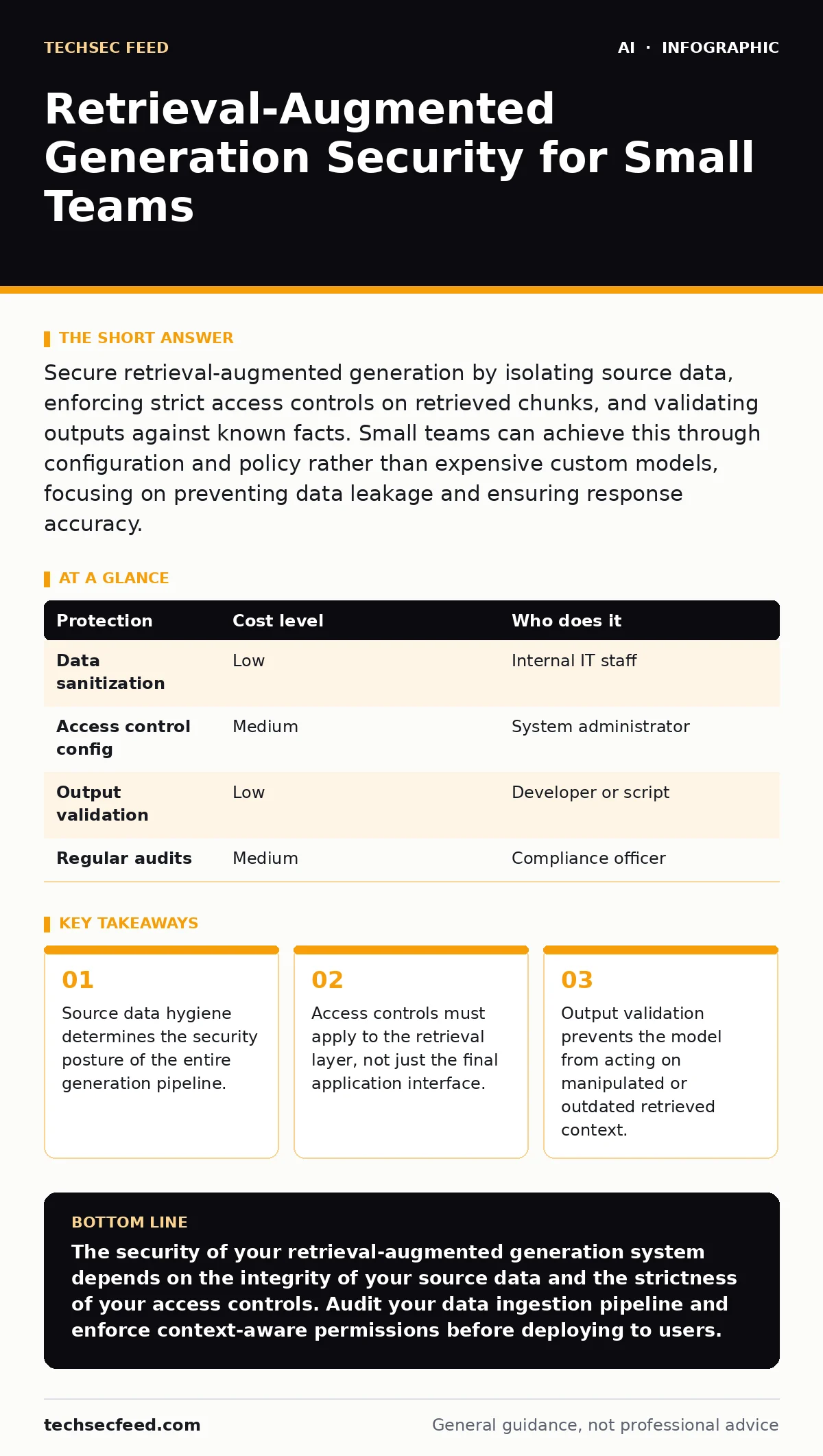
Secure retrieval-augmented generation by isolating source data, enforcing strict access controls on retrieved chunks, and validating outputs against known facts. Small teams can achieve this through configuration and policy rather than expensive custom models, focusing on preventing data leakage and ensuring response accuracy.
The Hidden Attack Surface in Small Deployments
Retrieval-augmented generation, or RAG, allows language models to answer questions using external documents rather than relying solely on their training data. This approach reduces hallucinations, which are fabricated details presented as facts. However, it introduces a new attack surface. The model does not generate answers from memory; it generates answers from what you feed it at runtime. If an attacker can influence what is retrieved, they influence what is generated.
For small organizations, the assumption is often that the model itself is the security boundary. This is incorrect. The model is merely an engine. The fuel is your data. If your retrieval system pulls from unsecured sources, the model will faithfully present that insecure data as authoritative truth. The security risk shifts from the AI vendor to your internal data management practices.
You must treat the retrieval index as a high-value asset. It contains the raw material for every response. Compromise here is total. There is no "partial" breach in RAG. If the index is poisoned or accessed by unauthorized users, the output is compromised.
Isolate the Source Data Layer
The first line of defense is separating the data used for retrieval from the general network. You should not connect the RAG system to live production databases or open shared drives. Instead, create a static copy of the necessary documents. This snapshot approach limits the blast radius. If the RAG system is compromised, the attacker accesses only the snapshot, not the live system.
This isolation also simplifies auditing. You can review the contents of the snapshot periodically. You can remove sensitive information before indexing. This process, known as data sanitization, ensures that personally identifiable information or trade secrets are not available for retrieval.
Consider the format of the data. Unstructured text files are easier to index but harder to control. Structured data requires more preparation but offers better access control granularity. Choose the format that allows you to define who can see what. If you cannot define access at the document level, do not index that document.
Enforce Context-Aware Access Controls
Traditional access control checks if a user has permission to view a document. RAG requires a different check. It must verify if the user has permission to have the model use that document to answer a specific question. This is context-aware access control.
Suppose a junior employee asks a question about a project they are not assigned to. The retrieval system finds the relevant document. Without context-aware controls, the model retrieves it and answers the question. The employee learns information they should not have. With proper controls, the system checks the user’s permissions against the document’s metadata before retrieval. If the user lacks access, the document is excluded from the search results.
This mechanism adds latency. Every query must pass through an authorization check before the vector search occurs. For small teams, this trade-off is necessary. Speed is less important than preventing unauthorized data exposure. You can optimize performance by caching authorization decisions for frequent queries, but never bypass the check.
Validate Outputs Against Known Facts
Even with secure retrieval, the model can misinterpret the context. It might combine two unrelated facts to create a false conclusion. This is a form of hallucination driven by external data. You cannot trust the model to self-correct. It lacks the ability to verify truth.
You need a validation layer. This layer compares the model’s output against the retrieved source material. If the output claims a fact that is not present in the retrieved chunks, the system flags it. This does not require a second AI model. Simple string matching and keyword verification can catch many errors.
For critical information, such as legal or financial advice, require citations. The system must link every claim in the response to a specific sentence in the source document. This allows a human reviewer to verify the accuracy quickly. It also discourages the model from fabricating sources, as it cannot generate valid citations for non-existent data.
Manage the Cost of Security
Security in RAG is not about buying expensive tools. It is about configuration and discipline. The costs are primarily operational. You need time to sanitize data, configure access controls, and monitor logs.
| Protection | Cost level | Who does it |
|---|---|---|
| Data sanitization | Low | Internal IT staff |
| Access control config | Medium | System administrator |
| Output validation | Low | Developer or script |
| Regular audits | Medium | Compliance officer |
Small businesses can delegate the monitoring aspect. You do not need to watch logs twenty-four hours a day. You can use automated alerting for anomalies, such as a sudden spike in retrieval requests or access from unusual locations. This reduces the operational burden while maintaining visibility.
Avoid complex custom models. They introduce additional vulnerabilities and require specialized expertise. Stick to established frameworks and standard protocols. The complexity of the model does not correlate with the security of the data. A simple, well-configured system is safer than a complex, poorly managed one.
Questions for Your IT Provider
When engaging a provider to set up or manage your RAG system, ask specific questions. General assurances are not enough. You need to know how they handle data at each stage.
- How is the retrieval index isolated from other client data?
- What mechanisms are in place to prevent prompt injection attacks?
- How do you handle updates to source documents in the index?
- Can you provide logs of all retrieval queries for audit purposes?
- What is the process for removing data from the index upon request?
- How do you validate that the output matches the retrieved source?
- What happens if the access control service fails?
These questions reveal the provider’s maturity. If they cannot answer them clearly, they may not understand the specific risks of RAG. Do not rely on their general AI security claims. Look for evidence of implementation.
Preventing Data Poisoning
Data poisoning occurs when an attacker inserts malicious content into the source data. The model retrieves this content and uses it to generate harmful responses. This is particularly dangerous in RAG because the model trusts the retrieved data implicitly.
You must control who can add or modify source documents. Limit write access to trusted administrators. Use version control for all documents. This allows you to track changes and revert to a clean state if necessary.
Regularly scan source documents for anomalies. Look for unexpected keywords, hidden text, or unusual formatting. These may indicate an attempt to manipulate the model’s behavior. Integrate this scanning into your data ingestion pipeline. Do not index documents until they pass the scan.
This practice aligns with responsible AI practices. It ensures that the system behaves as intended and does not amplify malicious content. It also protects your organization from liability. If a poisoned document causes harm, you are responsible for the data you chose to index.
The Limits of Automation
No amount of automation can replace human oversight. You must regularly review the system’s performance. Check for drift, where the system’s behavior changes over time due to new data or model updates.
Conduct periodic reviews of the access logs. Look for patterns that suggest unauthorized access or misuse. Even if no breach occurs, unusual activity may indicate a configuration error.
Remember that security is a process, not a product. It requires continuous attention. Small teams can achieve high security levels by focusing on the fundamentals: clean data, strict access, and verified outputs. Do not be distracted by complex features that offer marginal benefits.
Key takeaways
- Source data hygiene determines the security posture of the entire generation pipeline.
- Access controls must apply to the retrieval layer, not just the final application interface.
- Output validation prevents the model from acting on manipulated or outdated retrieved context.
The security of your retrieval-augmented generation system depends on the integrity of your source data and the strictness of your access controls. Audit your data ingestion pipeline and enforce context-aware permissions before deploying to users.
Frequently asked questions
Does using a private cloud solve RAG security issues?
No, a private cloud only limits external access. Internal threats and misconfigurations still allow unauthorized data retrieval and generation.
Can I use open-source models to avoid vendor risks?
Open-source models reduce vendor dependency but do not eliminate RAG-specific risks. You still must secure the retrieval layer and validate outputs.
How often should I update the retrieval index?
Update the index only when necessary. Frequent updates increase the risk of introducing unvetted data. Batch updates allow for better review.
What is prompt injection in RAG?
Prompt injection is an attack where malicious input manipulates the model’s instructions. In RAG, this can occur if retrieved data contains hidden commands that override the system prompt.
How this guide was produced: written by the TechSec Feed editorial team with AI assistance, checked against the public references listed below, and reviewed when the facts change. See our editorial policy or report an error.