
Large Language Models vs Machine Learning: Core Differences Explained
Large language models are a narrow subset of machine learning that predict text tokens, whereas machine learning covers a broader range of predictive and classification tasks across all data types.
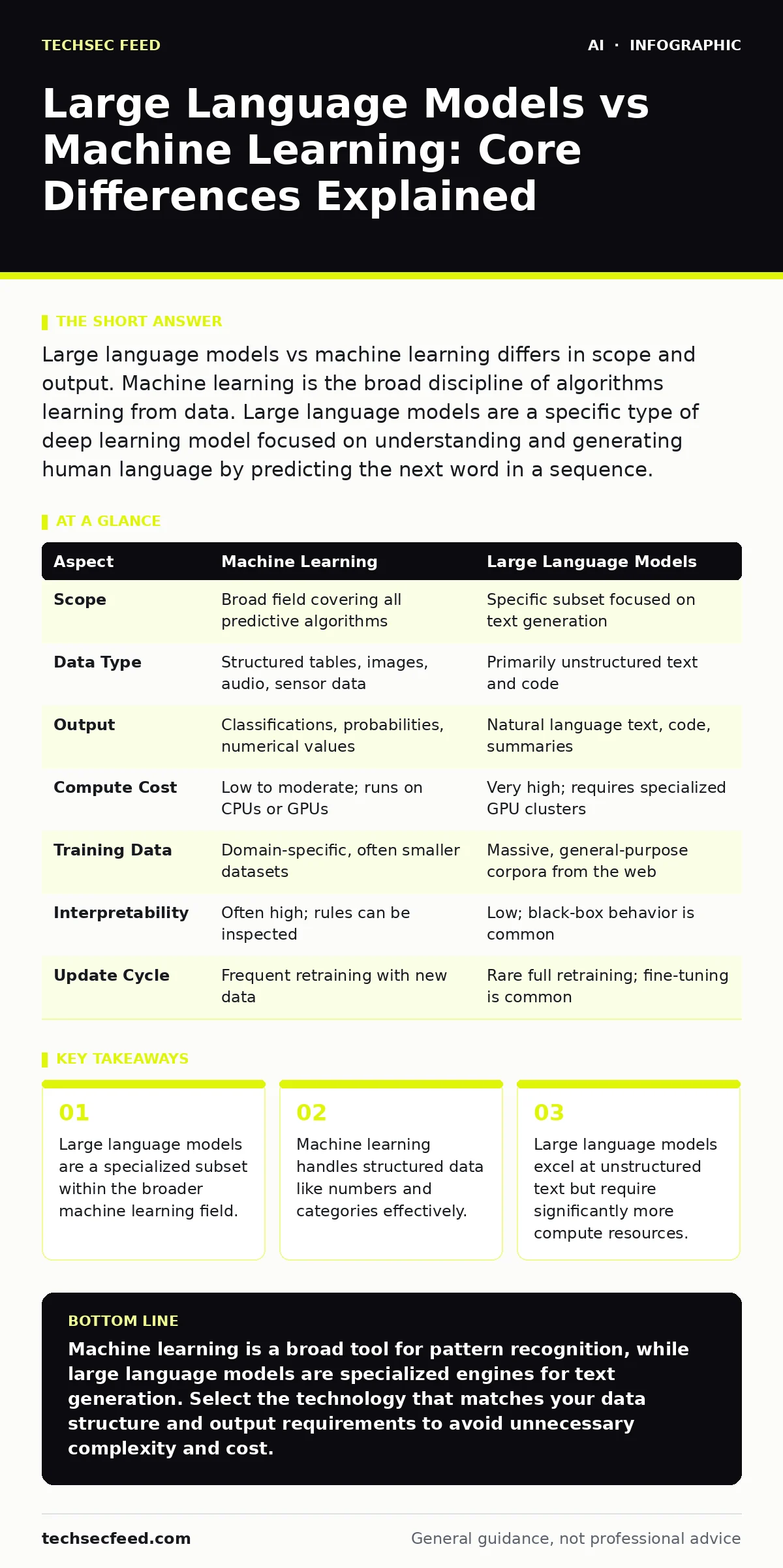
Large language models vs machine learning differs in scope and output. Machine learning is the broad discipline of algorithms learning from data. Large language models are a specific type of deep learning model focused on understanding and generating human language by predicting the next word in a sequence.
Defining the Difference in One Paragraph
Large language models vs machine learning is a question of specificity versus generality. Machine learning is the overarching field where computers use algorithms to identify patterns in data and make predictions without explicit programming for every rule. Large language models are a specific architecture within deep learning, a subfield of machine learning. These models are trained on massive corpora of text to predict the next token in a sequence.
They do not "know" facts in the human sense; they calculate probabilities of word combinations. Understanding this distinction prevents misapplying tools. You do not use a text-prediction engine to detect credit card fraud, nor do you use a simple classifier to write code. The difference lies in the input data structure and the nature of the output.
What Is Machine Learning?
Machine learning involves training models on historical data to recognize patterns. The system adjusts its internal parameters to minimize error rates. This field includes supervised learning, where the model learns from labeled examples, and unsupervised learning, where it finds hidden structures in unlabeled data. Common applications include image recognition, recommendation engines, and anomaly detection.
The goal is usually a binary decision, a classification label, or a numerical prediction. Machine learning models are often lightweight compared to modern AI systems. They run on standard hardware and can be updated with small datasets. This makes them suitable for environments with strict latency requirements. The model learns the relationship between input features and the desired output.
What Is a Large Language Model?
A large language model is a neural network with billions of parameters. It uses a transformer architecture to process sequences of text. The model ingests vast amounts of written information during pre-training. It learns the statistical relationships between words, phrases, and concepts. The primary task is next-token prediction. This mechanism allows it to generate coherent text, translate languages, and summarize documents.
Unlike traditional machine learning, which often relies on structured data, these models thrive on unstructured text. They capture semantic meaning and context over long distances in a document. However, they are computationally expensive. Training and inference require significant processing power. The model does not retrieve facts from a database; it generates them based on probability.
Comparison Table
| Aspect | Machine Learning | Large Language Models |
|---|---|---|
| Scope | Broad field covering all predictive algorithms | Specific subset focused on text generation |
| Data Type | Structured tables, images, audio, sensor data | Primarily unstructured text and code |
| Output | Classifications, probabilities, numerical values | Natural language text, code, summaries |
| Compute Cost | Low to moderate; runs on CPUs or GPUs | Very high; requires specialized GPU clusters |
| Training Data | Domain-specific, often smaller datasets | Massive, general-purpose corpora from the web |
| Interpretability | Often high; rules can be inspected | Low; black-box behavior is common |
| Update Cycle | Frequent retraining with new data | Rare full retraining; fine-tuning is common |
When to Choose Machine Learning
Choose traditional machine learning when your data is structured and the goal is precise classification or regression. Imagine you need to flag suspicious transactions in a banking system. A decision tree or a support vector machine can process numerical features efficiently. These models provide clear reasons for their decisions. You can inspect the feature importance.
This transparency is valuable for compliance and debugging. The models are also faster to train and deploy. They consume fewer resources. If you need real-time decisions on low-power devices, traditional algorithms are superior. They do not suffer from the hallucination risks inherent in generative models. You get a definitive yes or no, or a specific number.
See also: Machine Learning for Fraud Detection: How It Works and What It Misses · Generative AI Defined: Mechanics, Origins, and Operational Reality
When to Choose Large Language Models
Choose large language models when the task requires natural language understanding or generation. Suppose you need to summarize thousands of customer support tickets. A classifier can tag them as positive or negative, but it cannot write a summary. A large language model can read the context and produce a coherent paragraph. These models are also useful for code generation and complex query answering.
They handle ambiguity well. If your users ask questions in casual language, these models can parse intent better than rigid keyword search. However, you must manage the risk of incorrect information. Implement safeguards to verify critical outputs. These models are not suitable for tasks requiring exact factual recall without external verification.
Overlap and Hybrid Approaches
The line between these technologies blurs in hybrid systems. Retrieval-augmented generation security combines search with language models. The system retrieves factual documents and feeds them to the model for summarization. This reduces fabrication risks. You can also use machine learning to route queries. A classifier determines if a question is simple or complex.
Simple questions go to a rule-based system. Complex questions go to the large language model. This saves compute costs. You must also consider data poisoning attacks. Adversaries can inject bad data into training sets. Monitoring for training data leakage is critical in hybrid systems. Responsible AI practices help maintain trust in these combined workflows.
Implementation Considerations
Deploying these systems requires careful planning. Access controls for AI agents must be strict. The model should only access data it is permitted to see. AI usage policies at work should define acceptable use cases. Users might try to bypass restrictions. You must monitor for prompt injection attempts. These attacks trick the model into ignoring its instructions. Regular audits of model behavior are necessary. Check for bias in outputs. Ensure the system handles edge cases gracefully. Do not assume the model understands context perfectly. It predicts tokens based on patterns. Always validate critical decisions with human oversight or additional automated checks.
Key takeaways
- Large language models are a specialized subset within the broader machine learning field.
- Machine learning handles structured data like numbers and categories effectively.
- Large language models excel at unstructured text but require significantly more compute resources.
Machine learning is a broad tool for pattern recognition, while large language models are specialized engines for text generation. Select the technology that matches your data structure and output requirements to avoid unnecessary complexity and cost.
Frequently asked questions
Can machine learning models generate text?
Yes, some machine learning models like recurrent neural networks can generate text, but they are not as advanced or context-aware as modern large language models.
Do large language models require more data?
Yes, large language models typically require significantly more training data and computational resources than traditional machine learning models.
Is large language model technology a form of machine learning?
Yes, large language models are a specific type of deep learning model, which is a subfield of machine learning.
How do I prevent AI hallucinations in production?
Implement retrieval-augmented generation to ground responses in verified documents and use output validation layers to check for factual consistency.
How this guide was produced: written by the TechSec Feed editorial team with AI assistance, checked against the public references listed below, and reviewed when the facts change. See our editorial policy or report an error.