
What Is Data Leakage in Machine Learning: The Hidden Risk
Models memorize sensitive training data, creating a backdoor that exposes private information without any external hack.
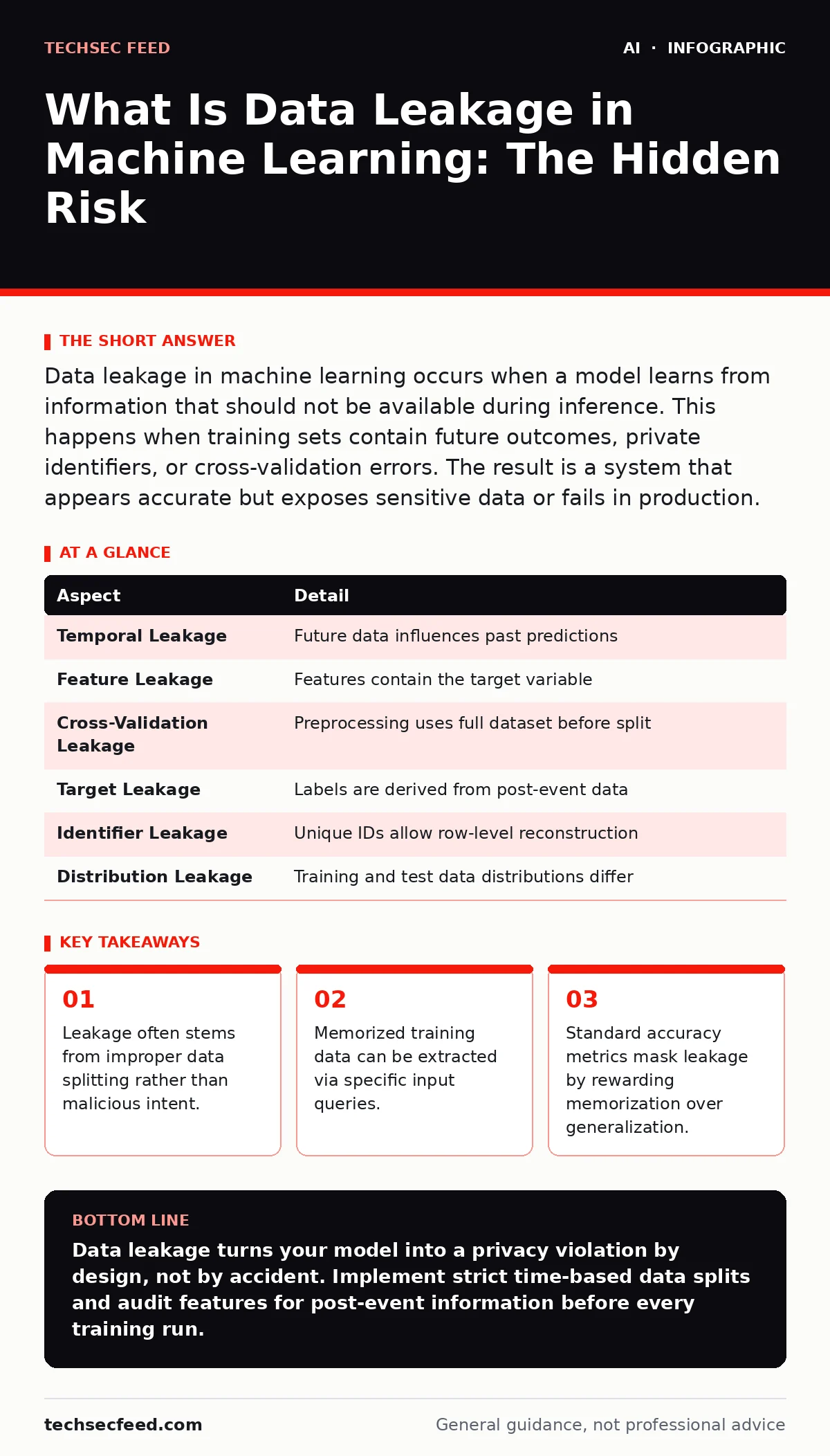
Data leakage in machine learning occurs when a model learns from information that should not be available during inference. This happens when training sets contain future outcomes, private identifiers, or cross-validation errors. The result is a system that appears accurate but exposes sensitive data or fails in production.
What Is Data Leakage in Machine Learning
Data leakage in machine learning is the unintentional inclusion of information in the training process that would not be available during real-world prediction. It creates a model that achieves high accuracy on test sets but fails to generalize to new, unseen data. The model effectively memorizes the answer key instead of learning the underlying patterns. This failure mode is distinct from a security breach where an attacker steals data. Instead, the system itself becomes a vector for exposure.
The mechanism relies on the statistical nature of training algorithms. Models minimize error by adjusting internal weights. When the training data contains labels derived from the future or features that uniquely identify individuals, the model latches onto these shortcuts. It treats correlation as causation. A model predicting credit risk might learn that a specific internal transaction ID always correlates with default. It does not learn financial behavior. It learns to recognize the ID. This creates a fragile system that collapses when deployed.
How Leakage Mechanisms Operate
Leakage enters the pipeline through three primary channels. The first is temporal leakage. This occurs when data from the future influences predictions about the past. Imagine a model trained to predict stock prices using data that includes closing prices from the same day. The model simply repeats the known value. It achieves near-perfect accuracy in training but offers no predictive power in live trading.
The second channel is feature leakage. This happens when a feature contains the target variable or a direct derivative of it. A healthcare model might use a patient's diagnosis code as a feature to predict the diagnosis. The code is essentially the answer. The model learns to copy the input rather than analyze symptoms. This is a structural error in the data schema, not a coding bug.
The third channel is cross-validation leakage. This occurs when data preprocessing steps, such as normalization or imputation, are applied to the entire dataset before splitting it into training and testing sets. Information from the test set leaks into the training process. The model sees the distribution of the test data before it is evaluated. This inflates performance metrics and hides the true error rate.
| Aspect | Detail |
|---|---|
| Temporal Leakage | Future data influences past predictions |
| Feature Leakage | Features contain the target variable |
| Cross-Validation Leakage | Preprocessing uses full dataset before split |
| Target Leakage | Labels are derived from post-event data |
| Identifier Leakage | Unique IDs allow row-level reconstruction |
| Distribution Leakage | Training and test data distributions differ |
Who It Affects and Why
This issue affects any organization using supervised learning. Financial institutions see leakage in fraud detection systems that use transaction flags generated after the fact. Healthcare providers encounter it in diagnostic tools that use lab results not available at the time of admission. Retailers face it in demand forecasting models that use sales data from the period being predicted.
The impact extends beyond poor performance. A model that memorizes training data can reveal sensitive information. If a model learns to predict a rare disease based on a unique combination of features, an attacker can query the model to confirm if a specific individual was in the training set. This is a form of membership inference. It violates privacy expectations. The model acts as an untrusted insider, revealing data it should only use internally.
What People Usually Get Wrong
Security teams often assume leakage is a malicious attack. They focus on defending against data poisoning attacks. They implement strict input validation and monitor for anomalies. This misses the point. Leakage is usually a result of sloppy data engineering. It is a process failure, not an adversary action. Treating it as a security incident leads to wasted effort on perimeter defenses while the root cause remains in the data pipeline.
Another common error is trusting high accuracy scores. It often indicates overfitting or leakage. Teams celebrate the high score and deploy the model. They fail to perform a sanity check on the features. They do not ask if the model could achieve the same accuracy with fewer features. If removing a single column drops accuracy significantly, that column likely contains leaked information.
Detection and Prevention Strategies
Prevention requires a rigorous data lifecycle. Start by defining the prediction time. Every feature must be available at the moment the prediction is made. If a feature is generated after the event, it is invalid. Document this constraint for every model. Enforce it through automated checks in the data pipeline. Reject any dataset that contains post-event features.
Use strict train-test splits. Split data by time, not randomly. Random splits allow future data to leak into the training set if the data is not sorted correctly. Time-based splits ensure the model learns from the past and predicts the future. This mimics real-world conditions. It also prevents cross-validation leakage. Preprocessing steps must be fitted on the training set only and then applied to the test set.
Monitor for memorization. Large models, such as large language models, are prone to memorizing exact phrases from their training data. This is a form of training data leakage. Implement output filters that detect and block the reproduction of sensitive information. Use differential privacy techniques during training. These methods add noise to the gradients, making it harder for the model to memorize individual records. This reduces the risk of membership inference attacks.
See also: Large Language Models vs Machine Learning: Core Differences Explained · Generative AI Defined: Mechanics, Origins, and Operational Reality
The Role of Data Quality
Data quality is the primary defense against leakage. Poor quality data often contains hidden identifiers or derived fields that cause leakage. Clean data reduces the surface area for error. Remove unique identifiers before training. Aggregate data where possible. Use synthetic data for testing. This ensures the model learns general patterns rather than specific instances.
Collaboration between data scientists and security teams is necessary. Data scientists understand the model requirements. Security teams understand the risk implications. They must work together to define what constitutes sensitive data. They must agree on the acceptable level of accuracy versus privacy. This balance is critical. A highly accurate model that leaks data is a liability. A private model that is useless is a waste of resources.
Integrating Security into the ML Lifecycle
Security must be integrated into every stage of the machine learning lifecycle. From data collection to model deployment, each step introduces potential leakage vectors. Implement automated checks for data drift and feature validity. Use tools that validate the schema and timing of data. Integrate these checks into the continuous integration pipeline. Block deployments that fail validation.
Treat AI models as untrusted insiders. They have access to sensitive data and can reveal it. Apply the same access controls to models as you do to databases. Monitor model queries for suspicious patterns. Limit the frequency of queries. Rate limit access to prevent enumeration attacks. This reduces the risk of data extraction.
Responsible AI practices include transparency and accountability. Document the data sources and preprocessing steps. Explain how the model makes decisions. This documentation helps identify potential leakage sources. It also provides an audit trail for regulatory compliance. Privacy-enhancing technologies, such as federated learning, can reduce the risk of leakage by keeping data local. These techniques allow models to learn from distributed data without centralizing it.
Conclusion of Risks and Mitigations
The risk of data leakage is persistent. It evolves with the complexity of models and data sources. As models become more powerful, their ability to memorize and reveal data increases. The defense must evolve accordingly. Focus on data quality, strict splitting, and continuous monitoring. Do not rely on accuracy metrics alone. Understand the mechanisms of leakage. Apply preventive measures at every stage. This approach ensures robust and secure machine learning systems.
Key takeaways
- Leakage often stems from improper data splitting rather than malicious intent.
- Memorized training data can be extracted via specific input queries.
- Standard accuracy metrics mask leakage by rewarding memorization over generalization.
Data leakage turns your model into a privacy violation by design, not by accident. Implement strict time-based data splits and audit features for post-event information before every training run.
Frequently asked questions
How do I know if my model has data leakage?
Check if removing a specific feature drastically reduces accuracy. If a feature contains the answer or a direct derivative, the model likely relies on it. Also, compare training and validation accuracy. A large gap suggests overfitting or leakage.
Can encryption prevent data leakage in machine learning?
No. Encryption protects data storage and transmission. It does not prevent the model from learning correlations within the decrypted training data. Leakage is a structural issue in the data pipeline, not a cryptographic failure.
What is the difference between data leakage and data poisoning?
Data leakage is unintentional and stems from poor data engineering. Data poisoning is a malicious attack where an adversary injects bad data to manipulate the model. Leakage creates privacy risks; poisoning creates integrity risks.
Does using synthetic data eliminate leakage risks?
Synthetic data reduces the risk of exposing real private information. However, if the synthetic data generation process is flawed, it can introduce new biases or leakage patterns. Validate synthetic data against real-world constraints.
How this guide was produced: written by the TechSec Feed editorial team with AI assistance, checked against the public references listed below, and reviewed when the facts change. See our editorial policy or report an error.