
Data Poisoning Attacks: How Malicious Inputs Corrupt AI Models
Data poisoning alters model behavior by injecting subtle errors during training, creating backdoors that evade standard validation checks and persist until the model is retrained from scratch.
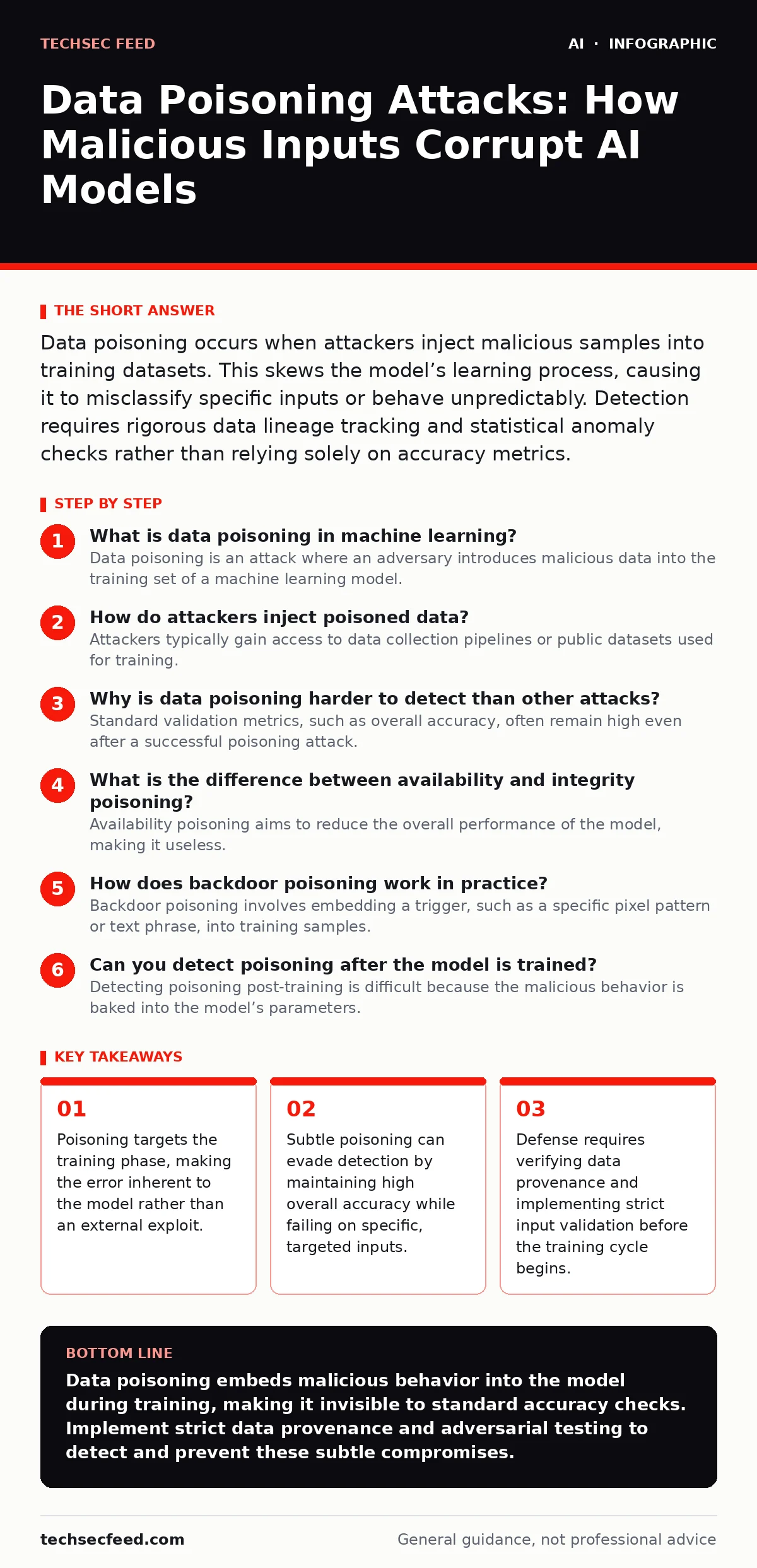
Data poisoning occurs when attackers inject malicious samples into training datasets. This skews the model’s learning process, causing it to misclassify specific inputs or behave unpredictably. Detection requires rigorous data lineage tracking and statistical anomaly checks rather than relying solely on accuracy metrics.
What is data poisoning in machine learning?
Data poisoning is an attack where an adversary introduces malicious data into the training set of a machine learning model. The goal is to corrupt the model’s learning process so it produces incorrect outputs for specific inputs. This differs from evasion attacks, which manipulate inputs at inference time, because poisoning embeds the flaw directly into the model’s weights.
The attack succeeds because models learn patterns from their data without understanding context or intent. If the training data contains a consistent lie, the model learns that lie as truth. This makes the resulting behavior indistinguishable from normal operation for most inputs, hiding the vulnerability until it is triggered.
How do attackers inject poisoned data?
Attackers typically gain access to data collection pipelines or public datasets used for training. They insert samples that look legitimate but contain subtle malicious signals, such as a specific image pattern paired with the wrong label. These samples are designed to blend in with the distribution of clean data to avoid triggering basic filters.
Suppose a security model is trained to detect spam emails. An attacker might add thousands of benign emails that contain a rare, unique string of characters labeled as "safe." The model learns to associate that specific string with safety. Later, the attacker can send phishing emails containing that string, bypassing the filter entirely.
Why is data poisoning harder to detect than other attacks?
Standard validation metrics, such as overall accuracy, often remain high even after a successful poisoning attack. The model performs well on the majority of the test set because the poison targets only a small, specific subset of inputs.
Detection requires looking for localized anomalies rather than global performance drops. You must analyze how the model behaves on edge cases or inputs that differ slightly from the norm. This demands more sophisticated testing than standard regression tests provide.
What is the difference between availability and integrity poisoning?
Availability poisoning aims to reduce the overall performance of the model, making it useless. Integrity poisoning aims to preserve overall performance while introducing specific, malicious behaviors. The latter is more dangerous because it creates a targeted backdoor that remains hidden during routine evaluation.
Integrity attacks are subtle. They require the attacker to understand the model’s architecture and loss function to craft inputs that minimize the impact on general accuracy while maximizing the effect on the target class. This precision makes integrity poisoning a significant threat to high-value models.
How does backdoor poisoning work in practice?
Backdoor poisoning involves embedding a trigger, such as a specific pixel pattern or text phrase, into training samples. The model learns to associate this trigger with a specific output, regardless of the true content. When the trigger appears in inference data, the model overrides its normal logic and produces the attacker’s chosen result.
Imagine a facial recognition system trained on photos that contain a small, invisible sticker. The model learns that any face with that sticker belongs to a specific individual. An attacker can then place that sticker on a photo of themselves to impersonate another person. The rest of the system functions normally, masking the compromise.
| Poisoning Type | Goal | Detection Difficulty | Primary Impact |
|---|---|---|---|
| Label Flipping | Corrupt class boundaries | Low to Moderate | General accuracy drop |
| Backdoor | Create specific trigger response | High | Targeted misclassification |
| Availability | Degrade overall utility | Low | System unusability |
Can you detect poisoning after the model is trained?
Detecting poisoning post-training is difficult because the malicious behavior is baked into the model’s parameters. Standard testing with clean data will not reveal the backdoor. You must test with adversarial examples or triggers that resemble the poisoning pattern to uncover the vulnerability.
One method is to analyze the model’s confidence scores on slightly perturbed inputs. A poisoned model may show unusually high confidence for inputs containing the trigger, even if the trigger is subtle. Another approach is to compare the model’s decisions against a baseline or ensemble of models trained on different data subsets. Discrepancies can indicate compromised training data.
How do you prevent data poisoning before training?
Prevention starts with strict data provenance and validation. You must verify the source of every data sample and ensure it has not been tampered with. Implementing cryptographic signatures for data files can help ensure integrity from collection to ingestion.
Filtering techniques can also help. Remove outliers and samples that deviate significantly from the expected distribution. However, sophisticated attacks mimic the distribution closely, so statistical filters alone are insufficient. You need a combination of source verification, statistical analysis, and human review for critical datasets.
What is the role of federated learning in poisoning risks?
Federated learning allows models to be trained across decentralized devices without sharing raw data. This reduces the risk of data leakage but introduces new poisoning vectors. Malicious clients can upload corrupted updates to the global model, skewing the aggregated parameters.
Defending against this requires robust aggregation rules. Techniques like median-based aggregation or clipping updates can limit the impact of malicious contributions. You must also monitor for clients that consistently submit updates that diverge from the consensus. This adds complexity to the coordination process but enhances security.
How does this relate to responsible AI practices?
Data poisoning highlights the fragility of AI systems when trust is placed solely in automated learning. Responsible AI practices demand transparency in data sourcing and model behavior. You must document the data lineage and the validation steps taken to ensure integrity.
This connects to broader efforts in generative AI security and NIST AI Risk Management Framework compliance. Ensuring data quality is not just a technical requirement but a governance one. You need policies that define who can contribute to training data and how those contributions are verified. Without these controls, the model remains vulnerable to manipulation.
Key takeaways
- Poisoning targets the training phase, making the error inherent to the model rather than an external exploit.
- Subtle poisoning can evade detection by maintaining high overall accuracy while failing on specific, targeted inputs.
- Defense requires verifying data provenance and implementing strict input validation before the training cycle begins.
Data poisoning embeds malicious behavior into the model during training, making it invisible to standard accuracy checks. Implement strict data provenance and adversarial testing to detect and prevent these subtle compromises.
Frequently asked questions
Can data poisoning affect large language models?
Yes, LLMs are vulnerable to poisoning through the training corpus. Injecting false information or biased patterns can alter the model’s responses to specific prompts or topics.
Is data poisoning the same as AI hallucinations?
No, hallucinations are unintentional errors in generation. Data poisoning is a deliberate attempt to corrupt the model’s knowledge or behavior through malicious training data.
How do I clean a poisoned dataset?
Cleaning is difficult without knowing the poison pattern. You may need to retrain from scratch using verified, clean data sources. Statistical outlier removal can help but is not guaranteed.
Does retrieval-augmented generation security prevent poisoning?
RAG reduces reliance on static training data by fetching information at query time. This mitigates some poisoning risks but introduces new vulnerabilities in the retrieval pipeline and source documents.
How this guide was produced: written by the TechSec Feed editorial team with AI assistance, checked against the public references listed below, and reviewed when the facts change. See our editorial policy or report an error.