
Small Business AI Governance: Practical Controls for Limited Teams
You can enforce strict AI output validation and input filtering with standard middleware layers, avoiding the need for expensive custom model training or dedicated staff.
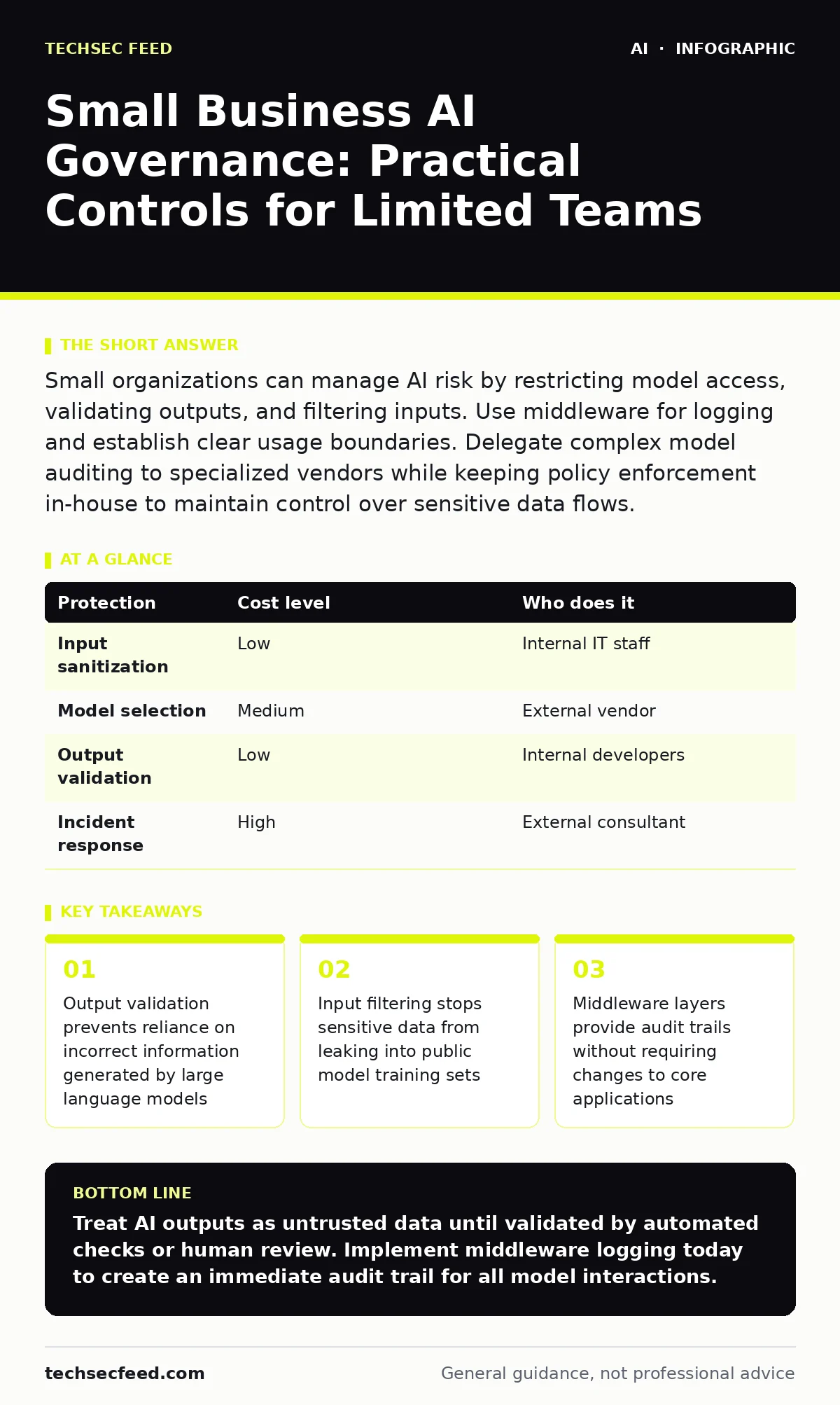
Small organizations can manage AI risk by restricting model access, validating outputs, and filtering inputs. Use middleware for logging and establish clear usage boundaries. Delegate complex model auditing to specialized vendors while keeping policy enforcement in-house to maintain control over sensitive data flows.
The Hidden Cost of Unchecked Automation
Small organizations often assume that because they have fewer users, their risk is lower. This assumption is incorrect. A single erroneous output from an AI system can trigger a chain reaction of operational failures. When you integrate AI into customer-facing workflows, you are effectively outsourcing decision-making to a probabilistic engine. This engine does not understand consequences. It predicts the next likely word, not the most accurate fact.
The primary risk for small teams is not a sophisticated hack. It is a mundane error that scales. If an automated system misclassifies a support ticket or generates incorrect code, the error propagates. You lack the manual oversight capacity to catch every mistake. Therefore, your controls must be automated and embedded in the workflow, not reliant on human review alone.
Budget-Conscious Control Mechanisms
You do not need enterprise-grade security suites to implement responsible AI practices. The most effective controls are often architectural choices rather than purchased tools. Start by isolating AI workloads. Run AI inference in a separate environment from your production database. This isolation ensures that if the AI service is compromised, the attacker cannot directly access your core records.
Use middleware to intercept requests and responses. Middleware sits between your application and the AI model. It can log every input and output. This creates an audit trail. You can use this trail to detect anomalies or to review specific cases later. Most open-source middleware tools are free and well-documented. They allow you to implement rate limiting and keyword filtering without writing custom code.
Data minimization is your strongest defense. Never send raw customer data to a public model. Pre-process your data to remove personally identifiable information. This technique, known as anonymization, reduces the risk of data leakage. If the model is breached or the provider retains your data for training, the damage is limited because the data is already stripped of identifying markers.
Delegation and Vendor Management
You cannot audit the internal mechanics of a proprietary AI model. You must delegate this responsibility to the provider. However, delegation does not mean abdication. You must verify that the provider meets specific security standards. Look for providers that publish their security whitepapers and undergo independent audits.
When selecting an IT provider or AI vendor, ask specific questions. Do not accept vague assurances. You need concrete answers about data handling and model behavior.
| Protection | Cost level | Who does it |
|---|---|---|
| Input sanitization | Low | Internal IT staff |
| Model selection | Medium | External vendor |
| Output validation | Low | Internal developers |
| Incident response | High | External consultant |
Focus your internal resources on input and output controls. These are within your sphere of influence. The model itself is a black box. You must trust the vendor’s security posture, but you verify it through contractual obligations and regular reviews.
Questions for Your IT Provider
When engaging a provider to manage your AI infrastructure, use this checklist to ensure they understand the specific risks of probabilistic systems.
- How do you isolate AI workloads from the main network?
- What logging mechanisms are in place for every API call?
- How do you handle data retention and deletion requests?
- What is your process for patching underlying model vulnerabilities?
- Do you provide tools for us to filter sensitive keywords before submission?
- How do you detect and prevent prompt injection attacks?
- What is your uptime guarantee for the inference API?
- Can you provide evidence of third-party security certifications?
These questions shift the conversation from general IT support to specific AI governance. A provider who cannot answer these questions clearly is not equipped to handle the nuances of machine learning security.
The Mechanics of Output Validation
Generative AI models are prone to hallucinations. These are confident but false statements. You must assume every output is potentially incorrect. Implement a validation layer that checks outputs against known facts or constraints. For example, if the AI generates a date, check if the date is in the future or past, depending on context.
Use rule-based checks for structured data. If the AI returns a JSON object, validate the schema. Ensure all required fields are present. Reject incomplete or malformed responses. This prevents downstream systems from crashing due to bad data.
For unstructured text, use confidence scores. Most models provide a measure of how certain they are about their response. Set a threshold. If the confidence is below the threshold, route the response to a human reviewer. This hybrid approach balances speed with accuracy. It allows the AI to handle routine tasks while flagging uncertain cases for human intervention.
See also: Why the CIA Triad Matters for Security Decisions
Policy as Code
Writing a policy document is not enough. You must enforce the policy through code. Define what data can be sent to the model. Define what outputs are acceptable. Encode these rules into your middleware. This ensures consistent enforcement regardless of who uses the system.
Refer to established frameworks for guidance. The NIST AI Risk Management Framework provides a structured approach to identifying and mitigating risks. You do not need to implement every control. Pick the ones that apply to your scale. Focus on transparency, validation, and governance.
An AI usage policy at work should specify which tools are approved. It should define prohibited uses, such as entering passwords or financial records. It should outline the process for reporting errors. Make this policy accessible to all employees. Train them on why these restrictions exist. Understanding the "why" increases compliance more than fear of punishment.
Monitoring for Adversarial Behavior
Attackers can manipulate AI systems through prompt injection. This is where an attacker embeds malicious instructions in the input data. The model executes these instructions, potentially bypassing security controls. This is similar to SQL injection but targets the model’s reasoning capabilities.
Imagine a user inputs a request that includes hidden commands. The model might ignore its system instructions and follow the hidden commands. To prevent this, sanitize all inputs. Remove any structured data that could be interpreted as code or commands. Use allowlists for expected input formats.
Monitor for unusual patterns in usage. Sudden spikes in request volume or unusual input lengths can indicate an attack. Set up alerts for these anomalies. Investigate them promptly. Early detection can prevent a minor incident from becoming a major breach.
The Limits of Automation
No control is perfect. AI systems will still make errors. Your goal is to reduce the frequency and impact of these errors. Accept that some level of risk remains. Mitigate it through redundancy and human oversight.
Do not rely solely on AI for critical decisions. Use it as a support tool. Let it draft, summarize, or suggest. Let humans decide. This division of labor preserves human agency while leveraging AI efficiency.
Stay informed about new threats. The field of AI security is evolving rapidly. New attack vectors emerge frequently. Subscribe to security advisories from your vendors. Participate in industry forums. Share lessons learned with peers. Collective knowledge strengthens individual defenses.
Key takeaways
- Output validation prevents reliance on incorrect information generated by large language models
- Input filtering stops sensitive data from leaking into public model training sets
- Middleware layers provide audit trails without requiring changes to core applications
Treat AI outputs as untrusted data until validated by automated checks or human review. Implement middleware logging today to create an immediate audit trail for all model interactions.
Frequently asked questions
How do I prevent sensitive data from being used to train public models?
Pre-process your data to remove personally identifiable information before sending it to the model. Use anonymization techniques and ensure your vendor contract explicitly prohibits data retention for training purposes.
Is it safe to use free AI tools for small business tasks?
Free tools often lack robust security controls and data protection guarantees. They may retain your data for training. Use them only for non-sensitive tasks and never input proprietary or customer data.
What is the difference between AI red teaming and standard testing?
Standard testing checks for known bugs. AI red teaming involves attempting to break the model’s safety guidelines or extract sensitive information. It tests the model’s resilience against adversarial inputs and prompt injection.
Can I fine-tune a model to reduce hallucinations?
Fine-tuning can improve accuracy on specific tasks, but it does not eliminate hallucinations. It may even introduce new biases. Use fine-tuning only for narrow, well-defined tasks and always maintain output validation layers.
How this guide was produced: written by the TechSec Feed editorial team with AI assistance, checked against the public references listed below, and reviewed when the facts change. See our editorial policy or report an error.