
How Anonymization Works: The Mechanics of Data De-identification
Anonymization is not a single switch but a mathematical process that trades data utility for privacy, often leaving subtle links that can re-identify individuals.
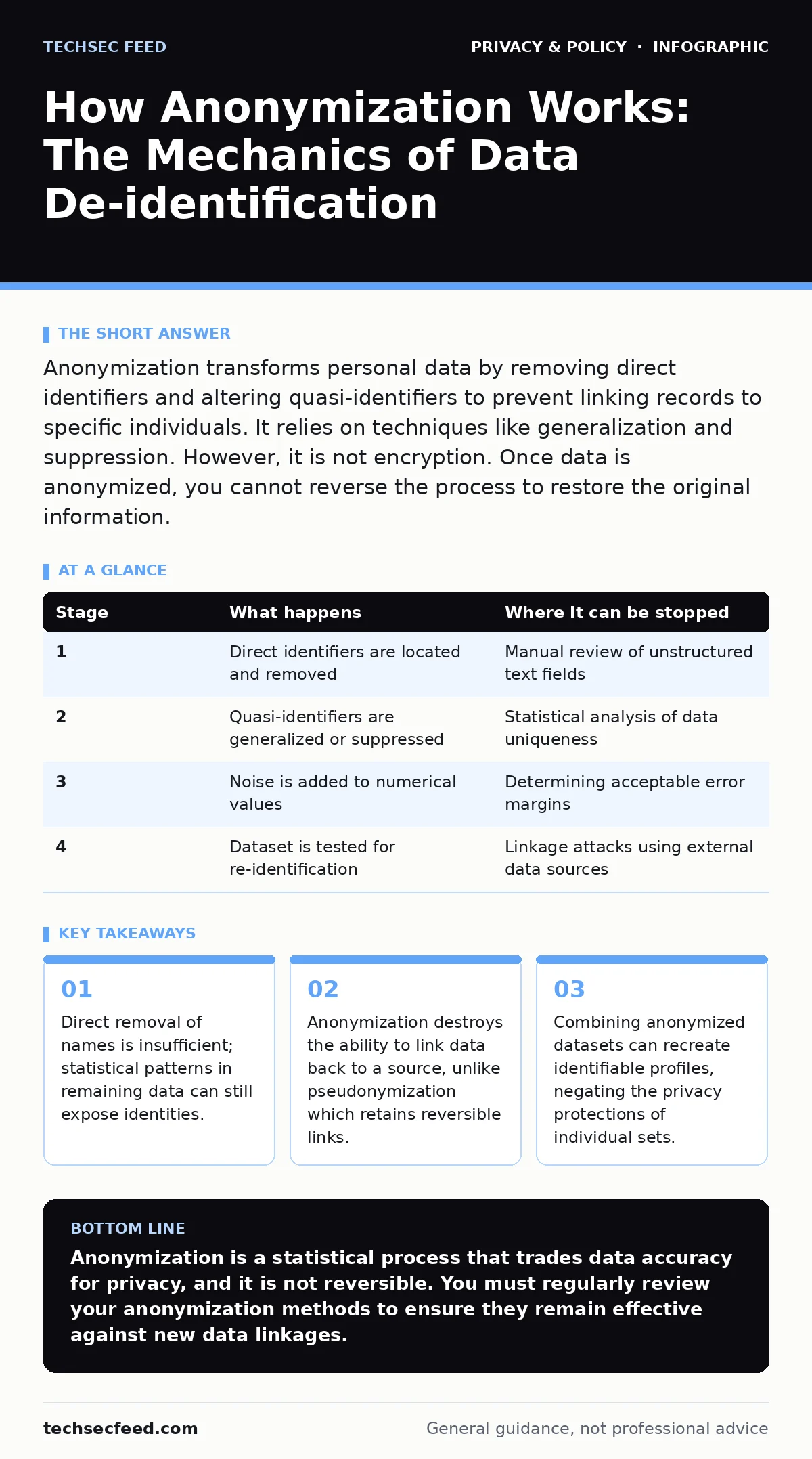
Anonymization transforms personal data by removing direct identifiers and altering quasi-identifiers to prevent linking records to specific individuals. It relies on techniques like generalization and suppression. However, it is not encryption. Once data is anonymized, you cannot reverse the process to restore the original information.
The Distinction Between Anonymization and Pseudonymization
You must first distinguish anonymization from pseudonymization, as the two are often confused in policy documents. Pseudonymization replaces direct identifiers with artificial identifiers, such as replacing a name with a random ID. This process is reversible if you hold the key. Anonymization, by contrast, is irreversible. It alters the data so that no individual can be identified, even by the data controller.
This distinction matters for compliance. Many privacy laws for small businesses treat pseudonymized data as personal data because re-identification is possible. Anonymized data falls outside the scope of these regulations because the link to the person is permanently severed. You cannot claim data is anonymized if you retain a mapping table that allows you to restore the original identities.
Stage 1: Identification of Direct Identifiers
The process begins by locating fields that directly point to a specific person. These are direct identifiers. Common examples include full names, email addresses, phone numbers, and government-issued identification numbers. You must find every instance of these fields in your dataset.
This step is often more difficult than it appears. Identifiers may be embedded in free-text fields, such as customer support notes or medical histories. They may also exist in file metadata, which often contains author names and creation dates. If you do not strip this metadata, the direct identifiers remain present in the file structure.
| Stage | What happens | Where it can be stopped |
|---|---|---|
| 1 | Direct identifiers are located and removed | Manual review of unstructured text fields |
| 2 | Quasi-identifiers are generalized or suppressed | Statistical analysis of data uniqueness |
| 3 | Noise is added to numerical values | Determining acceptable error margins |
| 4 | Dataset is tested for re-identification | Linkage attacks using external data sources |
Stage 2: Handling Quasi-Identifiers
Removing names is not enough. You must address quasi-identifiers. These are data points that do not uniquely identify a person on their own but can when combined with other data. Examples include zip code, birth date, and gender. A person’s zip code and birth date might be unique within a small population.
To protect privacy, you generalize these values. Instead of storing the exact birth date, you store the year. Instead of the specific zip code, you store the first three digits. This reduces the precision of the data. The trade-off is that the data becomes less useful for detailed analysis. You must decide how much precision you can afford to lose.
Stage 3: Adding Statistical Noise
For numerical data, such as income or age, you may add noise. This technique involves adding a small, random value to each data point. The random value is drawn from a specific mathematical distribution. This obscures the true value of any single record.
However, for any individual record, the true value is hidden. This method protects against attacks where an adversary tries to infer a specific value from the dataset. It does not protect against all forms of inference, but it raises the difficulty significantly.
Stage 4: Suppression of Outliers
Some data points are unique because they are outliers. A person with a rare medical condition in a small town might be identifiable even after generalization. If only one person in the dataset has a specific combination of attributes, that person is exposed.
You must suppress these records. Suppression means removing the record entirely or replacing the value with a placeholder. This prevents the outlier from being singled out. The risk here is bias. If you suppress too many records, the remaining dataset may no longer represent the population accurately. You must balance privacy with statistical validity.
See also: Retrieval-Augmented Generation Security for Small Teams
The Limits of Anonymization
Anonymization is not a static state. It is a condition that depends on the current state of external knowledge. Today, a combination of zip code and gender might be safe. Tomorrow, a new public dataset might link those attributes to names. This is known as a linkage attack.
You cannot guarantee that data will remain anonymous forever. As more data becomes available online, the risk of re-identification increases. People-search sites aggregate data from public records, social media, and other sources. This aggregation creates powerful lookup tables that can reverse-engineer anonymized datasets.
The Cost of Utility
The primary cost of anonymization is the loss of data utility. The more you alter the data to protect privacy, the less accurate your analysis becomes. You cannot have perfect privacy and perfect accuracy simultaneously. This is a fundamental trade-off.
For security operations teams, this means you must define your analytical needs before you anonymize. If you need to track individual user behavior, anonymization is the wrong tool. You should use pseudonymization instead, with strict access controls. If you only need aggregate trends, anonymization may be sufficient.
Re-identification Risks
Even well-anonymized data can be compromised. An adversary may use background knowledge to narrow down the possibilities. If they know the target lives in a certain area and has a certain job, they may be able to isolate their record in an anonymized dataset. This is particularly risky with small datasets or specialized populations.
Facial recognition risks highlight this issue. Even if faces are blurred, other features in the image, such as clothing or location, may serve as quasi-identifiers. You must consider all data fields, not just the obvious ones. Privacy audits can help identify these hidden links before they are exploited.
Maintaining Anonymity Over Time
Anonymization is not a one-time task. You must monitor the dataset for new risks. As new data sources become available, the risk of linkage attacks increases. You may need to re-anonymize the data or add more noise.
Workplace monitoring data often contains subtle identifiers, such as login times or device IDs. These can be used to track individuals even if names are removed. You must treat all data as potentially re-identifiable. Regular reviews are necessary to ensure that the anonymization techniques remain effective against evolving threats.
Key takeaways
- Direct removal of names is insufficient; statistical patterns in remaining data can still expose identities.
- Anonymization destroys the ability to link data back to a source, unlike pseudonymization which retains reversible links.
- Combining anonymized datasets can recreate identifiable profiles, negating the privacy protections of individual sets.
Anonymization is a statistical process that trades data accuracy for privacy, and it is not reversible. You must regularly review your anonymization methods to ensure they remain effective against new data linkages.
Frequently asked questions
Is anonymization the same as encryption?
No. Encryption hides data but can be reversed with a key. Anonymization alters data permanently so it cannot be reversed to identify the original person.
Can anonymized data be used for machine learning?
Yes, but the model may be less accurate. Noise and generalization reduce the precision of the training data, which can affect the performance of the resulting models.
How do I know if my data is truly anonymous?
You cannot know for certain. You can only assess the risk of re-identification based on current data and techniques. Regular privacy audits help manage this risk.
What happens if I accidentally re-identify someone?
You must treat the data as personal data again and apply appropriate security controls. You may also need to notify affected individuals depending on local regulations.
How this guide was produced: written by the TechSec Feed editorial team with AI assistance, checked against the public references listed below, and reviewed when the facts change. See our editorial policy or report an error.