
How People-Search Sites Aggregate Data and What You Can Do
Aggregators scrape public records and social media to build searchable profiles that persist long after you delete the original source data.
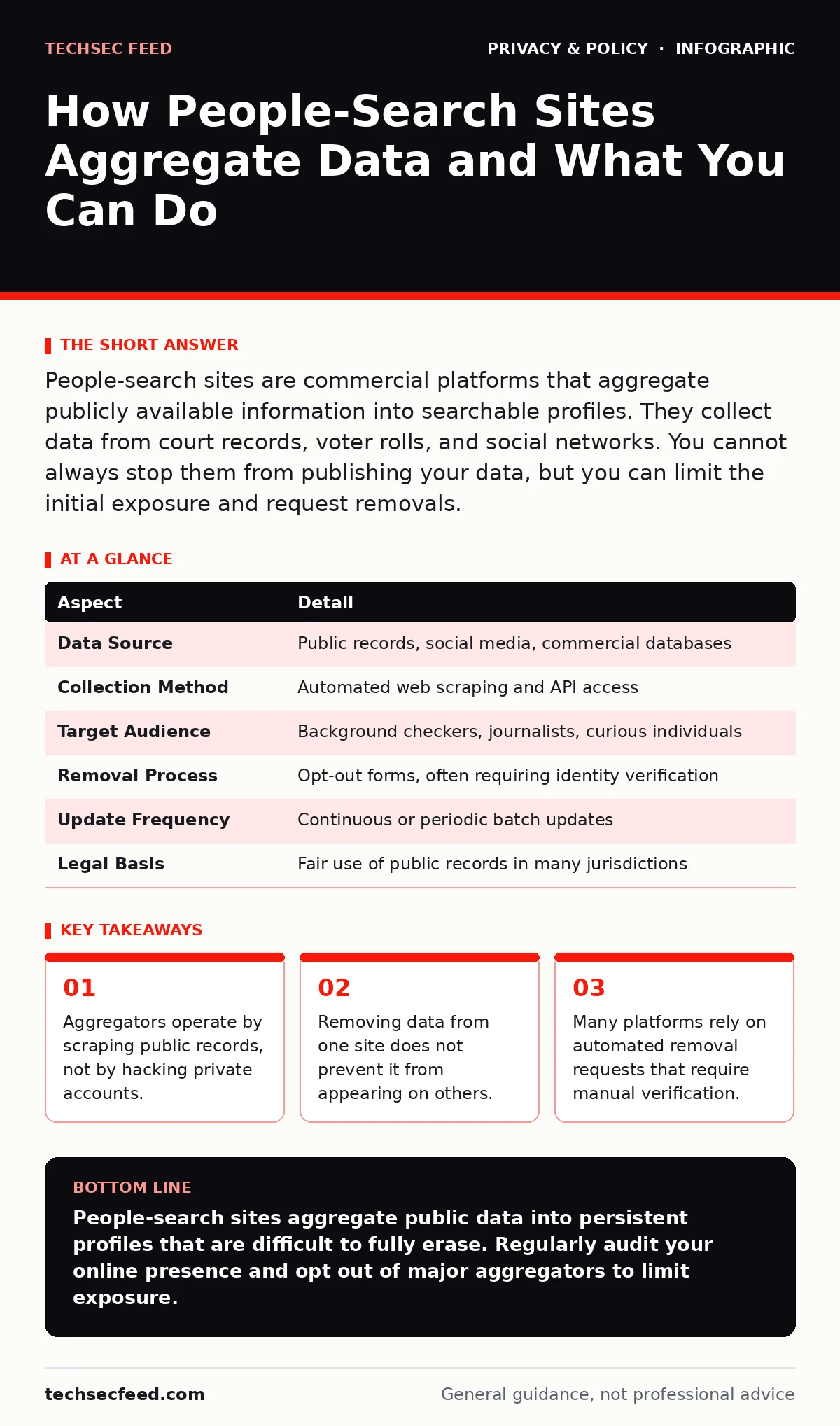
People-search sites are commercial platforms that aggregate publicly available information into searchable profiles. They collect data from court records, voter rolls, and social networks. You cannot always stop them from publishing your data, but you can limit the initial exposure and request removals.
The Digital Phone Book Analogy
Imagine a traditional phone book where every entry includes your home address, employer, and relatives' names. Now imagine that book updates itself in real time, pulling data from library records, property deeds, and social media profiles. This is the function of modern people-search sites. They do not create new information; they reassemble existing fragments into a coherent profile.
The structure resembles an index card system on an industrial scale. Each card represents a person. The system matches partial identifiers—like a name and a city—to merge disparate records. The result is a profile that appears more authoritative than the scattered source data. You interact with this system when you look up a classmate or verify a neighbor.
How Aggregation Works
Data brokers use automated tools to scrape websites. They target sources that are legally public, such as county clerk offices, state business registries, and election commissions. These sources often publish data in formats that are easy for machines to read. The aggregators then cross-reference this data with other datasets to fill in gaps.
If a court record lists your name and zip code, the broker matches that to a voter registration file that adds your middle initial. They may then link that to a social media profile that reveals your employer. The system assumes that identical names in the same geographic area refer to the same individual. This assumption is often incorrect, leading to merged identities.
| Aspect | Detail |
|---|---|
| Data Source | Public records, social media, commercial databases |
| Collection Method | Automated web scraping and API access |
| Target Audience | Background checkers, journalists, curious individuals |
| Removal Process | Opt-out forms, often requiring identity verification |
| Update Frequency | Continuous or periodic batch updates |
| Legal Basis | Fair use of public records in many jurisdictions |
The aggregation process is continuous. Brokers do not store a static snapshot. They run updates to capture new lawsuits, property transfers, or job changes. This means your profile evolves even if you take no action. The cost of maintaining these databases is low compared to the revenue generated by advertising and premium subscriptions.
Who Is Affected
Everyone with a digital presence is affected, but the impact varies by visibility. Individuals with common names face higher risks of identity confusion. The system may merge your criminal record with that of a stranger who shares your name and city. This error can affect employment opportunities or housing applications.
Public figures, professionals in regulated industries, and community leaders generate more public data. Their profiles are richer and more accurate because there are more data points to match. However, this accuracy increases the risk of doxxing, where malicious actors use the aggregated data to harass or intimidate.
Private citizens are not immune. A single public filing, such as a divorce decree or a property tax assessment, can trigger a profile creation. Once the profile exists, it attracts more data. Other brokers may buy the aggregated data and republish it. This creates a network effect where your information spreads across dozens of platforms.
Common Forms of Exposure
People-search sites present data in various formats. Some offer simple name-and-address lookups. Others provide detailed reports that include criminal history, bankruptcy filings, and relative information. The level of detail depends on the broker's data sources and pricing model.
Some platforms specialize in niche data. They may focus on professional licenses, educational history, or social media connections. These specialized brokers sell their data to larger aggregators, who combine it into general profiles. You may not recognize the source of the data because the broker strips the original context.
The exposure is not limited to text. Images from social media profiles may appear alongside your name. If you used a profile picture that shows your license plate or your home address, the aggregator may extract that information. This visual data adds a layer of risk that text-only records do not carry.
What People Usually Get Wrong
Many users believe that deleting their social media accounts removes their data from search sites. This is incorrect. The aggregators cache copies of the data. They do not constantly verify the source. Even if you delete your Facebook profile, the aggregator may retain your name, address, and photo for years.
Another misconception is that privacy settings on social platforms stop data brokers. Privacy settings control who can view your profile on that specific platform. They do not prevent the platform from sharing data with partners or publicizing certain fields. Aggregators often scrape public-facing metadata, which remains visible even if your main profile is private.
You might also assume that only you and your immediate family are listed. In reality, the system links you to associates. If you are listed as a dependent on a tax return or as a co-signer on a loan, your name appears in those records. The aggregator then connects you to those entities, expanding your digital footprint beyond your direct control.
See also: What Is Biometric Data Used For: Identity, Access, and Hidden Risks · Zero Knowledge Encryption Cloud Storage: How It Works and What You Lose
Reducing the Risk
You can limit the initial exposure by managing your public data. Review your social media profiles and remove personal details that are not necessary for your professional or social life. Disable location tagging on photos and avoid posting identifiable landmarks. This reduces the amount of data available for scraping.
Use a separate email address for public sign-ups and forum registrations. This keeps your primary contact information out of the hands of data miners. When you must provide personal information to a public entity, check if they offer an opt-out for third-party sharing. Some jurisdictions allow you to request that your contact information be redacted from public records.
Regularly search for yourself on major search engines. Look for profiles on known aggregator sites. Most of these sites have an opt-out process. It is often tedious, requiring you to submit identification and wait for verification. However, removing yourself from the largest platforms reduces the likelihood that smaller brokers will find and publish your data.
Consider the trade-off between convenience and privacy. Signing up for services with your phone number or home address generates data points. Each data point increases the accuracy of your aggregated profile. Be selective about where you provide this information.
The Limits of Control
You cannot fully erase your digital footprint. Public records are, by definition, public. Removing your data from one aggregator does not prevent it from being scraped again. The data exists in multiple places, and the system is designed to rebuild profiles from fragments.
The goal is not invisibility. It is damage control. By reducing the amount of sensitive data you publish, you lower the value of your profile to malicious actors. You also reduce the chance of identity errors. When you find incorrect information, dispute it immediately with the source. If the source corrects the record, the aggregators may update their data during their next scan.
This process requires ongoing attention. Data brokers adapt their scraping techniques. New data sources emerge. Your privacy posture must evolve with the technology. Treat your digital identity as a dynamic asset that requires regular maintenance.
Key takeaways
- Aggregators operate by scraping public records, not by hacking private accounts.
- Removing data from one site does not prevent it from appearing on others.
- Many platforms rely on automated removal requests that require manual verification.
- Your digital footprint expands through data brokers who share information.
People-search sites aggregate public data into persistent profiles that are difficult to fully erase. Regularly audit your online presence and opt out of major aggregators to limit exposure.
Frequently asked questions
Can I sue a people-search site for publishing my data?
Legal action is difficult because these sites rely on public records. Most courts uphold their right to republish legally available information. You may have recourse if the data is incorrect or if they violate specific state privacy laws.
Do tracker blockers stop data aggregation?
No. Tracker blockers prevent websites from following your browsing behavior. They do not stop data brokers from scraping public records or social media profiles. You need separate measures to limit public data exposure.
How do I handle incorrect information on these sites?
First, correct the error at the original source, such as the court or business registry. Then, submit a dispute to the aggregator with proof of the correction. It may take weeks or months for the aggregator to update its database.
Are there privacy laws that regulate these sites?
Some states have laws that allow individuals to request the removal of certain sensitive data, such as addresses for vulnerable individuals. Federal laws are less specific, focusing on data breach notification rather than aggregation. For small businesses, understanding privacy laws for small businesses may provide context on data handling obligations.
How this guide was produced: written by the TechSec Feed editorial team with AI assistance, checked against the public references listed below, and reviewed when the facts change. See our editorial policy or report an error.