
Right to be Forgotten Meaning: How Erasure Works in Practice
The right to be forgotten does not delete data everywhere, but only from systems where the data controller lacks a legal basis to keep it.
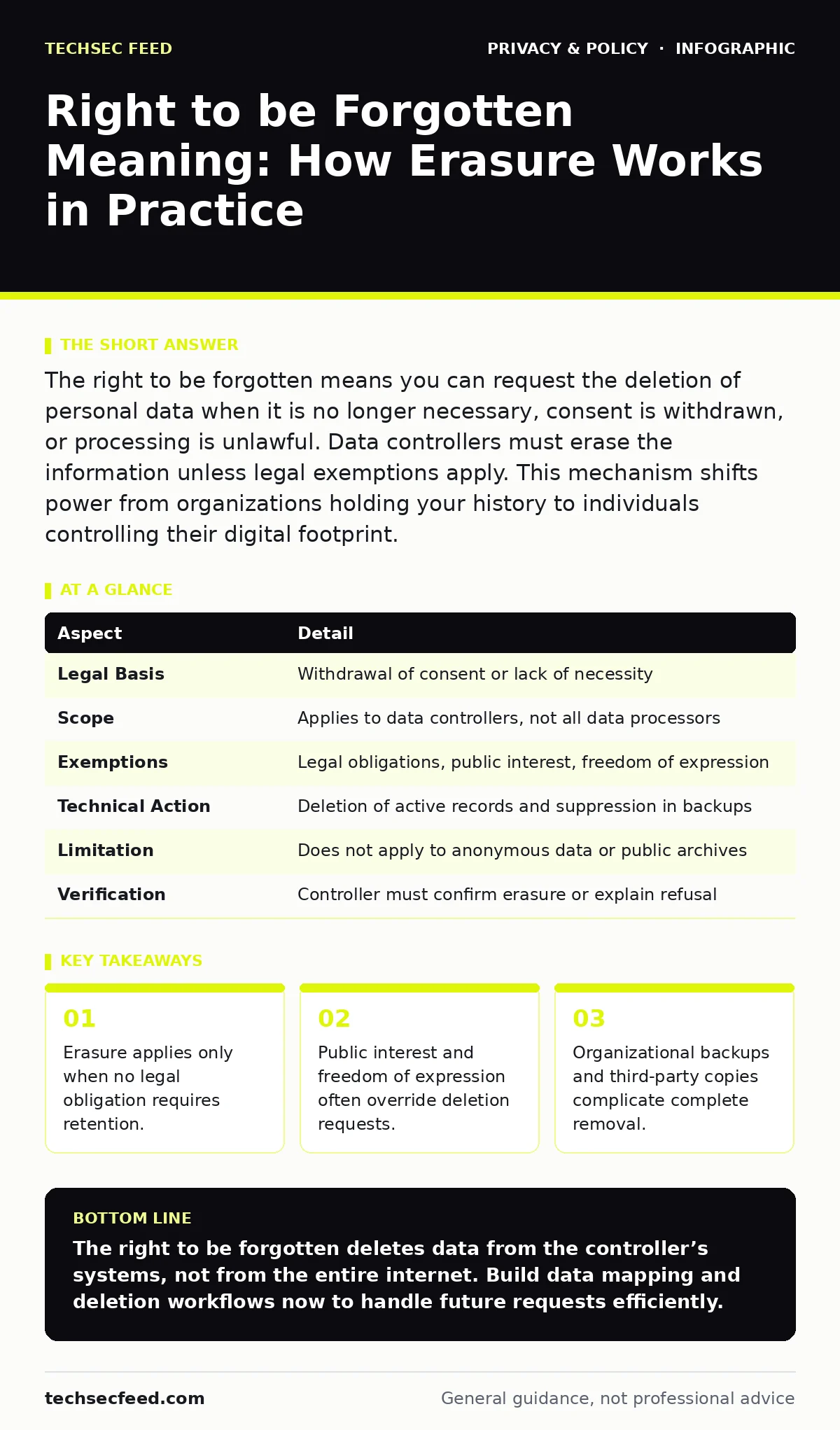
The right to be forgotten means you can request the deletion of personal data when it is no longer necessary, consent is withdrawn, or processing is unlawful. Data controllers must erase the information unless legal exemptions apply. This mechanism shifts power from organizations holding your history to individuals controlling their digital footprint.
Everyday Analogy for Data Erasure
Imagine you wrote a letter to a friend and mailed it. You later decide you want the letter to never have existed. You can ask your friend to burn their copy. You cannot reach into their mailbox, shred the letter before they read it, or erase the memory of the conversation they had with their spouse about it. The right to be forgotten works similarly. You can demand that the primary holder of your data destroy it. You cannot control copies made by others, nor can you erase the impact of data that was already published or used.
This analogy highlights the mechanical limit of the law. The law binds the entity you ask. It does not bind the internet. It does not bind the cloud provider storing the backup. It does not bind the journalist who published the fact. Understanding this boundary prevents frustration and sets realistic expectations for both individuals and security teams managing these requests.
Right to be Forgotten Meaning
The right to be forgotten meaning is the legal entitlement of an individual to request the deletion of their personal data from a data controller. This right is not an absolute command to vanish from history. It is a conditional right that triggers when specific criteria are met. The data must be personal, meaning it relates to an identified or identifiable living individual. The controller must process this data, meaning they determine the purposes and means of the processing.
The request succeeds when the data is no longer necessary for the original purpose, the individual withdraws consent, or the processing was unlawful. The request fails when the processing is necessary for compliance with a legal obligation, for the performance of a task carried out in the public interest, or for the exercise of the right to freedom of expression. The definition hinges on the balance between privacy rights and other fundamental rights.
| Aspect | Detail |
|---|---|
| Legal Basis | Withdrawal of consent or lack of necessity |
| Scope | Applies to data controllers, not all data processors |
| Exemptions | Legal obligations, public interest, freedom of expression |
| Technical Action | Deletion of active records and suppression in backups |
| Limitation | Does not apply to anonymous data or public archives |
| Verification | Controller must confirm erasure or explain refusal |
How the Mechanism Works in Practice
The process begins with a formal request. The individual contacts the data controller. The controller must verify the identity of the requester to prevent unauthorized deletion. This verification step is often the first friction point. The controller then reviews the data inventory. They identify all instances of the personal data. They check each instance against the legal exemptions.
If no exemption applies, the controller initiates deletion. This is not a simple file delete. It involves removing data from active databases, search indices, and customer relationship management systems. It also requires updating backups so that the data is overwritten in the next cycle. The controller must inform any third parties who received the data if deletion is technically feasible. If the data was shared with a partner organization, the controller must ask that partner to delete it too. This chain of responsibility extends the burden significantly.
Who Is Affected by the Request
Individuals are the primary beneficiaries. They can request erasure of photos, posts, purchase histories, and health records. Data controllers are the primary bearers of the burden. They must build systems to identify, locate, and delete data. This includes large technology companies, small businesses, and even non-profits that collect member information. Data processors, who act on behalf of controllers, must assist in the deletion. They do not make the decision but must execute it when instructed.
Third parties are indirectly affected. If a controller shares data with a vendor, that vendor may receive deletion requests. If a journalist publishes data, the journalist is usually exempt from deletion requests based on public interest. This creates a fragmented ecosystem. Some entities delete. Some retain. Some ignore. The individual must navigate this fragmentation. Security teams must design architectures that support granular deletion without breaking system integrity.
What People Usually Get Wrong
Many believe the right to be forgotten erases data from the entire internet. This is incorrect. The right applies to the specific controller you contact. It does not apply to independent actors who copied the data. Many believe it applies to all data. This is incorrect. It does not apply to anonymous data. If the data cannot identify you, the right does not trigger. It does not apply to data required for legal compliance, such as tax records or employment contracts.
Another common error is assuming immediate deletion. Controllers have a statutory period to respond. They may need time to locate data across legacy systems. They may need time to verify identity. Another error is assuming the right applies to public records. Court records, bankruptcy filings, and official registers are often exempt. The right balances privacy against the public’s right to know. Understanding these distinctions prevents unrealistic expectations and legal missteps.
See also: Child Identity Theft: Why Small Businesses Are Targets and How to Stop It
Technical Challenges for Security Teams
Implementing erasure requires precise data mapping. Teams must know where every piece of personal data lives. This includes primary databases, backup tapes, log files, and analytics platforms. Deleting from one system is easy. Deleting from all systems is hard. Backups present a unique challenge. You cannot easily edit a backup tape. You must wait for the backup cycle to overwrite the data. This creates a window where the data technically exists but is inaccessible.
Another challenge is derived data. If you calculate a score based on user behavior, deleting the raw behavior data may not delete the score. You must delete the derived data too. This requires understanding data lineage. If you do not track how data flows and transforms, you cannot guarantee erasure. This is why data subject access requests are often a precursor to erasure. You must find the data before you can delete it. Integrating privacy audits into the development lifecycle helps identify these dependencies early.
Legal Exemptions and Exceptions
The right to be forgotten is not absolute. Several exemptions protect other interests. Freedom of expression and information is a major exemption. News publishers and historians can retain data that is of public interest. Legal obligations are another. If the law requires keeping financial records for ten years, a deletion request cannot override that. Scientific or historical research may also be exempt, provided appropriate safeguards are in place.
Public health exemptions exist too. Data necessary for public health interventions can be retained. These exemptions mean that a deletion request may be partially granted. Some data is deleted. Some is kept. The controller must explain which data is kept and why. This transparency is crucial for trust. It shows that the decision was not arbitrary but based on legal necessity. Teams must document these decisions carefully.
Steps to Handle a Request
- Verify the identity of the requester. Use secure channels. Do not ask for more data than necessary.
- Locate all instances of the personal data. Use data mapping tools. Check primary and secondary systems.
- Review each instance for legal exemptions. Check for legal obligations, public interest, or consent withdrawal.
- Delete the data from active systems. Confirm deletion with logs.
- Handle backups appropriately. Ensure they are overwritten in the next cycle.
- Notify third parties if feasible. Document the effort.
- Respond to the requester. Confirm deletion or explain the refusal with legal citations.
This process requires discipline. Skipping steps leads to non-compliance. Incomplete deletion leads to fines. Proper documentation leads to defense. Integrating consent management platforms can automate parts of this workflow. These platforms track consent status and data location. They make the verification and location steps faster and more accurate.
Key takeaways
- Erasure applies only when no legal obligation requires retention.
- Public interest and freedom of expression often override deletion requests.
- Organizational backups and third-party copies complicate complete removal.
The right to be forgotten deletes data from the controller’s systems, not from the entire internet. Build data mapping and deletion workflows now to handle future requests efficiently.
Frequently asked questions
Does the right to be forgotten apply to search engines?
Search engines must remove links to personal information if the information is inadequate, irrelevant, or excessive. They do not remove the source page, only the link to it.
Can I use this right to delete my social media posts?
You can request deletion of your posts from the platform. The platform must delete them unless legal reasons require retention. Other users’ screenshots remain unaffected.
How long does a company have to respond?
Most jurisdictions require a response within one month. This period may be extended by two months for complex requests. The requester must be informed of any extension.
What happens if a company refuses my request?
You can lodge a complaint with the relevant supervisory authority. You may also have the right to seek a judicial remedy. The company must provide a reason for the refusal.
How this guide was produced: written by the TechSec Feed editorial team with AI assistance, checked against the public references listed below, and reviewed when the facts change. See our editorial policy or report an error.