Child Identity Theft: Why Small Businesses Are Targets and How to Stop It
Small firms hold child data without realizing it, creating silent liability through poor data hygiene and unmonitored third-party access.
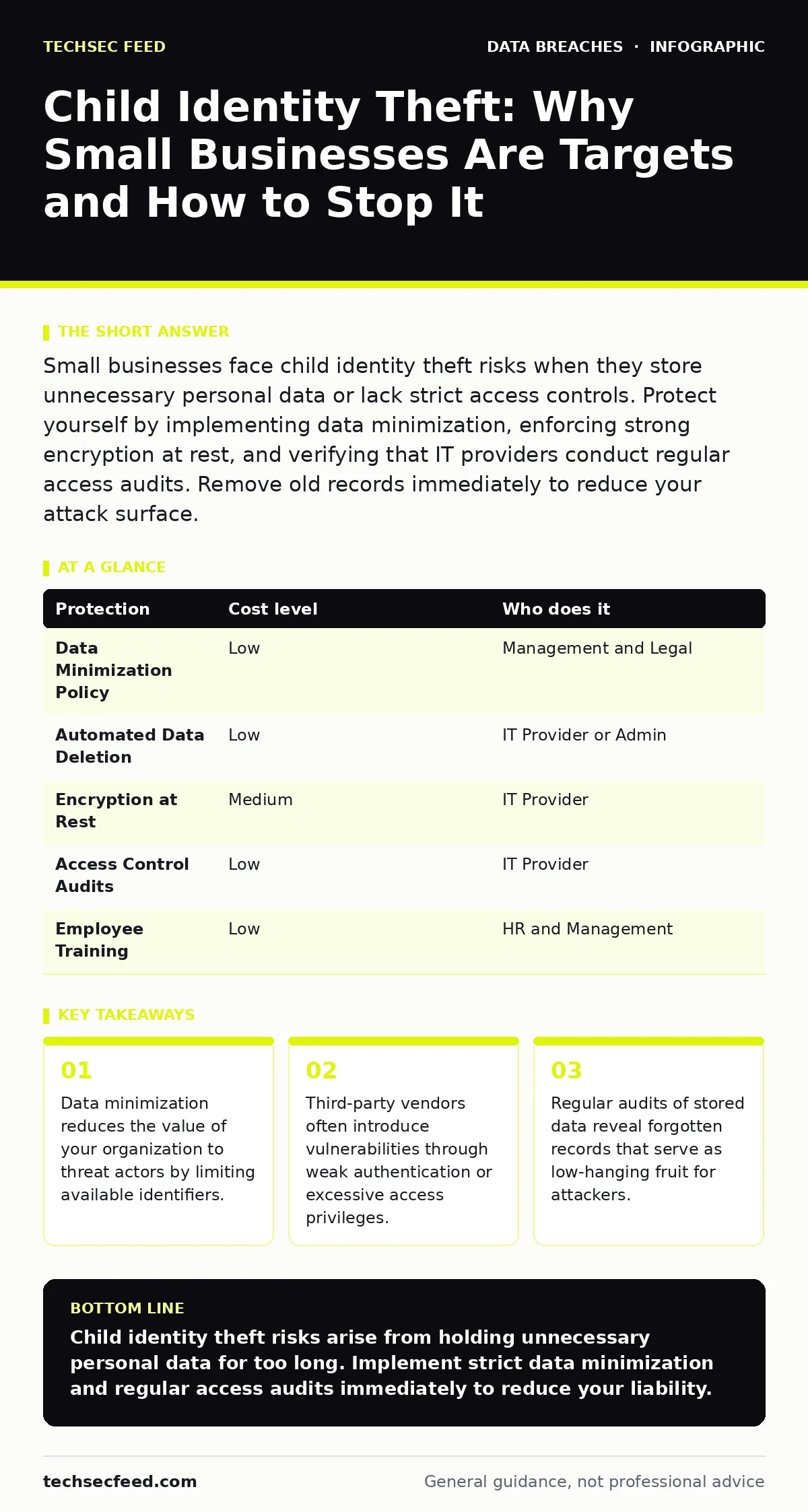
Small businesses face child identity theft risks when they store unnecessary personal data or lack strict access controls. Protect yourself by implementing data minimization, enforcing strong encryption at rest, and verifying that IT providers conduct regular access audits. Remove old records immediately to reduce your attack surface.
The Hidden Inventory of Minor Data
Small organizations often believe they are invisible to threat actors. This assumption fails when you consider the data you already hold. You may store contact information for clients, employees, or partners. If any of these individuals are minors, or if you hold data on their children, you possess high-value identifiers.
Threat actors do not need to breach a bank to cause harm. They need a name, a date of birth, and a social security number or national ID equivalent. Your database might contain these fragments scattered across spreadsheets, email archives, and CRM systems. The aggregation of this data creates a complete identity profile.
The risk is not just reputational. Legal frameworks in many jurisdictions impose strict penalties for mishandling minor data. You may face fines even if you did not intend to harm anyone. The violation occurs simply because the data existed on your systems longer than necessary.
Why Small Organizations Are Exposed
Small firms lack the security operations centers of large enterprises. You likely rely on generalist IT staff or outsourced providers. This creates gaps in monitoring and response. Threat actors target these gaps because the effort to breach you is low, and the reward is high.
Your exposure comes from three sources. First, data hoarding. You keep records "just in case" they are needed later. This increases the volume of data an attacker can steal. Second, weak access controls. Multiple employees share accounts or use weak passwords. This makes it easy for an attacker to move laterally within your network.
Third, third-party risk. You use software vendors, cloud providers, or freelance developers. They may have access to your data. If their security is weak, your data is compromised. You are responsible for the breach, even if the vulnerability was in their system. This is a common oversight in small business security planning.
The Mechanics of Child Identity Theft
Child identity theft is distinct from adult identity theft. A minor does not check their credit report or monitor their bank accounts. The stolen identity can remain dormant for years. The attacker builds a credit history, opens accounts, or commits crimes in the child’s name.
By the time the fraud is discovered, the damage is extensive. The child may be unable to get a job, rent an apartment, or obtain student loans. The cleanup process involves legal documents, credit freezes, and years of administrative effort. For your business, the discovery of such a breach triggers immediate legal scrutiny.
The attacker’s goal is long-term gain. They do not need to use the identity immediately. They wait until the child reaches adulthood. This dormancy period makes detection nearly impossible for the victim. It also means your breach may not be reported for a decade. The liability remains with you, the data holder.
Low-Cost Protections for Data Hygiene
You do not need expensive security suites to reduce risk. The most effective protection is data minimization. This is the practice of collecting only the data you strictly need and deleting it when no longer required. If you do not need a child’s date of birth, do not store it.
Implement a data retention policy. Define how long you keep each type of record. Automate the deletion process where possible. This reduces the amount of data available in a breach. It also simplifies compliance with privacy regulations.
Use encryption at rest for all stored data. This ensures that if an attacker steals your hard drives or database files, they cannot read the contents without the decryption key. Combine this with encryption in transit to protect data moving between your servers and users. These are standard protocols that most modern systems support out of the box.
| Protection | Cost level | Who does it |
|---|---|---|
| Data Minimization Policy | Low | Management and Legal |
| Automated Data Deletion | Low | IT Provider or Admin |
| Encryption at Rest | Medium | IT Provider |
| Access Control Audits | Low | IT Provider |
| Employee Training | Low | HR and Management |
What to Ask Your IT Provider
Your IT provider is your first line of defense. You must verify their security practices. Do not assume they follow best practices. Ask specific questions about how they handle your data.
- How do you manage access to our production databases?
- Do you conduct regular audits of user permissions?
- What is your process for identifying and deleting obsolete data?
- How do you monitor for unauthorized access attempts?
- Do you provide logs of all data access and modifications?
If your provider cannot answer these questions clearly, they are a risk. You need a partner who understands data hygiene, not just server uptime. Check their documentation for references to password reuse prevention and stolen session tokens mitigation. These are common vectors for account takeover.
See also: Data Subject Access Requests: Mechanism, Limits and Hidden Costs
The Cost of Inaction
Ignoring data hygiene has hidden costs. Beyond legal fines, you face operational disruption. A breach requires you to freeze operations while you investigate. You must notify affected parties and regulators. This takes time and resources you do not have.
Reputational damage is harder to quantify but equally damaging. Clients trust you with their information. If you betray that trust, they leave. It is difficult to rebuild a reputation for security. Competitors will highlight your failure.
The cost of prevention is low compared to the cost of a breach. Implementing data minimization and encryption takes hours, not months. It requires discipline, not budget. The return on investment is reduced liability and improved trust.
Building a Sustainable Security Culture
Security is not a one-time project. It is an ongoing process. You must embed security into your daily operations. Train your employees on data handling procedures. Make them aware of the risks of data scraping and scareware tactics.
Review your data inventory regularly. Identify new data sources and assess their necessity. Delete old data proactively. Monitor your systems for unusual activity. Respond to incidents quickly using a predefined incident communication plans.
By taking these steps, you reduce your exposure to child identity theft. You protect your clients, your employees, and your business. The goal is not perfect security, which is impossible. The goal is resilience. You must be able to detect, respond, and recover from incidents.
Key takeaways
- Data minimization reduces the value of your organization to threat actors by limiting available identifiers.
- Third-party vendors often introduce vulnerabilities through weak authentication or excessive access privileges.
- Regular audits of stored data reveal forgotten records that serve as low-hanging fruit for attackers.
Child identity theft risks arise from holding unnecessary personal data for too long. Implement strict data minimization and regular access audits immediately to reduce your liability.
Frequently asked questions
Does insurance cover child identity theft breaches?
Cyber insurance may cover legal fees and notification costs, but it does not prevent the breach. Policies often exclude negligence or failure to follow standard security practices.
How long should I keep client records?
Keep records only as long as legally required or operationally necessary. For most marketing data, this is a short period. Delete records immediately after their purpose is fulfilled.
Can I use free tools for encryption?
Yes, many open-source tools provide strong encryption. The key is proper implementation and key management. Misconfigured free tools can be as risky as no encryption.
What if a vendor is breached?
You are likely still liable. Ensure your contracts with vendors include security requirements and indemnification clauses. Monitor their security posture regularly.
How this guide was produced: written by the TechSec Feed editorial team with AI assistance, checked against the public references listed below, and reviewed when the facts change. See our editorial policy or report an error.