Incident Communication Plans: How to Stop Chaos When Systems Fail
Most organizations fail not because of the technical breach, but because they lack a pre-approved script for who speaks and when.
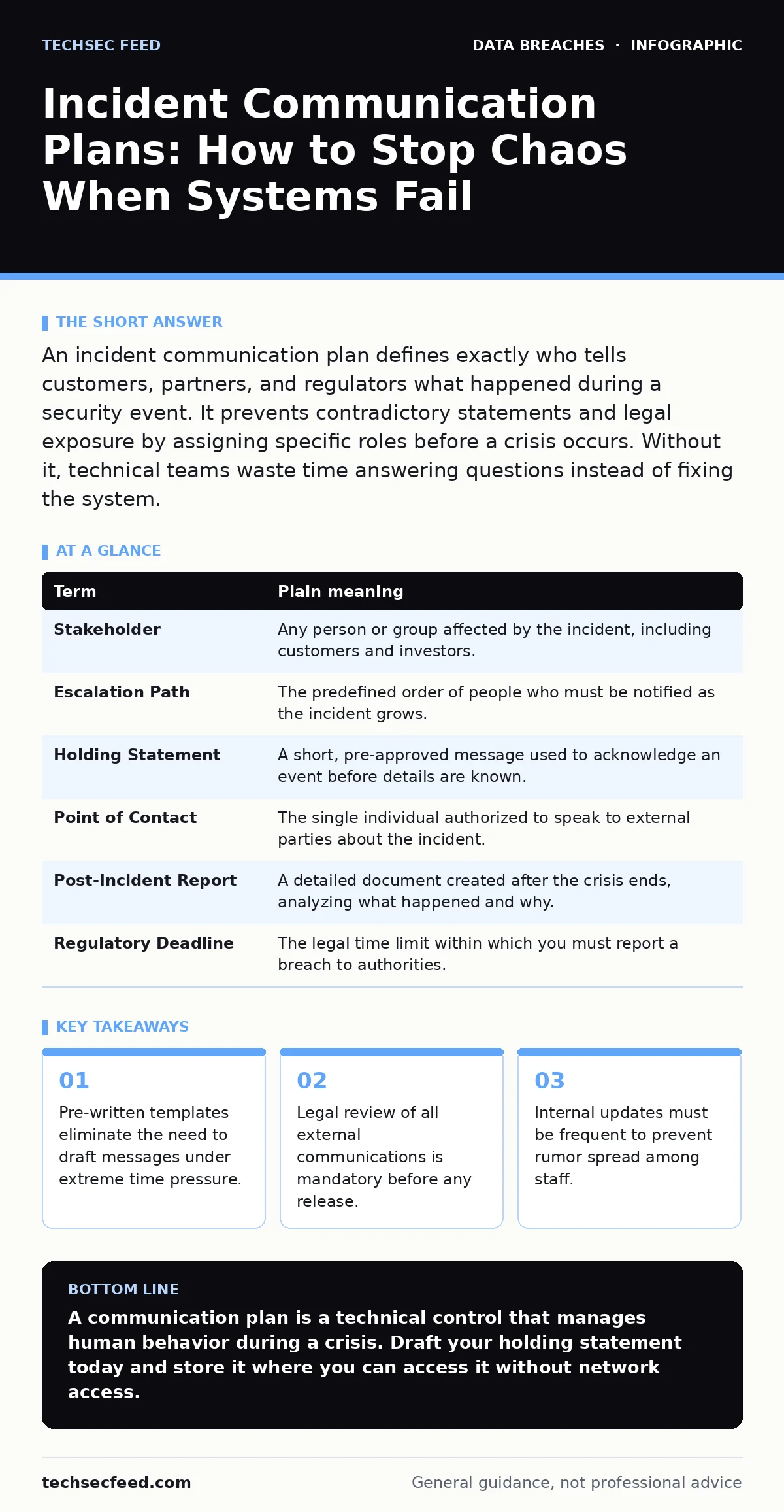
An incident communication plan defines exactly who tells customers, partners, and regulators what happened during a security event. It prevents contradictory statements and legal exposure by assigning specific roles before a crisis occurs. Without it, technical teams waste time answering questions instead of fixing the system.
The Air Traffic Control Model
Imagine a commercial airplane losing an engine over the ocean. The pilots do not spend their first minutes debating what to type on social media. They follow a strict checklist. They stabilize the aircraft. They notify the control tower. They announce the situation to passengers using a rehearsed script. The goal is not to explain why the engine failed. The goal is to maintain order while experts work on the problem.
Security incidents follow the same physics. When your systems are compromised, your technical team are the pilots. They need quiet and focus. Everyone else is a passenger or a regulator. If the passengers start shouting instructions, the plane crashes. Your communication plan is the checklist that keeps the cabin calm while the cockpit works.
Defining the Communication Chain
You cannot manage what you do not define. Most organizations have a plan for detecting threats. Few have a plan for describing them. The gap between detection and disclosure is where reputational damage occurs. You need a clear hierarchy. Who has the authority to speak to the press? Who updates the status page? Who informs legal counsel?
This hierarchy must be static. It does not change based on the severity of the attack. If a junior engineer receives a call from a journalist, they must know exactly what to say. Usually, that answer is "I will have someone from our security team call you back." That simple deflection buys time.
| Term | Plain meaning |
|---|---|
| Stakeholder | Any person or group affected by the incident, including customers and investors. |
| Escalation Path | The predefined order of people who must be notified as the incident grows. |
| Holding Statement | A short, pre-approved message used to acknowledge an event before details are known. |
| Point of Contact | The single individual authorized to speak to external parties about the incident. |
| Post-Incident Report | A detailed document created after the crisis ends, analyzing what happened and why. |
| Regulatory Deadline | The legal time limit within which you must report a breach to authorities. |
The Hidden Cost of Silence
Silence feels like safety. It is often the opposite. When you do not communicate, stakeholders fill the void with their own narratives. These narratives are rarely favorable. They assume the worst. They assume you are hiding something. This uncertainty triggers secondary risks. Customers may cancel contracts. Partners may freeze integration.
Consider the mechanics of password reuse. If a breach exposes credentials, users will try to log in elsewhere. If you do not tell them to reset their passwords immediately, they leave those other accounts vulnerable. Your silence directly enables further compromise. Speaking up is an operational control. It limits the blast radius of the initial failure.
Internal vs External Messages
You must treat your employees and your customers as different audiences. They need different information. Your employees need to know how to handle calls from angry customers. They need to know which services are down. They need to know they are safe. Your customers need to know if their data is at risk. They need to know what steps to take.
Mixing these audiences causes confusion. If you send a technical root-cause analysis to customers, they will panic. If you send a vague "we are looking into it" to your support team, they will field calls with no answers. Keep the channels separate. Use a dedicated internal channel for staff updates. Use email or status pages for customers.
Drafting the Holding Statement
You will not know the full scope of an incident in the first hour. You should not try to explain it. Use a holding statement. This is a pre-written template that acknowledges the issue without admitting liability or revealing technical details. It should state that you are aware, that you are investigating, and that you will provide more information soon.
This template should be reviewed by legal counsel before you ever need it. It must comply with your local regulations. It should not contain speculative language. Avoid words like "maybe," "possibly," or "we think." Use "we are assessing" and "we are verifying." Precision in language reduces legal risk.
See also: AI Hallucination Incident Response and Recovery Steps · AS-REP Roasting Response: Containment, Recovery and Prevention Steps
Try This Now
- Identify the single person in your organization who is authorized to speak to the media. Write their name and phone number down.
- Draft a one-paragraph holding statement. Have your legal team review it. Save it in an offline location.
- Map the encryption at rest status of your most sensitive data. If you cannot explain where this data lives, you cannot explain if it was stolen.
The Feedback Loop
Communication is not a one-way broadcast. It is a loop. You must listen to the questions you receive. These questions reveal what your stakeholders are afraid of. If customers keep asking about credit cards, your next update must address payment data. If employees are worried about payroll, address that specifically.
Ignore this feedback and you lose trust. Trust is harder to rebuild than technical systems. A breach breaks your infrastructure. Poor communication breaks your relationship. You can patch a server. You cannot patch a reputation that has shattered.
Key takeaways
- Pre-written templates eliminate the need to draft messages under extreme time pressure.
- Legal review of all external communications is mandatory before any release.
- Internal updates must be frequent to prevent rumor spread among staff.
A communication plan is a technical control that manages human behavior during a crisis. Draft your holding statement today and store it where you can access it without network access.
Frequently asked questions
How long should I wait before communicating after a breach?
Communicate as soon as you have confirmed the incident is real. Delaying only increases speculation and legal risk. Use a holding statement if you lack details.
Should I mention specific attack vectors in public updates?
No. Revealing specific attack methods helps attackers refine their tools. Share high-level impacts only. Save technical details for the post-incident report.
Who should write the customer notification?
Security writes the draft. Legal reviews it for liability. PR reviews it for tone. The final approval should come from executive leadership.
What if I don't know if customer data was stolen?
State that you are conducting a forensic investigation. Do not guess. It is better to update later with "data was not found" than to say "data was safe" and be wrong.
How this guide was produced: written by the TechSec Feed editorial team with AI assistance, checked against the public references listed below, and reviewed when the facts change. See our editorial policy or report an error.