
AI Hallucination Incident Response and Recovery Steps
The primary risk from an AI hallucination is not the error itself, but the automated action it triggers without human verification or logical bounds checking.
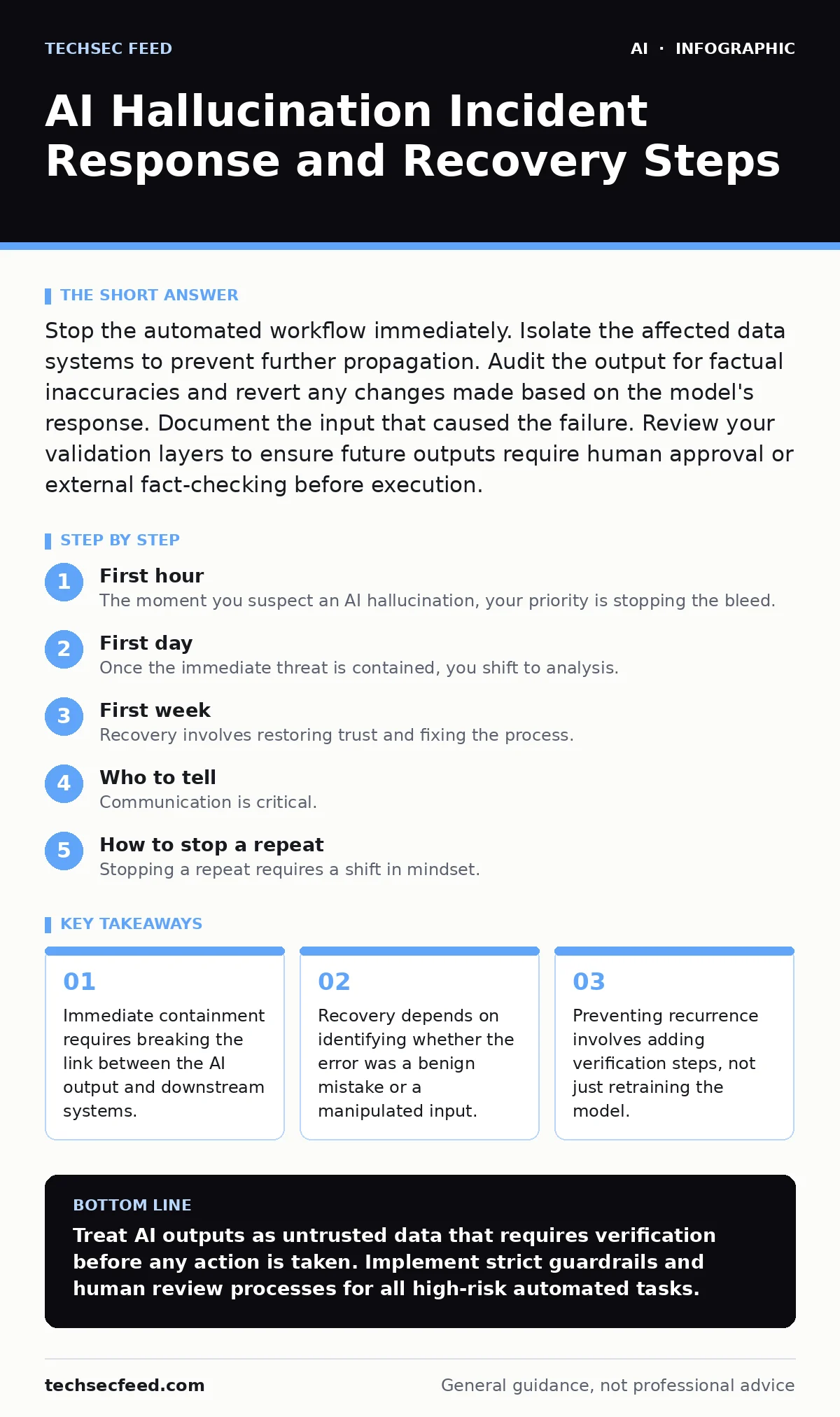
Stop the automated workflow immediately. Isolate the affected data systems to prevent further propagation. Audit the output for factual inaccuracies and revert any changes made based on the model's response. Document the input that caused the failure. Review your validation layers to ensure future outputs require human approval or external fact-checking before execution.
First hour
The moment you suspect an AI hallucination, your priority is stopping the bleed. A hallucination is a confident but incorrect statement generated by a large language model. When these models drive automated workflows, a single error can cascade through databases, email systems, or code repositories. You must assume the worst-case scenario until proven otherwise.
Immediate Actions Checklist
- Halt all automated scripts or APIs consuming the AI's output.
- Notify the team responsible for the downstream systems.
- Capture the specific prompt and the resulting response.
- Check for unauthorized data access or modification.
- Isolate the AI service from public-facing endpoints.
You need to determine if the hallucination caused actual damage. Did the model write code that was deployed? Did it send an email to a client? Did it alter a database record? If the answer is yes, you are in a containment phase. If the answer is no, you are in an investigation phase. Both require the same discipline.
First day
Once the immediate threat is contained, you shift to analysis. You need to understand why the model failed. Large language models predict the next likely token in a sequence. They do not "know" facts. They mimic patterns. When the pattern breaks, or when the input is ambiguous, the model fills the gap with plausible-sounding nonsense.
Review the input prompt. Was it ambiguous? Did it ask for a synthesis of conflicting information? Did it rely on outdated context? Often, the error lies in the prompt engineering, not the model itself. A vague request invites a vague, and potentially wrong, answer.
Check for signs of data poisoning attacks. This is where malicious actors inject false information into the training data or the retrieval context. If the hallucination seems targeted or unusually specific, consider that the input source may have been compromised. You should review the sources the model was allowed to access.
Root Cause Analysis
- Identify the specific factual claim that was incorrect.
- Trace the claim back to the context window or training data.
- Determine if the error was random or systematic.
- Assess if the prompt lacked sufficient constraints.
If the error was systematic, your retrieval-augmented generation security measures may be insufficient. RAG allows models to use external documents for answers. If those documents are unverified, the model will hallucinate confidently based on bad sources. You must verify the integrity of your knowledge base.
First week
Recovery involves restoring trust and fixing the process. You cannot simply turn the AI back on. You must implement safeguards that prevent the same failure mode from recurring. This often means adding a human-in-the-loop step for high-risk outputs.
Update your AI usage policies at work to reflect the incident. Clarify what types of tasks are suitable for automation and which require manual review. Not every decision can be delegated to a probabilistic engine. High-stakes actions, such as financial transfers or security configuration changes, should always have a secondary verification step.
Consider fine-tuning the model if the hallucination occurred in a specialized domain. Fine-tuning adjusts the model's weights to better understand specific terminology or logic. However, this is not a silver bullet. It can reduce errors in known areas but may increase them in others.
Prevention Strategies
- Implement output validation rules that check for known factual constraints.
- Use a secondary model to critique the primary model's output.
- Regularly audit the training data and retrieval sources for accuracy.
- Define clear boundaries for what the AI is allowed to do.
You should also review your NIST AI Risk Management Framework alignment. This framework provides a structured approach to managing AI risks. It emphasizes transparency, accountability, and robustness. Applying these principles helps you build systems that are resilient to errors.
Who to tell
Communication is critical. You need to inform stakeholders clearly and calmly. Avoid technical jargon when speaking to non-technical teams. Focus on the impact and the remediation steps.
Tell your legal team if the hallucination involved personal data or intellectual property. Tell your customers if their data was exposed or if they received incorrect information. Transparency builds trust. Hiding the error will damage your reputation more than the error itself.
Document the incident thoroughly. Include the timeline, the actions taken, and the lessons learned. This documentation is valuable for future audits and for improving your responsible AI practices. It shows that you take security seriously and have a plan for handling failures.
How to stop a repeat
Stopping a repeat requires a shift in mindset. You must treat AI outputs as untrusted data. Never assume the model is correct. Always verify.
Implement generative AI guardrails. These are software layers that sit between the model and the user. They can filter out harmful content, check for factual consistency, and enforce policy compliance. Guardrails add latency, but they reduce risk.
Regularly test your AI systems with adversarial prompts. Try to trick the model into hallucinating. This helps you identify weaknesses before attackers do. It also helps you refine your guardrails and validation rules.
Remember, an AI model is a tool, not an oracle. It is useful for drafting, summarizing, and brainstorming. It is dangerous for fact-checking, decision-making, and execution without human oversight. Keep the human in the loop.
Key takeaways
- Immediate containment requires breaking the link between the AI output and downstream systems.
- Recovery depends on identifying whether the error was a benign mistake or a manipulated input.
- Preventing recurrence involves adding verification steps, not just retraining the model.
Treat AI outputs as untrusted data that requires verification before any action is taken. Implement strict guardrails and human review processes for all high-risk automated tasks.
Frequently asked questions
How do I know if an AI response is a hallucination?
Check the facts against a trusted source. Look for overly confident language on uncertain topics. If the model cites sources that do not exist, it is likely a hallucination.
Can I prevent hallucinations completely?
No. Hallucinations are inherent to the probabilistic nature of large language models. You can reduce their frequency and impact, but you cannot eliminate them entirely.
Should I stop using AI if it hallucinates?
No. Hallucinations are a risk, not a reason to abandon the technology. Manage the risk with proper controls, validation, and human oversight.
What is the difference between a hallucination and a data poisoning attack?
A hallucination is an unintentional error. Data poisoning is an intentional manipulation of the model's input or training data to produce a specific, incorrect output.
How this guide was produced: written by the TechSec Feed editorial team with AI assistance, checked against the public references listed below, and reviewed when the facts change. See our editorial policy or report an error.