
Treating AI Models as Untrusted Insiders: A Security Framework
Treating AI models as untrusted insiders forces you to audit model behavior rather than just input data, revealing hidden exfiltration paths that traditional network security misses entirely.
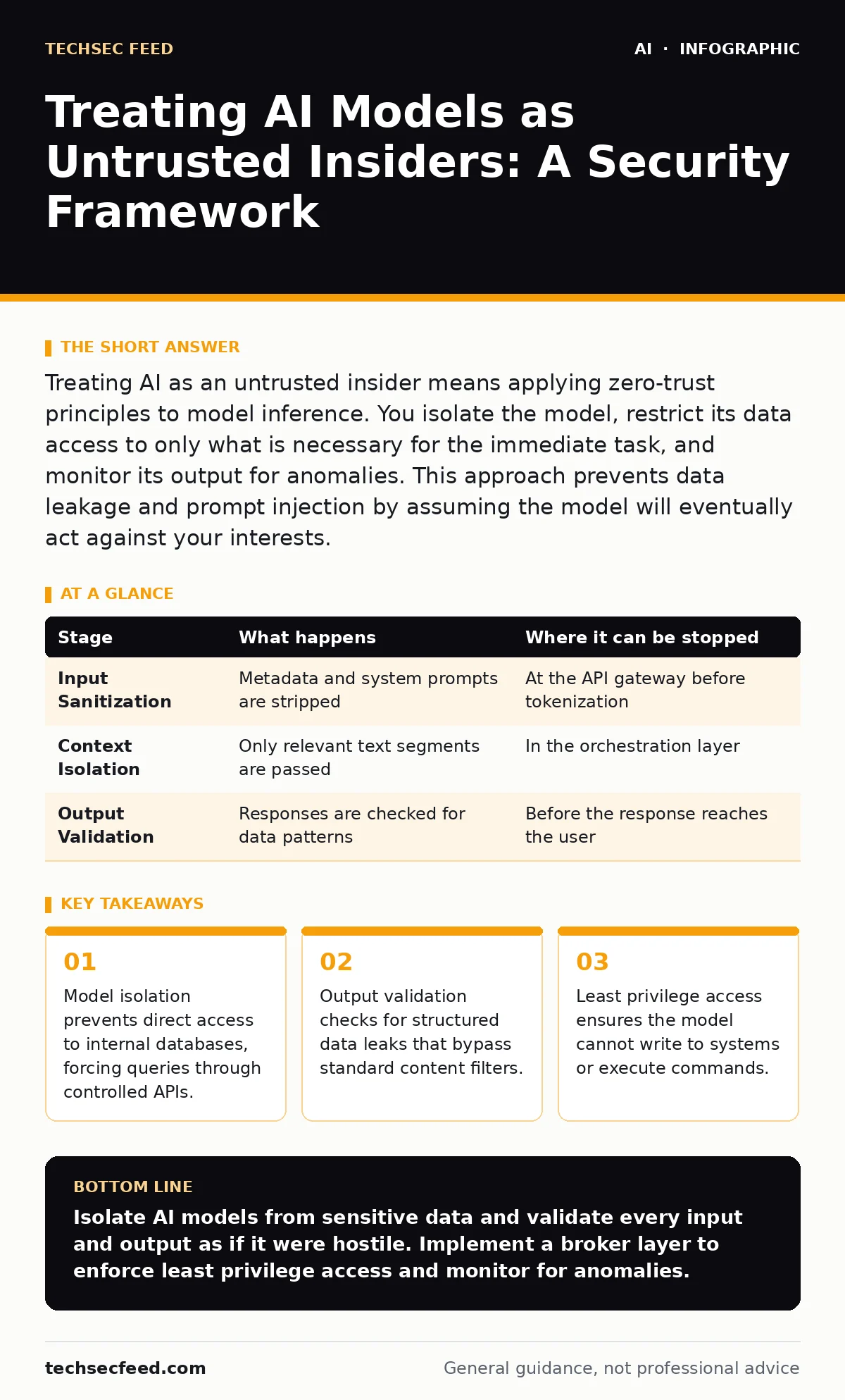
Treating AI as an untrusted insider means applying zero-trust principles to model inference. You isolate the model, restrict its data access to only what is necessary for the immediate task, and monitor its output for anomalies. This approach prevents data leakage and prompt injection by assuming the model will eventually act against your interests.
The Zero-Trust Model Architecture
Standard security assumes the perimeter is secure and insiders are trusted. AI models break this assumption. A large language model can memorize training data or be manipulated to reveal sensitive information via prompt injection. Treating the model as an untrusted insider requires architectural changes that isolate the model from sensitive resources.
You must separate the model from the data it processes. Direct database connections are prohibited. Instead, the model interacts with data through read-only APIs that enforce strict filtering. This separation ensures that even if the model is compromised, it cannot directly access or modify core systems. The model becomes a stateless processor rather than a connected service.
Stage 1: Input Sanitization and Context Isolation
The first stage involves stripping the input of any context that could influence the model’s behavior beyond the intended task. This is not just about removing HTML tags or special characters. It is about removing metadata, user identifiers, and system prompts that could be exploited for jailbreaking.
Context isolation means the model receives only the specific text segment required for the current operation. Historical conversation data is excluded unless explicitly required and sanitized. This prevents the model from using previous interactions to infer sensitive patterns or bypass safety filters. The input is treated as hostile until proven benign.
| Stage | What happens | Where it can be stopped |
|---|---|---|
| Input Sanitization | Metadata and system prompts are stripped | At the API gateway before tokenization |
| Context Isolation | Only relevant text segments are passed | In the orchestration layer |
| Output Validation | Responses are checked for data patterns | Before the response reaches the user |
Stage 2: Least Privilege Data Access
The model must not have direct access to databases or file systems. It operates in a sandboxed environment with no network egress capabilities. When the model needs data, it requests it through a broker service. This broker validates the request, retrieves the data, and returns only the necessary fields.
This mechanism prevents the model from querying for data it does not need. For example, if the model is summarizing a document, it receives the text, not the file path or ownership details. The broker acts as a gatekeeper, ensuring that the model’s access is limited to the minimum information required to complete the specific task. This reduces the attack surface significantly.
Stage 3: Output Validation and Anomaly Detection
The model’s output is never trusted. It is treated as potentially malicious. Validation rules check the output for structured data, such as email addresses, phone numbers, or code snippets, that should not be present in the response. If the model is supposed to return a summary, it should not return raw JSON or SQL queries.
Anomaly detection looks for deviations from expected behavior. If the model suddenly starts generating verbose explanations or repeats input data verbatim, the system flags it as suspicious. This is critical for detecting prompt injection attacks where the model is tricked into revealing its system instructions or training data. The validation layer must be fast and accurate to prevent latency issues.
Stage 4: Continuous Monitoring and Logging
Logging every interaction between the user, the model, and the data broker is mandatory. These logs must include the input, the output, and the metadata of the request. They are stored in a secure, tamper-proof location. This allows for forensic analysis after a security incident.
Monitoring tools analyze these logs for patterns that indicate abuse. For instance, a sudden spike in requests for specific types of data might indicate an attacker trying to extract information. The monitoring system must be able to distinguish between normal usage and malicious activity. This requires baseline metrics and alerting thresholds that are regularly updated.
The Limits of Model Isolation
Isolating the model does not eliminate all risks. The model can still infer sensitive information from the data it is given. If the input data contains sensitive information, the model might memorize it and reproduce it in future responses. This is known as memorization.
Additionally, model isolation adds latency and complexity. Every request must pass through multiple layers of validation and sanitization. This can impact performance and user experience. Balancing security with usability is a constant challenge. You must define acceptable latency thresholds and optimize the validation rules accordingly.
Integration with Existing Security Frameworks
This approach must integrate with your existing access controls for AI agents and AI governance frameworks. The model is just another component in your security ecosystem. It must adhere to the same policies and standards as other systems.
Training data leakage is a related concern. If the model was trained on sensitive data, it might reproduce that data even if the input is clean. You must ensure that the training data is sanitized and that the model is evaluated for memorization before deployment. Generative AI introduces unique risks that traditional security tools cannot address.
Handling Prompt Injection Attacks
Prompt injection is a technique where an attacker embeds malicious instructions in the input data. The model executes these instructions, potentially bypassing safety filters. Treating the model as an untrusted insider helps mitigate this risk by isolating the input and validating the output.
However, prompt injection can still occur. The model might be tricked into ignoring its system instructions. To counter this, you must use robust prompt engineering techniques. This includes separating user input from system instructions and using delimiters to distinguish between them. You must also monitor for unusual model behavior that might indicate a successful injection.
The Hidden Cost of Trust
The biggest risk in AI security is assuming the model is trustworthy. Once you grant the model access to data, you lose control over how that data is used. The model might infer sensitive information or be manipulated to reveal secrets.
Treating the model as an untrusted insider forces you to confront this reality. It requires a shift in mindset from trusting the technology to verifying its behavior. This approach is more secure but also more complex. You must invest in the infrastructure and processes to support this level of scrutiny.
Key takeaways
- Model isolation prevents direct access to internal databases, forcing queries through controlled APIs.
- Output validation checks for structured data leaks that bypass standard content filters.
- Least privilege access ensures the model cannot write to systems or execute commands.
Isolate AI models from sensitive data and validate every input and output as if it were hostile. Implement a broker layer to enforce least privilege access and monitor for anomalies.
Frequently asked questions
How do I prevent data poisoning attacks during training?
Validate and sanitize all training data before it is used. Implement data lineage tracking to identify the source of any data. Regularly audit the training dataset for anomalies and remove any suspicious entries.
Can I use embeddings to secure my AI models?
Embeddings can help in detecting similar inputs and outputs, but they do not prevent data leakage. They are a tool for analysis, not a security control. Use them in conjunction with other security measures.
What is the role of machine learning for fraud detection in this context?
Machine learning models can be used to detect anomalous behavior in AI interactions. They can identify patterns that indicate prompt injection or data exfiltration. However, they must be carefully tuned to avoid false positives.
How do access controls for AI agents differ from traditional access controls?
AI agents require dynamic access controls that adapt to the context of the request. Traditional access controls are static and based on user identity. AI agents need controls that consider the input, the task, and the output.
How this guide was produced: written by the TechSec Feed editorial team with AI assistance, checked against the public references listed below, and reviewed when the facts change. See our editorial policy or report an error.