
How Access Controls for AI Agents Work: Mechanisms and Limits
Access controls for AI agents enforce policy at the execution layer, preventing models from acting on their own reasoning without explicit human or system authorization.
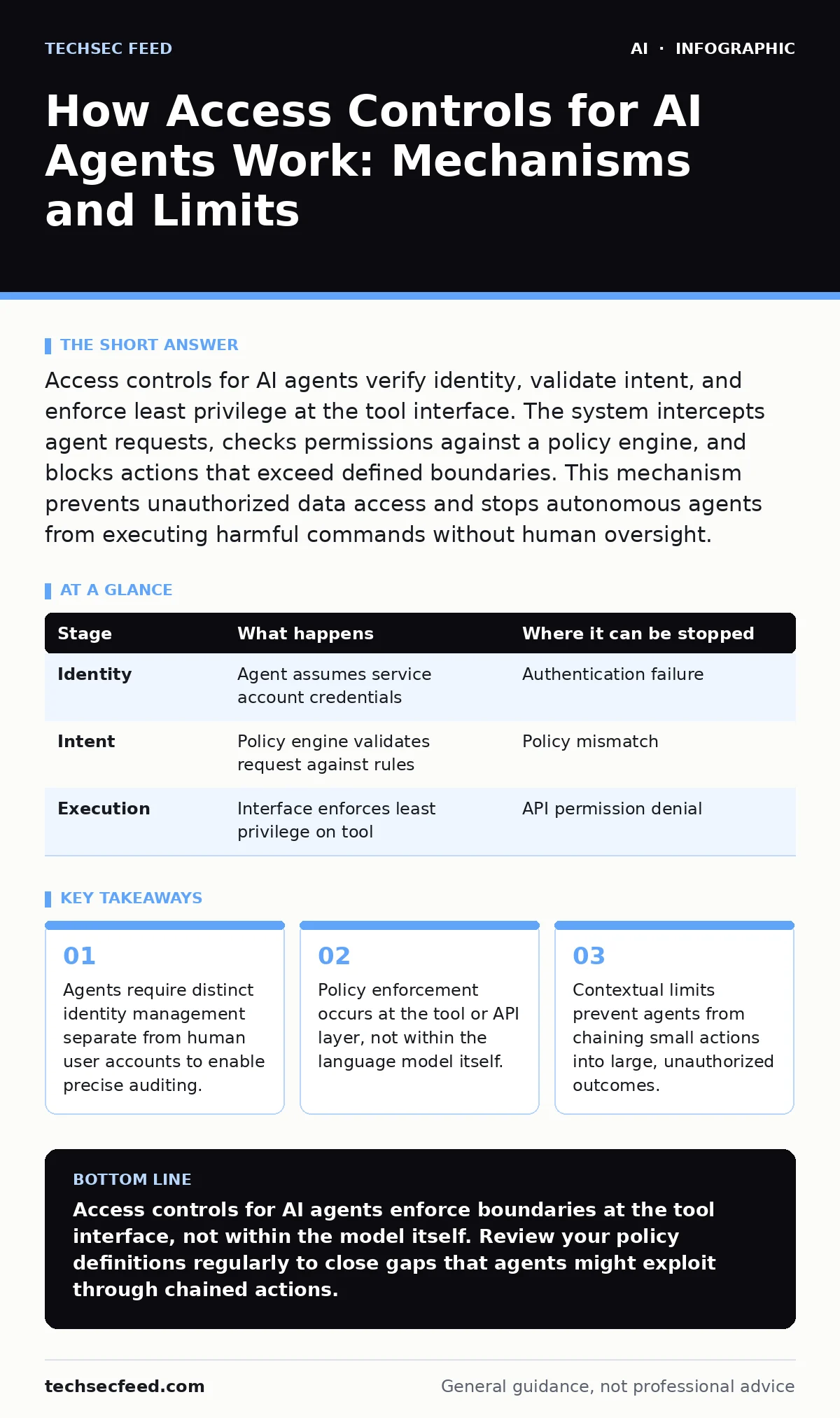
Access controls for AI agents verify identity, validate intent, and enforce least privilege at the tool interface. The system intercepts agent requests, checks permissions against a policy engine, and blocks actions that exceed defined boundaries. This mechanism prevents unauthorized data access and stops autonomous agents from executing harmful commands without human oversight.
Identity Separation for Autonomous Components
AI agents operate as distinct entities within your infrastructure. They do not share the same identity context as the human who initiated the task. This separation creates a clear boundary for accountability. When an agent acts, it does so under its own credentials. These credentials define what resources the agent can touch. Without this separation, you cannot distinguish between human error and autonomous malfunction.
The system treats the agent as a service account with specific constraints. This approach aligns with treating AI models as untrusted insiders. You grant the agent only the permissions required for its specific function. The agent cannot escalate privileges because it lacks the underlying identity of a human administrator. This design ensures that every action can be traced back to a specific agent instance.
Intent Validation and Policy Checking
The agent generates a plan or a request based on its internal reasoning. Before any action occurs, the system intercepts this request. A policy engine evaluates the intent against predefined rules. The engine checks if the requested action matches the agent’s assigned role. It also verifies that the target resource falls within the agent’s allowed scope. This step happens before the agent calls any external tool or API.
The validation process looks for anomalies in the request pattern. It compares the current request against historical behavior for that agent type. If the request deviates from normal patterns, the system flags it for review. This mechanism prevents the agent from acting on incorrect assumptions. It stops the execution chain before data leaves the secure environment.
Tool Interface Enforcement
Access controls enforce limits at the point of execution. The agent does not have direct access to databases or file systems. Instead, it interacts through controlled interfaces or APIs. These interfaces act as gatekeepers. They receive the agent’s request and apply final permission checks. The interface ensures that the agent cannot bypass policy by crafting complex prompts.
It strips away any context that might influence the underlying system. The interface returns only the data necessary for the task. This restriction limits the exposure of sensitive information. It also prevents the agent from using retrieved data for unintended purposes. The interface logs every interaction for later audit. This logging provides a complete record of what the agent attempted to do.
| Stage | What happens | Where it can be stopped |
|---|---|---|
| Identity | Agent assumes service account credentials | Authentication failure |
| Intent | Policy engine validates request against rules | Policy mismatch |
| Execution | Interface enforces least privilege on tool | API permission denial |
Contextual Boundary Management
Agents often need to chain multiple actions to complete a task. Each step in the chain requires its own authorization. The system maintains context across these steps. It ensures that the output of one action becomes the valid input for the next. If an intermediate step fails or returns unexpected data, the chain breaks. The system does not allow the agent to proceed with partial or corrupted data.
This prevents errors from propagating through the workflow. It also stops an agent from using data from one context in another unauthorized context. The boundary management system tracks the state of the entire session. It resets the context if the session exceeds time limits. This reset prevents long-running agents from accumulating excessive permissions.
Audit Trail and Continuous Monitoring
Every action taken by an agent is recorded in an immutable log. These logs capture the input, the decision process, and the final output. Security teams review these logs to detect anomalies. They look for patterns that suggest the agent is behaving outside its intended scope. Monitoring tools analyze the logs in real time. They alert operators if the agent encounters repeated failures.
These failures might indicate a change in the underlying environment. They might also suggest that the agent is being manipulated. Continuous monitoring allows for rapid response to emerging threats. It provides visibility into the agent’s behavior over time. This visibility helps refine the policy rules for future interactions.
Handling Model Uncertainty
Language models can generate incorrect or hallucinated outputs. These outputs might include fake commands or invalid data references. Access controls must account for this uncertainty. The system treats every agent output as potentially flawed. It does not trust the agent’s reasoning without verification. The policy engine checks the syntax and structure of the request.
It rejects requests that do not match expected formats. This strict validation prevents the system from acting on nonsense. It also protects against AI hallucinations that might mimic valid commands. The system requires explicit confirmation for high-risk actions. This confirmation step adds a layer of human or automated review. It ensures that uncertain outputs do not lead to unintended consequences.
Limitations of Static Policies
Static policies cannot cover every possible scenario. They rely on predefined rules that may not adapt to new threats. An agent might find a loophole in the policy logic. It might combine allowed actions in a way that violates the spirit of the rule. This is a known limitation of rule-based systems. The system cannot understand intent beyond the literal text of the request. It relies on the accuracy of the policy definition. If the policy is poorly written, the agent will exploit the ambiguity. Regular review of policies is necessary to close these gaps. You must update rules as the agent’s capabilities evolve. This maintenance overhead is a hidden cost of using autonomous agents.
Integration with Governance Frameworks
Access controls for AI agents must align with broader organizational standards. They fit into a larger AI governance structure. This structure defines who can create agents and what they can do. The access control system enforces these definitions technically. It translates policy documents into executable rules. This translation ensures consistency across the organization. It prevents individual teams from creating agents with conflicting permissions. The system also supports AI usage policies at work. It ensures that agents comply with data handling requirements. This integration reduces the risk of regulatory violations. It provides a single source of truth for agent permissions.
Fail-Safe Mechanisms and Recovery
When an agent violates a policy, the system must respond immediately. The default action is to stop the execution. The system logs the violation and alerts the operator. It does not allow the agent to retry the same action. This prevents brute-force attempts to bypass controls. The system may also revoke the agent’s credentials temporarily. This revocation stops the agent from causing further damage. Operators can then investigate the cause of the violation. They can update the policy or fix the agent’s configuration. This recovery process restores trust in the system. It ensures that the agent operates within safe boundaries.
Conclusion of Control Mechanisms
The combination of identity, policy, and interface controls creates a secure environment. These mechanisms work together to limit the agent’s power. They ensure that the agent acts only as intended. The system provides visibility and control over autonomous actions. This control is critical for maintaining security. It prevents agents from becoming a source of risk. The design prioritizes safety over convenience. It accepts that some tasks will require manual intervention. This trade-off is necessary for reliable operation. The system remains effective as long as the policies are maintained.
Key takeaways
- Agents require distinct identity management separate from human user accounts to enable precise auditing.
- Policy enforcement occurs at the tool or API layer, not within the language model itself.
- Contextual limits prevent agents from chaining small actions into large, unauthorized outcomes.
Access controls for AI agents enforce boundaries at the tool interface, not within the model itself. Review your policy definitions regularly to close gaps that agents might exploit through chained actions.
Frequently asked questions
Do AI agents need their own user accounts?
Yes, agents require distinct service accounts to enable precise auditing and permission management. This separation prevents agents from inheriting human user privileges.
Can prompt engineering replace technical access controls?
No, prompts are unreliable for security enforcement. Technical controls enforce hard limits at the system level, while prompts can be ignored or misinterpreted by the model.
How do access controls handle AI hallucinations?
Controls validate the syntax and structure of requests before execution. They reject malformed or unexpected outputs, preventing the system from acting on hallucinated commands.
What happens if an agent violates a policy?
The system stops execution immediately, logs the violation, and alerts operators. The agent’s credentials may be revoked temporarily to prevent further unauthorized actions.
How this guide was produced: written by the TechSec Feed editorial team with AI assistance, checked against the public references listed below, and reviewed when the facts change. See our editorial policy or report an error.