
AI Governance Framework: Structure, Controls, and Hidden Costs
Governance fails when teams treat models as static software rather than dynamic systems that drift and degrade over time without constant monitoring.
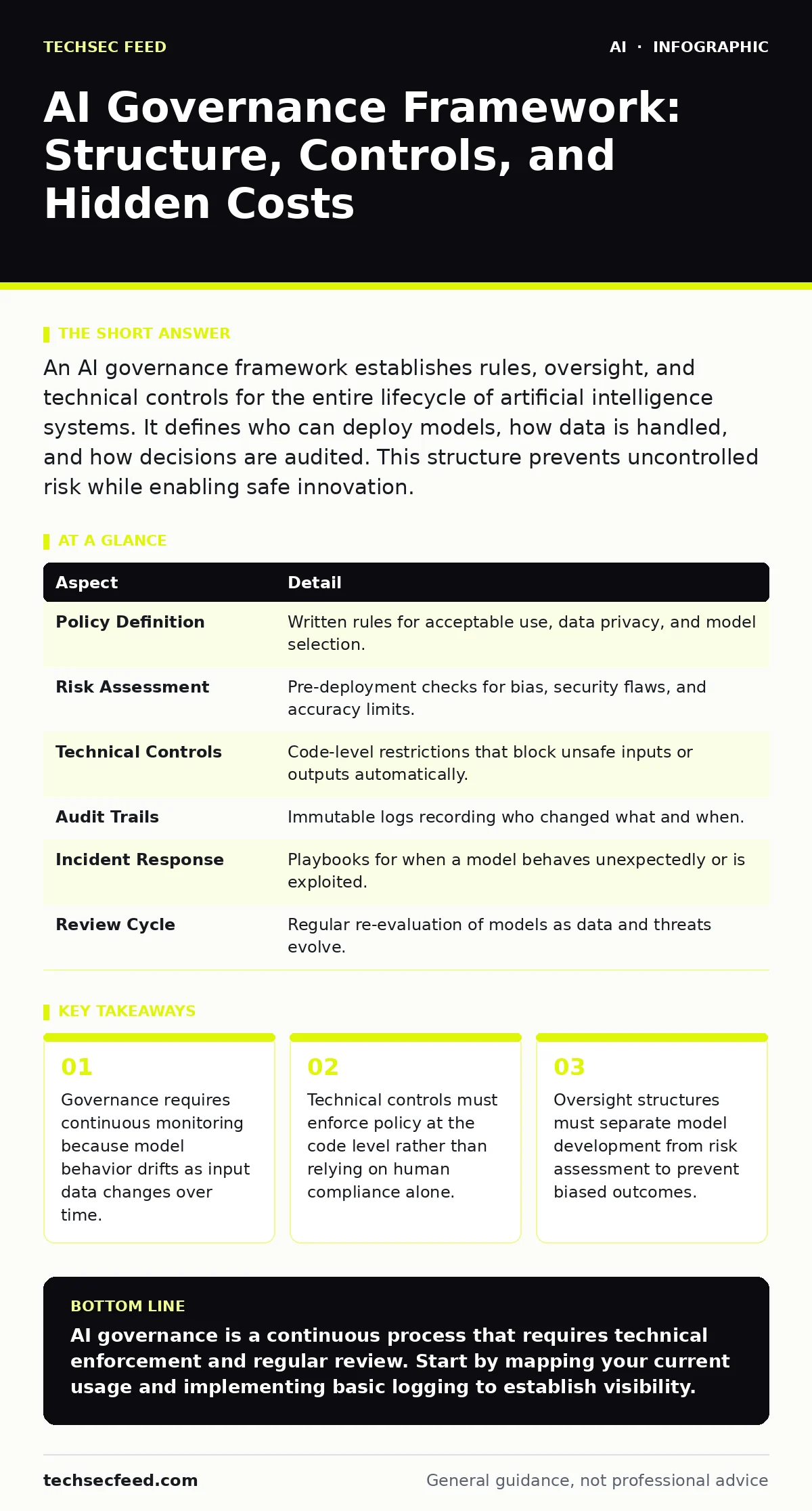
An AI governance framework establishes rules, oversight, and technical controls for the entire lifecycle of artificial intelligence systems. It defines who can deploy models, how data is handled, and how decisions are audited. This structure prevents uncontrolled risk while enabling safe innovation.
Everyday Analogy for System Control
Imagine a commercial airline. Pilots do not decide flight paths on impulse. Air traffic control provides routes. Maintenance crews follow strict checklists. Black boxes record every decision. This structure prevents chaos. AI governance works the same way. It replaces ad-hoc experimentation with structured oversight. The pilot is the developer. The air traffic control is the policy framework. The black box is the audit log. Without this structure, every deployment is a risky experiment.
At a Glance: Governance Components
| Aspect | Detail |
|---|---|
| Policy Definition | Written rules for acceptable use, data privacy, and model selection. |
| Risk Assessment | Pre-deployment checks for bias, security flaws, and accuracy limits. |
| Technical Controls | Code-level restrictions that block unsafe inputs or outputs automatically. |
| Audit Trails | Immutable logs recording who changed what and when. |
| Incident Response | Playbooks for when a model behaves unexpectedly or is exploited. |
| Review Cycle | Regular re-evaluation of models as data and threats evolve. |
What Is an AI Governance Framework
An AI governance framework is a structured set of policies, processes, and technical controls that manage the development, deployment, and operation of artificial intelligence systems. It ensures that models behave as intended and comply with organizational standards. The framework connects high-level strategy with low-level engineering. It answers who can build models, what data they can use, and how errors are handled. This structure reduces the chance of accidental harm or malicious exploitation. It turns vague intentions into enforceable rules. Without it, teams operate in silos with inconsistent standards.
How the Framework Operates in Practice
The framework operates through three layers. The first layer is policy. It defines acceptable use cases and prohibited activities. The second layer is process. It mandates reviews before deployment. The third layer is technology. It enforces rules automatically. For example, a policy might ban using customer data for training. The process requires a privacy review. The technology blocks the data from entering the training pipeline. These layers work together. If one fails, the others provide backup. This redundancy is necessary because humans make mistakes. Automation catches errors that reviewers miss.
Who Is Affected by Governance Rules
Governance affects every role in the organization. Developers must write code that complies with security standards. They cannot bypass controls for convenience. Data engineers must ensure training data is clean and legally sourced. They must document where data comes from. Product managers must define clear success metrics and failure thresholds.
They cannot deploy models that lack clear evaluation criteria. Legal teams must review compliance with external regulations. They must update policies as laws change. Security teams must monitor for attacks. They must treat AI models as untrusted insiders. This broad impact means governance is not just an IT concern. It is a business-wide discipline.
See also: What Is Data Leakage in Machine Learning: The Hidden Risk
Common Misconceptions About AI Safety
Many teams believe governance is a one-time checklist. This view is dangerous. Models degrade over time. Input data changes. Attackers find new methods. A model that is safe today may be unsafe tomorrow. Another common mistake is treating AI as software. Software does not change its behavior without code updates. AI models can produce different outputs for similar inputs. This non-determinism requires continuous monitoring. Teams often ignore the cost of governance. They see it as overhead. In reality, lack of governance costs more in incident response. It also damages trust. Users lose confidence when systems behave unpredictably.
Building Controls That Actually Work
Effective controls are embedded in the development pipeline. They are not afterthoughts. You must define clear boundaries for model capabilities. You must restrict access to sensitive data. You must log all interactions. Logging is critical for forensic analysis. If a model makes a wrong decision, you need to know why. You must also plan for failure. What happens if the model is compromised? What happens if it produces harmful content? You need automated kill switches. These switches stop the model when it violates rules. They prevent small errors from becoming large incidents. This approach aligns with responsible AI practices. It ensures that innovation does not outpace safety.
The Hidden Cost of Poor Oversight
Poor oversight creates hidden technical debt. When teams skip reviews, they accumulate risk. This risk manifests as unexpected behavior. It may take months to discover a bias in the model. It may take years to find a data poisoning attack. Fixing these issues later is expensive. It requires retraining models. It requires cleaning data. It requires rebuilding trust. The cost of prevention is lower than the cost of remediation. Prevention also provides clarity. Teams know what is allowed. They do not waste time guessing. This clarity speeds up development. It reduces friction between teams. Governance is an enabler, not a blocker.
Integrating With Existing Security Practices
AI governance must integrate with existing security practices. It cannot exist in isolation. You must apply the same rigor to AI as you do to traditional software. This means version control. This means peer review. This means automated testing. You must also consider retrieval-augmented generation security. This technique uses external data to improve model answers.
It introduces new attack vectors. You must secure the data source. You must verify the relevance of retrieved information. You must also manage AI agents carefully. These autonomous systems can take actions. You must limit their scope. You must monitor their decisions. This integration ensures consistent protection across the organization.
What To Do Next
Start by defining your risk tolerance. Decide what you are willing to accept. Then map your current AI usage. Identify where models are deployed. Assess the data they use. Implement basic logging. Ensure you can trace decisions. Build a small team to oversee this process. Define clear policies. Enforce them with technical controls. Review your approach regularly. Update it as technology changes. This iterative approach builds resilience. It protects your organization while enabling innovation.
Key takeaways
- Governance requires continuous monitoring because model behavior drifts as input data changes over time.
- Technical controls must enforce policy at the code level rather than relying on human compliance alone.
- Oversight structures must separate model development from risk assessment to prevent biased outcomes.
AI governance is a continuous process that requires technical enforcement and regular review. Start by mapping your current usage and implementing basic logging to establish visibility.
Frequently asked questions
How do I prevent data poisoning attacks in my models?
Implement strict data validation pipelines. Verify the source and integrity of all training data. Use anomaly detection to identify unusual patterns in inputs.
What is the difference between AI governance and AI ethics?
Ethics provides the principles and values. Governance provides the rules and processes to implement those values. Ethics asks what is right. Governance ensures it is done.
Can I automate AI governance entirely?
No. Automation enforces rules, but humans must define them. Humans must also review exceptions and update policies. Automation supports governance but does not replace judgment.
How often should I review my AI governance framework?
Review it at least annually. Review it immediately after any significant incident. Review it when new models are deployed. Review it when regulations change.
How this guide was produced: written by the TechSec Feed editorial team with AI assistance, checked against the public references listed below, and reviewed when the facts change. See our editorial policy or report an error.