
vector embeddings example: how numeric maps hide data risks
Numeric representations of text allow instant similarity searches but create new attack surfaces for data exfiltration and inference.
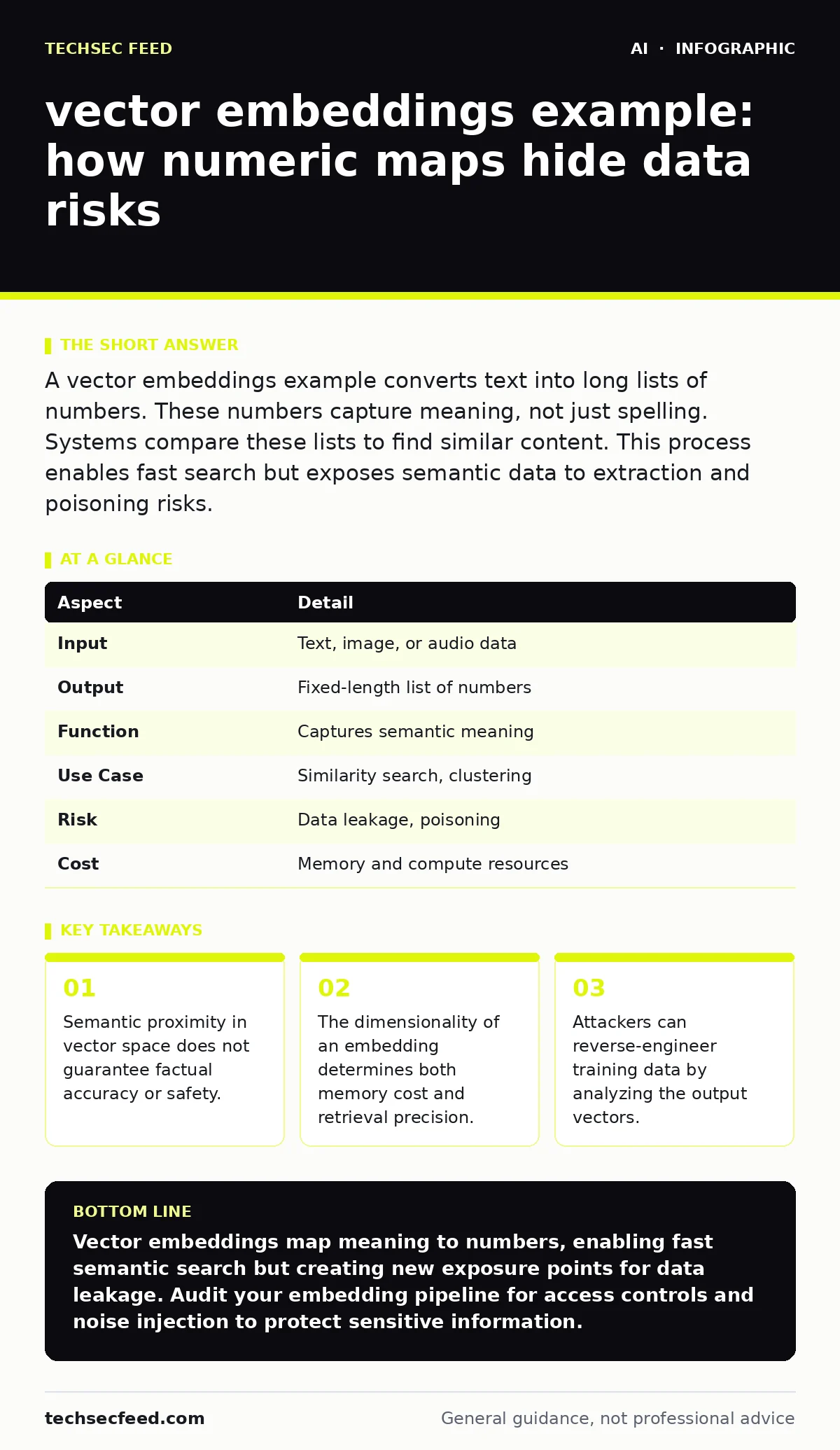
A vector embeddings example converts text into long lists of numbers. These numbers capture meaning, not just spelling. Systems compare these lists to find similar content. This process enables fast search but exposes semantic data to extraction and poisoning risks.
Why meaning matters more than words
Imagine a library where books are not sorted by author or title. Instead, every book is assigned a coordinate in a multi-dimensional room. Books about "dogs" sit near books about "puppies". Books about "cars" sit far away. This spatial arrangement is the core function of an embedding.
A vector embedding is a numerical representation of data that captures its semantic meaning. It transforms unstructured information like text, images, or audio into fixed-length lists of numbers. These numbers allow machines to calculate similarity between items. The system does not read the words. It measures the distance between the numeric points.
This approach changes how software handles information. Traditional search looks for exact keyword matches. If you search for "canine", a keyword system might miss a document about "dogs". An embedding system finds the document because the numeric coordinates for "canine" and "dogs" are close together. The system understands context, not just character strings.
vector embeddings example
To understand the mechanics, consider a simple text classification task. You want to group customer support tickets by topic. You feed the tickets into an embedding model. The model outputs a list of numbers for each ticket. A ticket about "login failure" might produce a vector starting with [0.1, -0.5, 0.9]. A ticket about "password reset" might produce [0.2, -0.6, 0.8].
The system calculates the distance between these two vectors. The distance is small. The system groups them together. A ticket about "billing" produces [0.9, 0.1, -0.2]. The distance to the login tickets is large. The system keeps them separate. This example shows how numeric proximity maps to conceptual similarity.
How the mapping works
The process begins with a pre-trained model. This model has already processed massive amounts of text. It has learned which words appear together and which concepts are related. When you input new text, the model breaks it into tokens. It passes these tokens through multiple layers of neural networks.
Each layer extracts different features. Early layers might identify individual words. Later layers identify phrases and sentence structure. The final layer outputs the vector. This vector is fixed in size. A model might always output 768 numbers, regardless of whether the input is one word or one page.
This fixed size is critical for performance. It allows the system to store millions of vectors in memory. It enables rapid comparison using standard mathematical operations. The model does not need to re-read the text to compare it. It only needs to compare the numbers. This efficiency is why embeddings power modern retrieval systems.
| Aspect | Detail |
|---|---|
| Input | Text, image, or audio data |
| Output | Fixed-length list of numbers |
| Function | Captures semantic meaning |
| Use Case | Similarity search, clustering |
| Risk | Data leakage, poisoning |
| Cost | Memory and compute resources |
The hidden costs of dimensionality
Every number in the vector adds memory overhead. A vector with 1,536 dimensions takes twice as much space as one with 768 dimensions. This matters when you store millions of records. Memory costs scale linearly with dimensionality. High-dimensional vectors also slow down search operations.
There is a trade-off between precision and speed. Higher dimensions can capture more nuance. They distinguish between subtle differences in meaning. Lower dimensions are faster to compute and store. They may merge distinct concepts into the same cluster. You must choose a dimensionality that fits your accuracy requirements and your infrastructure limits.
Another cost is the training data footprint. The model that creates the embeddings retains patterns from its training set. If the training data contains biased or sensitive information, the embeddings will reflect those patterns. This makes it difficult to audit the system for fairness or compliance. The numeric representation hides the source of the bias.
Who it affects
Developers building search engines use embeddings to improve relevance. They replace keyword matching with semantic matching. This affects user experience directly. Users find what they need faster. They do not need to know the exact terminology used in the database.
Security teams face new challenges. Embeddings can leak information about the training data. An attacker who can query the embedding model might infer sensitive details. This is a form of model inversion. The attacker reconstructs private data from the numeric outputs. This risk exists even if the original data is deleted.
Legal and compliance officers must consider data residency. The vectors themselves are data. They represent personal or proprietary information. Storing these vectors in a cloud database may violate data protection laws. The numeric format does not remove the data from regulatory scope. It only changes how it is stored.
See also: Large Language Models vs Machine Learning: Core Differences Explained · Generative AI Defined: Mechanics, Origins, and Operational Reality
What people usually get wrong
Many assume that similar vectors mean identical content. This is false. Two texts can be semantically similar but factually opposite. A vector for "the sky is blue" might be close to a vector for "the ocean is blue". They share color and nature concepts. They do not share truth values. The system cannot distinguish fact from fiction based on the vector alone.
Another mistake is trusting the default parameters. Embedding models often come with pre-set configurations. These defaults may not suit your specific use case. A model trained on general news may perform poorly on legal documents. You need to fine-tune the model or choose a domain-specific variant. Using a generic model for specialized tasks reduces accuracy.
People also overlook the index structure. Storing vectors is not enough. You need an efficient way to search them. Linear scans compare every vector in the database. This is too slow for large datasets. Approximate nearest neighbor algorithms speed up search by grouping similar vectors. These algorithms introduce a small error margin. You must balance speed against precision.
Mitigating the risks
You can reduce data leakage by adding noise to the vectors. This technique, known as differential privacy, makes it harder to reverse-engineer the original text. The noise degrades search accuracy slightly. You must test the impact on your specific workload. Too much noise renders the search useless. Too little noise leaves the data exposed.
Access controls are critical. Not everyone should be able to query the embedding index. Restrict access to authorized applications and users. Log all queries to the embedding database. This helps detect unusual patterns that might indicate an attack. An attacker might probe the system with many queries to map the data.
Regular audits of the embedding model are necessary. Check for drift in the data distribution. If your input data changes over time, the embeddings may become less accurate. You may need to retrain the model or update the index. This is related to data poisoning attacks, where malicious inputs degrade the model's performance.
Next steps for implementation
Start by defining your similarity metric. Decide what "similar" means for your use case. Is it about topic, sentiment, or entity? This choice determines which model you use. Different models optimize for different aspects of meaning. A model good for sentiment analysis may be poor for entity recognition.
Prototype with a small dataset. Measure the accuracy and latency of the search. Adjust the dimensionality and the index parameters. Find the sweet spot between speed and precision. Document the configuration decisions. This documentation helps future teams understand the trade-offs.
Integrate the embeddings into your broader security strategy. Consider retrieval-augmented generation security if you use these vectors with large language models. The vectors provide context to the model. If the context is poisoned or leaked, the model's output is compromised. Ensure the entire pipeline is secure.
Key takeaways
- Semantic proximity in vector space does not guarantee factual accuracy or safety.
- The dimensionality of an embedding determines both memory cost and retrieval precision.
- Attackers can reverse-engineer training data by analyzing the output vectors.
- Indexing strategies significantly impact the speed and accuracy of similarity searches.
Vector embeddings map meaning to numbers, enabling fast semantic search but creating new exposure points for data leakage. Audit your embedding pipeline for access controls and noise injection to protect sensitive information.
Frequently asked questions
Can vector embeddings be reversed to original text?
Partially. Advanced techniques can reconstruct fragments of the original text from the vector, especially if the model is small or the data is unique.
How do I choose the right embedding model?
Select a model trained on data similar to your use case. General models work for broad topics. Domain-specific models work for technical or legal text.
What is the difference between keyword search and vector search?
Keyword search matches exact words. Vector search matches meaning. Vector search finds synonyms and related concepts that keyword search misses.
Do embeddings slow down my database?
Yes, if you use linear scans. Use approximate nearest neighbor indexes to maintain speed. These indexes trade a small amount of accuracy for significant speed gains.
How this guide was produced: written by the TechSec Feed editorial team with AI assistance, checked against the public references listed below, and reviewed when the facts change. See our editorial policy or report an error.