
Machine Learning for Fraud Detection: How It Works and What It Misses
Machine learning for fraud detection identifies anomalies by finding hidden patterns in data, but it often flags legitimate behavior as malicious when user habits shift unexpectedly.
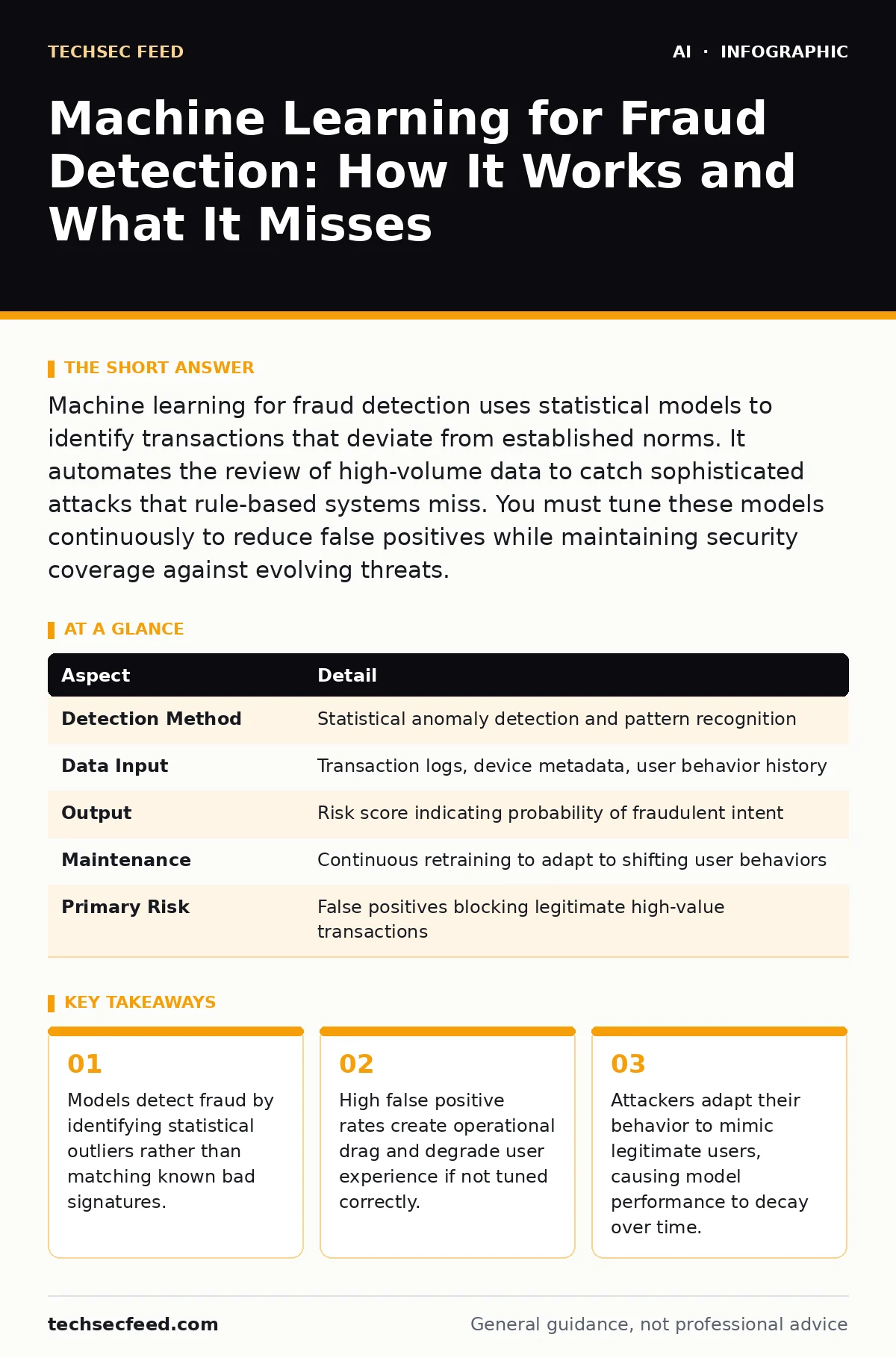
Machine learning for fraud detection uses statistical models to identify transactions that deviate from established norms. It automates the review of high-volume data to catch sophisticated attacks that rule-based systems miss. You must tune these models continuously to reduce false positives while maintaining security coverage against evolving threats.
How Machine Learning for Fraud Detection Works
Imagine a librarian who knows every patron’s reading habits. If a quiet student suddenly checks out 50 heavy textbooks in one hour, the librarian flags the event. The librarian does not need a rule stating "students cannot take 50 books." The librarian recognizes the deviation from the norm. Machine learning for fraud detection operates on this same principle of behavioral baselining.
The system ingests historical transaction data to build a profile of normal activity for each user or account. It calculates features such as transaction frequency, geographic location, device fingerprint, and time of day. When a new event occurs, the model compares it against the established baseline. If the probability of the event belonging to the "normal" cluster falls below a set threshold, the system flags it for review.
This approach differs fundamentally from rule-based systems. Models are dynamic. They learn that a specific user never buys from a certain country, regardless of the amount. The model assigns a risk score based on the aggregate deviation of multiple features, not just one threshold breach.
| Aspect | Detail |
|---|---|
| Detection Method | Statistical anomaly detection and pattern recognition |
| Data Input | Transaction logs, device metadata, user behavior history |
| Output | Risk score indicating probability of fraudulent intent |
| Maintenance | Continuous retraining to adapt to shifting user behaviors |
| Primary Risk | False positives blocking legitimate high-value transactions |
Who It Affects
The impact of machine learning for fraud detection extends beyond the security team. Customers experience friction when their legitimate actions trigger security holds. A user traveling abroad may find their card declined because the location deviates from their home pattern. This friction leads to abandoned carts and support calls.
Merchants bear the cost of manual review. When a model flags a transaction, a human analyst must verify it. High false positive rates require larger review teams. This labor cost scales with the volume of flagged events. Merchants also face chargeback fees if they fail to catch fraud that the model missed.
Attackers adapt to these systems. They study the features models use and adjust their tactics. If a model flags rapid successive logins, attackers slow down their attempts. If it flags new devices, attackers use compromised credentials from similar devices. This cat-and-mouse dynamic means the system affects attackers by raising their operational cost, forcing them to be more careful and slower.
What People Usually Get Wrong
Many organizations treat the model as a set-and-forget solution. They deploy it and assume it will improve automatically. Models degrade over time. User behavior changes seasonally or after marketing campaigns. A model trained on winter data may flag summer travel patterns as suspicious. Without retraining, the model’s accuracy drops.
Another common error is ignoring the feedback loop. When analysts review flagged transactions, they mark them as true fraud or false positive. This labeled data is the fuel for retraining. If teams do not feed this feedback back into the training pipeline, the model never learns from its mistakes. It continues to make the same errors, wasting analyst time.
Teams often over-rely on accuracy metrics. You must evaluate precision and recall. Precision measures how many flagged events are actually fraud. Recall measures how much actual fraud the model catches. Balancing these two metrics is the core engineering challenge.
The Hidden Cost of False Positives
Every false positive carries a hidden cost. The immediate cost is the analyst’s time to review the case. The secondary cost is customer churn. If a user’s account is locked repeatedly, they may switch to a competitor. The tertiary cost is brand damage. Users perceive excessive security friction as incompetence or lack of trust.
Suppose a legitimate user buys a gift card for a friend. The model flags this because the recipient’s address is in a high-risk region. The user must call support to prove the purchase is legitimate. This interaction takes 15 minutes of support staff time and frustrates the buyer. If this happens three times, the buyer leaves.
Security teams often view false positives as a necessary evil. They are not. They indicate a misaligned model. The model is learning the wrong features or the threshold is too sensitive. Reducing false positives requires better feature engineering. You must include context that distinguishes legitimate unusual behavior from malicious behavior. For example, a user logging in from a new device after a password reset is unusual but expected. A model that ignores the password reset context will flag this as suspicious.
Adapting to Adversarial Behavior
Attackers do not behave randomly. They study your defenses. If they know you use machine learning for fraud detection, they will attempt to poison your training data. They might generate thousands of small, legitimate-looking transactions to train your model to accept that pattern. Once the model accepts the pattern, the attacker executes a large fraud using the same signature.
This is known as model poisoning. It requires the attacker to have access to the production system to inject data. This is why treating AI models as untrusted insiders is a necessary security posture. You must assume the model itself can be manipulated.
Another tactic is evasion. Attackers modify their requests to stay just below the detection threshold. If the model flags transactions over a certain risk score, attackers adjust their behavior to score slightly lower. This requires the model to use ensemble methods. Combining multiple models with different detection logic makes it harder for attackers to find a single blind spot. One model might detect geographic anomalies, while another detects device fingerprint mismatches. Both must be satisfied for the transaction to pass.
See also: Large Language Models vs Machine Learning: Core Differences Explained · Generative AI Defined: Mechanics, Origins, and Operational Reality
Integrating With Human Review
Machine learning for fraud detection does not replace humans. It prioritizes work. The model scores every event. The highest risk events go to senior analysts. Lower risk events go to junior staff or automated workflows. This tiered approach maximizes efficiency.
You must design the workflow around the model’s confidence. If the model is highly confident, you can automate the decision. Block the transaction or allow it without human review. If the model is uncertain, route it to a human. The human’s decision then becomes a new training example. This creates a closed loop where the system improves with every interaction.
Access controls for AI agents must be strict. The model should only have read access to transaction data. It should not have the ability to modify user accounts or delete logs. The model is a sensor, not an actor. Separating detection from action prevents a compromised model from causing damage directly.
Maintaining Model Integrity
Regular audits are necessary to ensure the model remains aligned with business goals. Check for drift. Data drift occurs when the input data distribution changes. Concept drift occurs when the relationship between input features and the target variable changes. Both degrade performance.
You must monitor feature importance. If the model starts relying on a feature that is easily manipulated, it is vulnerable. For example, if the model relies heavily on IP address reputation, attackers can use clean IPs. You must diversify features to include device telemetry, behavioral biometrics, and network metadata.
Generative AI can help create synthetic data for training. This allows you to test the model against rare fraud scenarios without exposing real user data. However, you must validate that the synthetic data accurately reflects real-world distributions. Poor synthetic data can introduce biases that harm the model’s performance in production.
Key takeaways
- Models detect fraud by identifying statistical outliers rather than matching known bad signatures.
- High false positive rates create operational drag and degrade user experience if not tuned correctly.
- Attackers adapt their behavior to mimic legitimate users, causing model performance to decay over time.
Frequently asked questions
Does machine learning for fraud detection replace rule-based systems?
No. Rules provide a baseline for known threats and regulatory compliance. Models handle complex, unknown patterns. The best systems use both, with rules catching obvious threats and models handling nuanced anomalies.
How often should you retrain a fraud detection model?
Retraining frequency depends on data velocity and concept drift. Many teams retrain weekly or monthly. You should monitor performance metrics continuously and trigger retraining when accuracy drops below a defined threshold.
Can attackers fool machine learning fraud models?
Yes. Attackers use techniques like model poisoning and evasion to bypass detection. You must assume the model can be fooled and implement layered defenses, including human review and diverse feature sets.
What is the biggest risk of using AI for fraud detection?
The biggest risk is operational fatigue from high false positive rates. This leads to analyst burnout and customer churn. You must prioritize precision to ensure that flagged events are likely to be fraudulent.
How this guide was produced: written by the TechSec Feed editorial team with AI assistance, checked against the public references listed below, and reviewed when the facts change. See our editorial policy or report an error.