What Is Data Residency: How Location Rules Protect Your Cloud
Data residency rules force you to treat server location as a security control, creating hidden friction in disaster recovery and compliance audits.
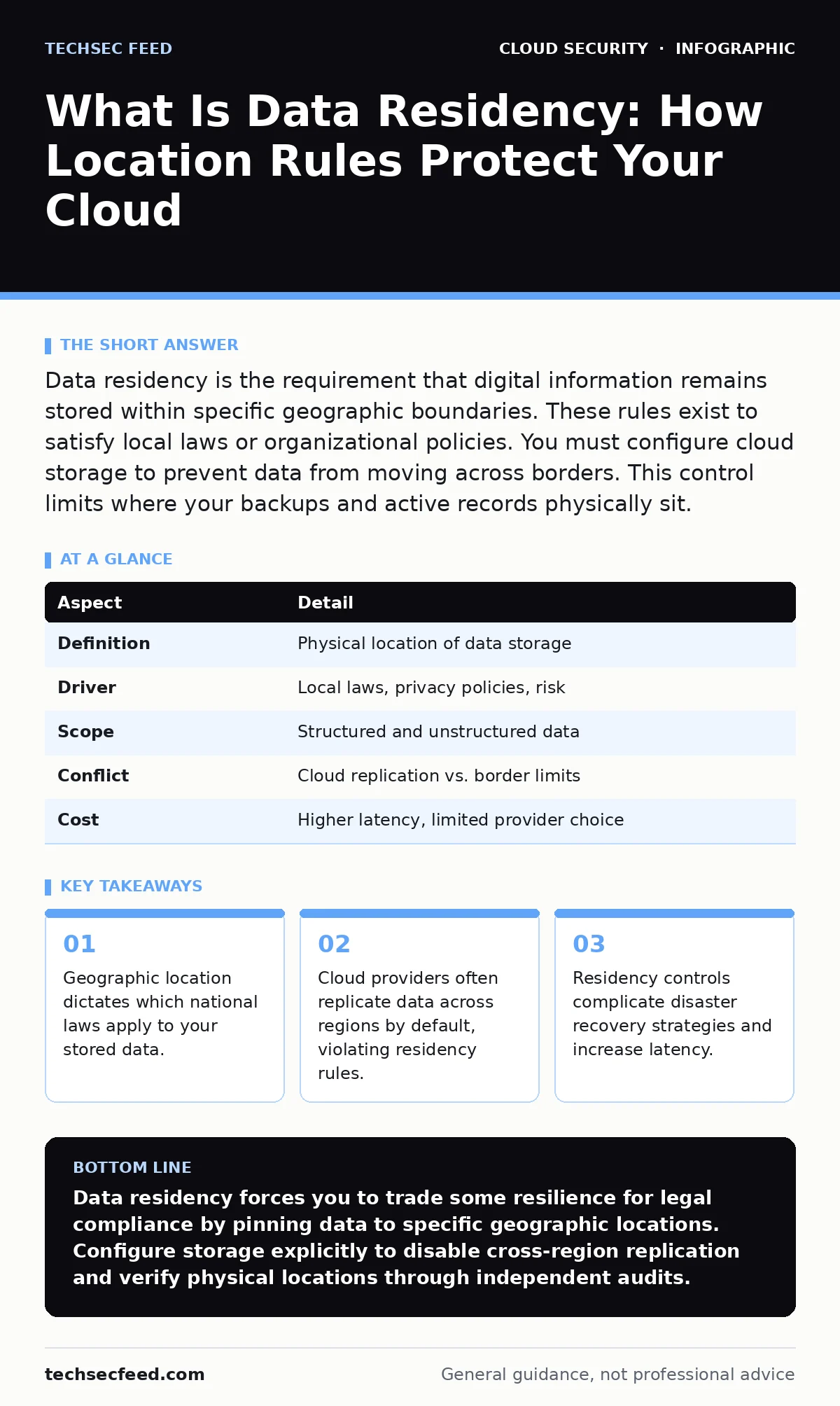
Data residency is the requirement that digital information remains stored within specific geographic boundaries. These rules exist to satisfy local laws or organizational policies. You must configure cloud storage to prevent data from moving across borders. This control limits where your backups and active records physically sit.
The Postal Service Analogy
Imagine you send a sealed letter to a friend. You expect it to stay in your country until it arrives. Now imagine the postal service decides to copy that letter, store the copy in a warehouse in another country, and then mail the original. You did not ask for this. You cannot read the copy. You do not know where it sits. Data residency works like that postal rule, but for digital files. You expect your data to stay in a specific place. Cloud infrastructure often moves it without asking.
What Is Data Residency
Data residency is the legal or policy requirement that data stays within a defined geographic boundary. It differs from data sovereignty, which focuses on which national laws govern the data. Residency cares about physical location. Sovereignty cares about legal jurisdiction. You can have data in a country that follows foreign laws, or data in a country that follows local laws. The distinction matters for compliance teams. You must know where the disks spin.
| Aspect | Detail |
|---|---|
| Definition | Physical location of data storage |
| Driver | Local laws, privacy policies, risk |
| Scope | Structured and unstructured data |
| Conflict | Cloud replication vs. border limits |
| Cost | Higher latency, limited provider choice |
How Residency Controls Work
Cloud providers divide their infrastructure into regions and availability zones. A region is a geographic area, like a state or a country. An availability zone is a distinct data center within that region. To enforce residency, you must pin your storage buckets and databases to a specific region. You must disable cross-region replication. This prevents the cloud provider from creating shadow copies in neighboring zones. Many default configurations enable replication for durability. You must turn this off to meet residency requirements.
Who Residency Rules Affect
Regulators enforce residency for financial records, health data, and government information. They want to ensure local courts can access evidence. They want to prevent foreign intelligence agencies from scanning backups. Organizations adopt residency to meet these rules. They also use it to manage risk. If a foreign government seizes a data center, your data is gone. Residency limits this exposure. It forces you to choose providers with local presence. It reduces your reliance on global infrastructure.
The Hidden Cost of Compliance
Residency creates friction in disaster recovery. You cannot easily replicate data to a distant region for safety. This limits your options during a regional outage. You may need to build secondary infrastructure in a different country. This doubles your costs. It increases complexity. You must manage two sets of configurations. You must ensure both sets meet residency rules. This tension between safety and location is the core challenge. You trade resilience for compliance.
See also: Cloud Disaster Recovery: How to Restore Services Without Downtime · Detect Overprivileged Cloud Identities Through Log Analysis
What People Usually Get Wrong
Many teams assume that selecting a region name ensures residency. This is incorrect. Cloud providers may move data within that region for maintenance. They may move it to a neighboring region for performance. You must verify the physical location of the underlying hardware. You must check the provider’s documentation for data movement policies. Some providers offer "locked" regions where data never leaves. Others do not. You must read the fine print.
Another common error is ignoring metadata. Metadata describes your data. It often travels with the data. If you store files in one region and indexes in another, you may violate residency. You must treat metadata as data. You must pin it to the same location. This requires strict configuration management. It requires regular auditing.
Configuring Residency in Practice
You start by mapping your data types to residency requirements. Not all data needs strict residency. Public marketing materials can sit anywhere. Customer payment details cannot. You classify your data first. You then configure storage policies. You disable cross-region replication. You enable encryption at rest with keys stored locally. This prevents foreign entities from reading the data even if they access the disks. You must also manage access logs. Logs often contain data snippets. They must reside in the same region.
The Role of Access Controls
Residency is not just about storage. It is about access. If a user in one country accesses data in another, you may violate residency. You must restrict access by geography. You can use identity providers to check user location. You can block requests from outside allowed regions. This adds latency to authentication. It may frustrate remote workers. You must balance security with usability. You must document exceptions for legitimate business needs.
Residency also affects third-party vendors. If you use a analytics tool, where does it store your data? You must vet their infrastructure. You must ensure they honor your residency requirements. You must include these terms in contracts. You must audit their compliance annually. This extends your security boundary. It increases your management overhead.
Integrating with Security Practices
Residency controls must align with other security measures. You cannot isolate data without monitoring it. You must log all access attempts. You must alert on unusual access patterns. This ties into cloud logging gaps. If your logs are incomplete, you cannot prove residency compliance. You must ensure your logging strategy covers all storage actions. You must store logs in the same region as the data. This creates a closed loop of evidence.
You must also consider hybrid cloud security. If you move data between on-premises servers and the cloud, you must enforce residency at the boundary. You must inspect traffic leaving your network. You must block unauthorized destinations. You must validate that cloud storage matches your policies. This requires continuous monitoring. It requires automated checks.
Residency also impacts just-in-time access. If you grant temporary access to data, you must ensure the access session respects residency. You must terminate sessions that violate location rules. You must log these terminations. This reduces the window of exposure. It ensures that even temporary access stays within bounds.
Auditing and Verification
You cannot trust provider dashboards alone. You must perform independent verification. You can use infrastructure-as-code tools to check configurations. You can scan for disabled replication settings. You can verify encryption key locations. You must run these checks automatically. You must integrate them into your deployment pipeline. This aligns with shift-left security. You catch errors before they reach production. You reduce the risk of accidental violation.
You must also audit third-party services. You must request their compliance reports. You must verify their data centers. You must ensure they do not move data without notice. You must include breach notification clauses. You must define penalties for violations. This creates accountability. It protects your organization from downstream risks.
Residency is a continuous process. Providers change their infrastructure. Laws change. You must monitor for changes. You must update your configurations. You must re-audit regularly. You must stay informed about new regions. You must evaluate new providers carefully.
Key takeaways
- Geographic location dictates which national laws apply to your stored data.
- Cloud providers often replicate data across regions by default, violating residency rules.
- Residency controls complicate disaster recovery strategies and increase latency.
- You must verify physical storage locations, not just administrative regions.
Data residency forces you to trade some resilience for legal compliance by pinning data to specific geographic locations. Configure storage explicitly to disable cross-region replication and verify physical locations through independent audits.
Frequently asked questions
Does data residency mean data sovereignty?
No. Residency refers to physical location. Sovereignty refers to the legal jurisdiction governing the data. You can have data in a country with different laws.
Can I use cloud services if I have strict residency rules?
Yes, but you must choose providers with local regions. You must disable cross-region replication. You must verify that metadata and logs stay local.
How do I prove data residency to auditors?
You provide configuration snapshots showing disabled replication. You provide encryption key locations. You provide access logs showing no cross-border movement.
What happens if a cloud provider moves my data?
You may violate compliance rules. You may face fines. You may lose customer trust. You must monitor for unauthorized moves.
How this guide was produced: written by the TechSec Feed editorial team with AI assistance, checked against the public references listed below, and reviewed when the facts change. See our editorial policy or report an error.