
Just in Time Access Control: Mechanics, Risks, and Implementation
Just in time access control eliminates standing privileges, ensuring users hold zero permissions until the precise moment they need to perform a specific task.
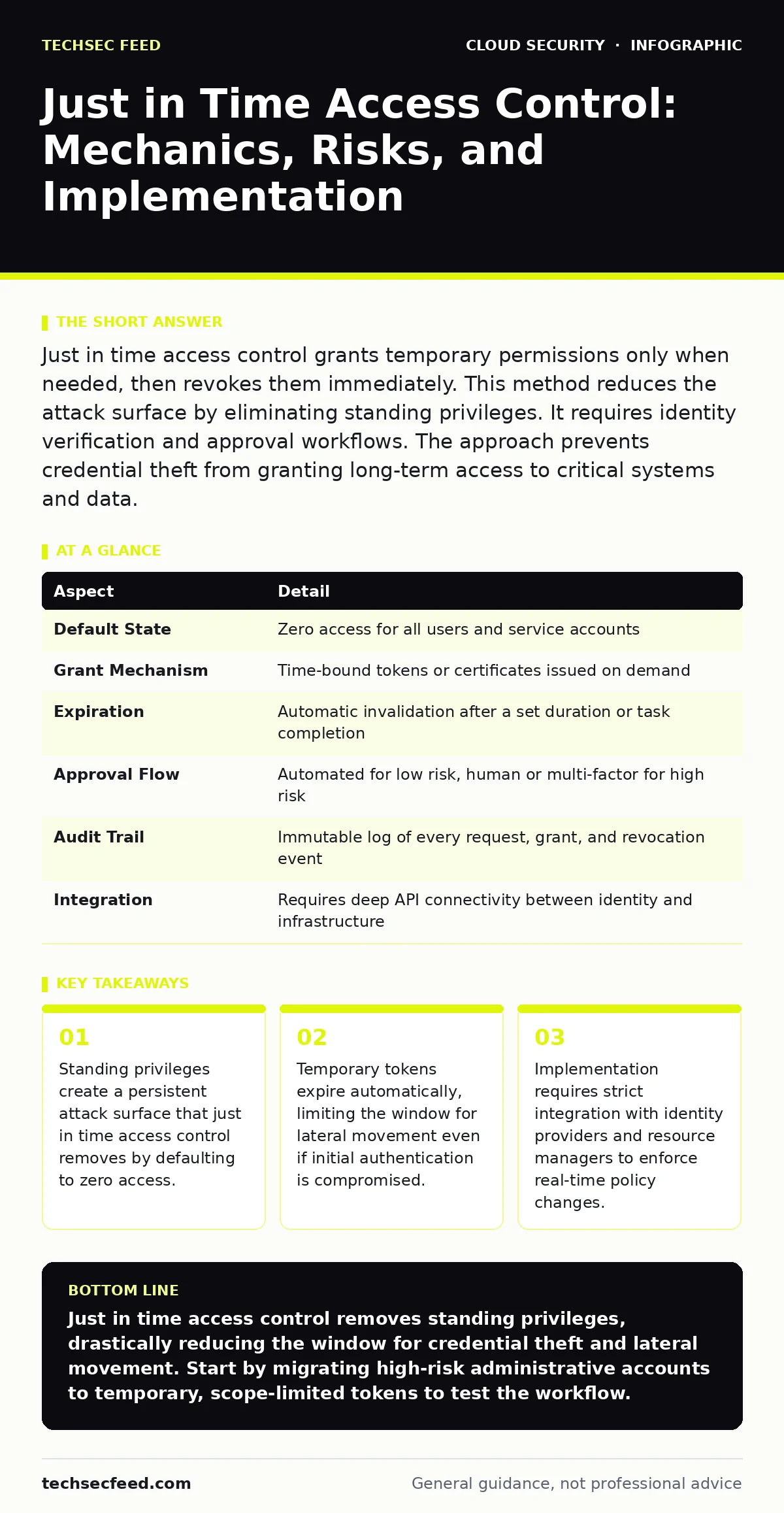
Just in time access control grants temporary permissions only when needed, then revokes them immediately. This method reduces the attack surface by eliminating standing privileges. It requires identity verification and approval workflows. The approach prevents credential theft from granting long-term access to critical systems and data.
The Library Card Analogy
Imagine a library that gives every member a master key to every room. Most members never enter the archives, but the key remains in their pocket. A thief only needs to steal one wallet to access every secret file. Now imagine the library issues a single-use pass for the archives, valid for ten minutes. The pass disappears after use. The thief steals the wallet, but finds no keys. This shift from permanent keys to temporary passes defines just in time access control.
The core principle is simple. You do not have access by default. You request access for a specific duration. The system grants it, you perform the task, and the system revokes it. This model replaces the static permission model that has dominated infrastructure management for decades. Static permissions assume that if you need access today, you will need it tomorrow. This assumption is rarely true for administrative tasks.
How Just in Time Access Control Works
The mechanism relies on three components: an identity provider, a policy engine, and the target resource. When you request access, the identity provider verifies your credentials. The policy engine evaluates your request against current rules. These rules consider your role, the time of day, and the sensitivity of the resource. If the request is approved, the system generates a temporary credential. This credential is often a short-lived token or a virtual private key.
The target resource accepts only these temporary credentials. Standing credentials, such as long-lived API keys or saved passwords, are rejected for privileged operations. The token has an expiration timestamp embedded within it. When the timestamp passes, the token becomes invalid. The resource manager does not need to actively revoke the token. The token simply stops working. This passive expiration reduces the operational load on the security team.
| Aspect | Detail |
|---|---|
| Default State | Zero access for all users and service accounts |
| Grant Mechanism | Time-bound tokens or certificates issued on demand |
| Expiration | Automatic invalidation after a set duration or task completion |
| Approval Flow | Automated for low risk, human or multi-factor for high risk |
| Audit Trail | Immutable log of every request, grant, and revocation event |
| Integration | Requires deep API connectivity between identity and infrastructure |
Who This Model Affects
This approach changes how engineers, security operators, and automated services interact with infrastructure. Human users lose the convenience of always-on access. They must plan their work windows or request emergency access. This friction is intentional. It forces a pause that can prevent accidental misconfigurations or malicious actions. The friction also creates a clear audit trail. Every privileged action is tied to a specific request and approval.
Service accounts are equally affected. Automated scripts often run with broad permissions to handle edge cases. Just in time access control requires these scripts to request specific permissions for each execution. This breaks the pattern of "fire and forget" automation. Scripts must be designed to handle authentication failures and token renewal. This shift aligns with the principles of serverless security risks, where ephemeral compute resources require ephemeral identities.
What People Usually Get Wrong
Many teams treat this as a simple password change. They replace long-lived passwords with short-lived tokens but leave the underlying permission scope wide open. The token expires, but the user still has access to everything. This is a failure of scope, not duration. The goal is to limit both time and scope. A token that grants full admin rights for ten minutes is still dangerous. It should grant only the specific command needed.
Another common error is ignoring the approval workflow. Teams automate all requests to reduce friction. This removes the human checkpoint that catches anomalous behavior. If a user requests access to a database they never touch, the system should flag it. Automated approvals should only apply to routine, expected tasks. Unusual requests require manual review. This balance prevents alert fatigue while maintaining security.
Integrating With Existing Systems
Implementation requires breaking the link between identity and persistent permissions. You cannot simply toggle a setting in your current identity provider. You need a middleware layer that intercepts access requests. This layer checks the policy and issues the temporary credential. It then communicates with the target system to allow the credential. This integration is complex. It requires APIs that support dynamic policy enforcement.
The identity provider must support short-lived tokens. Traditional SAML assertions may be too long-lived. You need OpenID Connect or similar protocols that support fine-grained scopes and short expiration times. The resource managers must accept these tokens. This often requires updating configuration files or deployment scripts. The change is not cosmetic. It alters the fundamental authentication flow.
Handling Edge Cases and Failures
Network outages can break the authentication chain. If the policy engine is down, users cannot request access. This creates a single point of failure. You must design for resilience. Caching approved requests locally can help, but it introduces risk. The cache must be encrypted and time-limited. Another edge case is the "break-glass" scenario. An emergency requires immediate access without standard approvals. You need a separate, highly monitored channel for this. It must be logged and reviewed immediately after use.
The Hidden Cost of Complexity
The trade-off is operational complexity. You add a layer of indirection between the user and the resource. This layer can fail. Debugging authentication issues becomes harder. You must trace the request through the identity provider, the policy engine, and the resource manager. Each step adds latency. For high-frequency operations, this latency is unacceptable. Just in time access control is best suited for privileged, low-frequency tasks. It is not ideal for high-throughput application traffic.
This complexity also increases the skill requirement for operations teams. Engineers must understand token lifecycles, scope definitions, and policy rules. Training is not optional. Without it, users will find workarounds. They may save credentials in insecure locations or share accounts. These workarounds undermine the entire model. The security gain is only real if the operational burden is managed correctly.
Reducing the Attack Surface
The primary benefit is the reduction of standing privileges. Standing privileges are the fuel for lateral movement. An attacker who compromises a user account with standing admin rights can move freely. With just in time access control, the compromised account has no privileges. The attacker must steal a valid, short-lived token. This token expires quickly. The window for exploitation shrinks from days to minutes.
This model also limits the impact of insider threats. A disgruntled employee cannot exfiltrate data using their usual credentials. They must request access, which triggers logging and potentially approval. This visibility deters malicious action. It also helps in forensic investigations. You can see exactly who accessed what, when, and why. This clarity is often missing in traditional models.
Next Steps for Implementation
Start with a pilot program. Select a small group of high-privilege users and a specific set of resources. Implement the policy engine and test the workflow. Measure the friction. Adjust the approval rules to balance security and productivity. Expand gradually. Do not attempt a big-bang rollout. The integration complexity is too high for a rapid deployment.
Review your existing permissions. Identify accounts with standing privileges that are rarely used. These are the best candidates for migration. Remove their standing permissions. Force them to use the just in time flow. This cleanup is necessary before scaling. It prevents confusion and reduces the number of exceptions you must manage.
This approach complements other security measures. It works well with cloud logging gaps analysis, as it generates precise audit trails. It also reduces the risk of overprivileged cloud identities, a common misconfiguration. By combining these practices, you create a defense-in-depth strategy. The temporary nature of access ensures that even if other controls fail, the attacker has limited time and scope.
Key takeaways
- Standing privileges create a persistent attack surface that just in time access control removes by defaulting to zero access.
- Temporary tokens expire automatically, limiting the window for lateral movement even if initial authentication is compromised.
- Implementation requires strict integration with identity providers and resource managers to enforce real-time policy changes.
Just in time access control removes standing privileges, drastically reducing the window for credential theft and lateral movement. Start by migrating high-risk administrative accounts to temporary, scope-limited tokens to test the workflow.
Frequently asked questions
Does just in time access control work for service accounts?
Yes, service accounts can use short-lived tokens issued by the policy engine. The application must be designed to request and refresh these tokens dynamically.
What happens if the policy engine goes offline?
Users cannot request new access. Pre-approved cached tokens may work if designed for resilience, but new privileged actions will fail until the engine is restored.
Is this different from multi-factor authentication?
MFA verifies identity. Just in time access control manages permission duration and scope. They are complementary. MFA is often required to request the temporary token.
How do I handle emergency access requests?
Implement a break-glass procedure with separate, highly monitored credentials. These should be used only in crises and audited immediately afterward.
How this guide was produced: written by the TechSec Feed editorial team with AI assistance, checked against the public references listed below, and reviewed when the facts change. See our editorial policy or report an error.