
Serverless Security Risks: How Attacks Bypass Traditional Defenses
Serverless architectures shift the attack surface from the operating system to the function configuration and event triggers, hiding threats in plain sight within standard cloud logs.
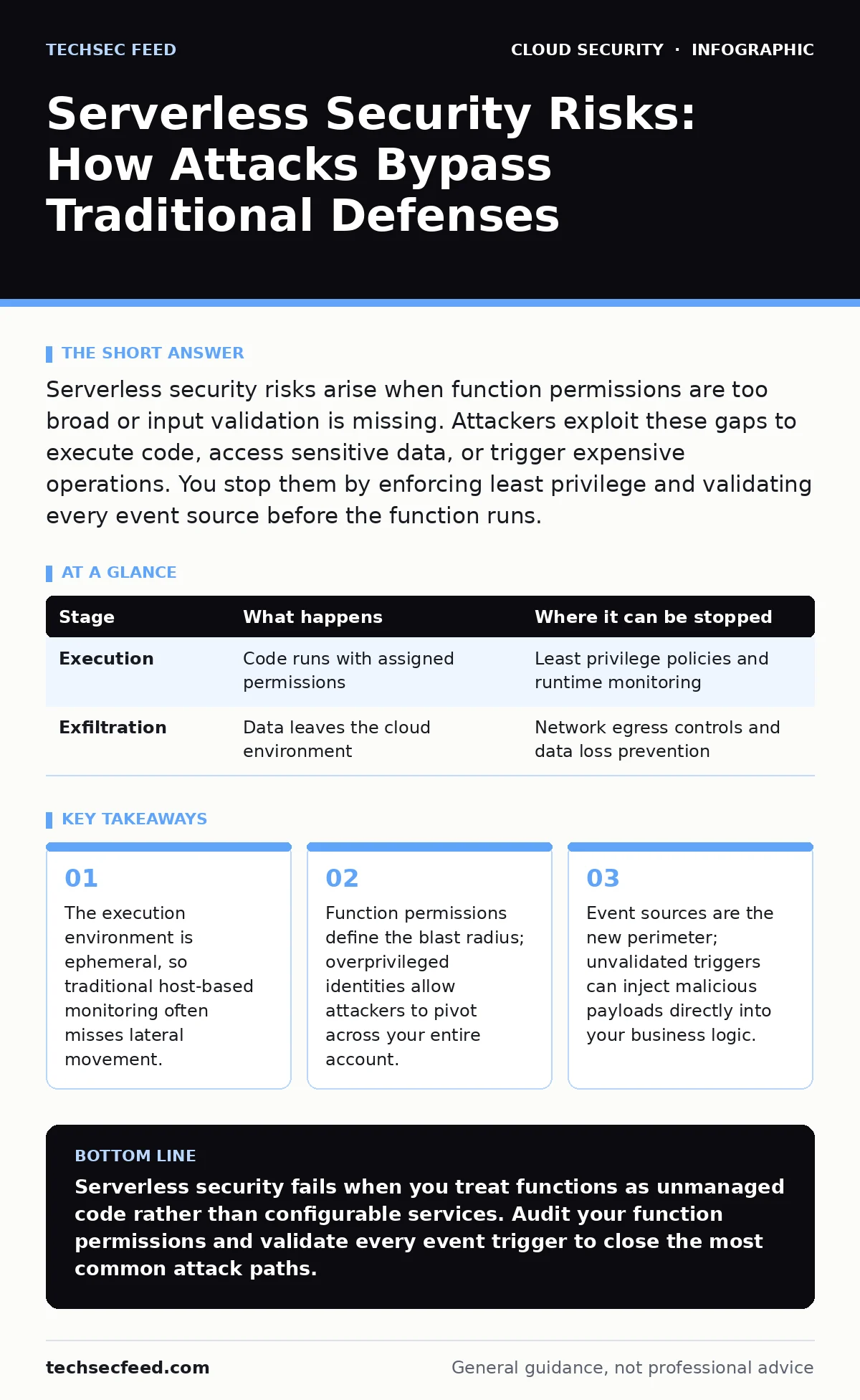
Serverless security risks arise when function permissions are too broad or input validation is missing. Attackers exploit these gaps to execute code, access sensitive data, or trigger expensive operations. You stop them by enforcing least privilege and validating every event source before the function runs.
The Invisible Perimeter
Serverless computing removes the server from your management scope. You deploy code, and the cloud provider handles the infrastructure. This abstraction creates a false sense of security. You believe the provider secures the host, so you focus only on the code. This is a dangerous oversight. The security boundary moves from the network edge to the function itself.
The provider secures the underlying hardware and hypervisor. You secure the function configuration, the code, and the permissions. If you leave a gap in any of these layers, an attacker can execute arbitrary code. They do not need to break into a server. They only need to trigger your function with malicious input.
Stage 1: The Trigger Vector
Every serverless function starts with an event. This event could be an HTTP request, a file upload to storage, or a message in a queue. The trigger is the entry point. If the trigger is public or poorly authenticated, anyone can invoke your function.
Imagine a function that processes image uploads. It triggers when a file lands in a storage bucket. If the bucket allows public writes, an attacker can upload a malicious file. The function runs automatically. It processes the file without checking who sent it. The trigger vector is the first line of defense. If it fails, the rest of the security model is irrelevant.
Stage 2: Input Validation Failure
Once the function executes, it processes the input. Many developers assume the cloud provider sanitizes data. It does not. The provider delivers the event payload exactly as received. If your code trusts this payload, you are vulnerable.
Attackers inject payloads that exploit logic flaws. They might send a JSON object with unexpected fields. They might send a string that causes a buffer overflow. They might send a command that triggers command injection. If your code does not validate the type, size, and content of the input, it will execute the malicious payload.
Stage 3: Privilege Escalation
The function needs permissions to work. It needs to read from storage, write to a database, or send emails. These permissions are granted via an identity. If this identity has more permissions than necessary, an attacker can exploit it.
Suppose your function only needs to read one specific file. You grant it permission to read the entire storage account. An attacker triggers the function with a modified input. The function executes with the elevated identity. It reads all files in the account. This is overprivileged cloud identities in action. The attacker did not break into the storage system. They used your function as a proxy.
Stage 4: Lateral Movement
Serverless functions are ephemeral. They exist only while executing. After execution, the environment is destroyed. This makes lateral movement difficult but not impossible. Attackers use the function’s permissions to move to other resources.
They might write a new function. They might modify existing configurations. They might create new identities. The goal is to establish persistence. Since the original function environment is gone, traditional forensics fail. You must rely on audit logs. If logging is incomplete, the attacker operates in the dark.
See also: Cloud Logging Gaps: 7 Configuration Mistakes That Hide Attacks · What Is Data Residency: How Location Rules Protect Your Cloud
Stage 5: Data Exfiltration
The final stage is data extraction. The attacker has access to sensitive data. They need to get it out. They might write the data to a public storage bucket. They might send it to an external server. They might encode it in HTTP headers.
The function’s network permissions determine how data leaves. If the function can access the internet, exfiltration is easy. If it is restricted to a private network, the attacker must find another path. They might use DNS tunneling. They might use ICMP packets. The method depends on the network constraints.
| Stage | What happens | Where it can be stopped |
|---|---|---|
| Execution | Code runs with assigned permissions | Least privilege policies and runtime monitoring |
| Exfiltration | Data leaves the cloud environment | Network egress controls and data loss prevention |
Stage 6: Financial Damage
Some attacks do not steal data. They consume resources. This is denial-of-wallet attacks. An attacker triggers your function thousands of times. Each execution costs money. If the function performs expensive operations, the bill grows rapidly.
Imagine a function that transcodes video. It takes five minutes to run. An attacker triggers it ten thousand times. Your cloud bill spikes. You do not notice until the end of the billing cycle. The attack stops only when you detect the anomaly or hit a spending limit.
Interrupting the Chain
You can stop this chain at multiple points. The most effective point is the trigger. Enforce strict authentication. Validate every input. Do not assume the event source is safe.
The second point is permissions. Grant the minimum required permissions. Use cloud entitlements to audit what your functions can do. Regularly review these permissions. Remove any that are no longer needed.
The third point is monitoring. Enable detailed logging. Monitor for unusual patterns. Look for spikes in execution frequency. Look for unexpected data access. Integrate these logs into your cloud incident response plan.
The Hidden Cost of Abstraction
Serverless computing shifts complexity. It moves it from infrastructure management to configuration management. You no longer patch operating systems. You patch configurations. This requires a different skill set.
You must understand the provider’s security model. You must understand how permissions propagate. You must understand how events are routed. If you lack this knowledge, you will miss risks. You will assume the provider handles everything. This assumption is the root of most serverless security failures.
Consider using cloud-native application protection platforms (CNAPP) to automate some of this visibility. These tools scan your configurations and code for misconfigurations. They provide a centralized view of your serverless security posture.
Beyond Basic Protection
Basic security measures are not enough. You need to address the unique aspects of serverless. You need to protect against scheduled task abuse. Attackers might modify the schedule of a function to run at inconvenient times. They might change the payload to perform malicious actions.
You must also consider cloud disaster recovery. If your serverless functions are compromised, how do you restore them? Do you have backups of your code and configurations? Do you have a process to roll back changes?
Finally, watch for cloud cryptojacking. Attackers might inject mining code into your functions. This code runs every time the function executes. It consumes CPU cycles. It increases your bills. It slows down your applications. Detecting this requires runtime monitoring and behavioral analysis.
Key takeaways
- The execution environment is ephemeral, so traditional host-based monitoring often misses lateral movement.
- Function permissions define the blast radius; overprivileged identities allow attackers to pivot across your entire account.
- Event sources are the new perimeter; unvalidated triggers can inject malicious payloads directly into your business logic.
Serverless security fails when you treat functions as unmanaged code rather than configurable services. Audit your function permissions and validate every event trigger to close the most common attack paths.
Frequently asked questions
Does serverless eliminate the need for firewalls?
No, it shifts the focus. You still need network controls, but the primary defense becomes identity and input validation.
Can serverless functions be hacked remotely?
Yes, if they are exposed to the internet or triggered by unauthenticated events. The code executes on remote servers, so any accessible trigger is a potential entry point.
How do I detect lateral movement in serverless?
You must monitor API call logs and permission changes. Since the environment is ephemeral, traditional host-based detection fails. You rely on cloud audit trails.
Is serverless more secure than traditional servers?
It reduces the attack surface by removing OS management, but it introduces new risks related to configuration and permissions. Security depends on how well you manage these new variables.
How this guide was produced: written by the TechSec Feed editorial team with AI assistance, checked against the public references listed below, and reviewed when the facts change. See our editorial policy or report an error.