
Cloud Cryptojacking: Detection, Prevention, and Resource Limits
Cryptomining malware often hides in plain sight by mimicking legitimate container traffic and exploiting idle compute resources during off-hours.
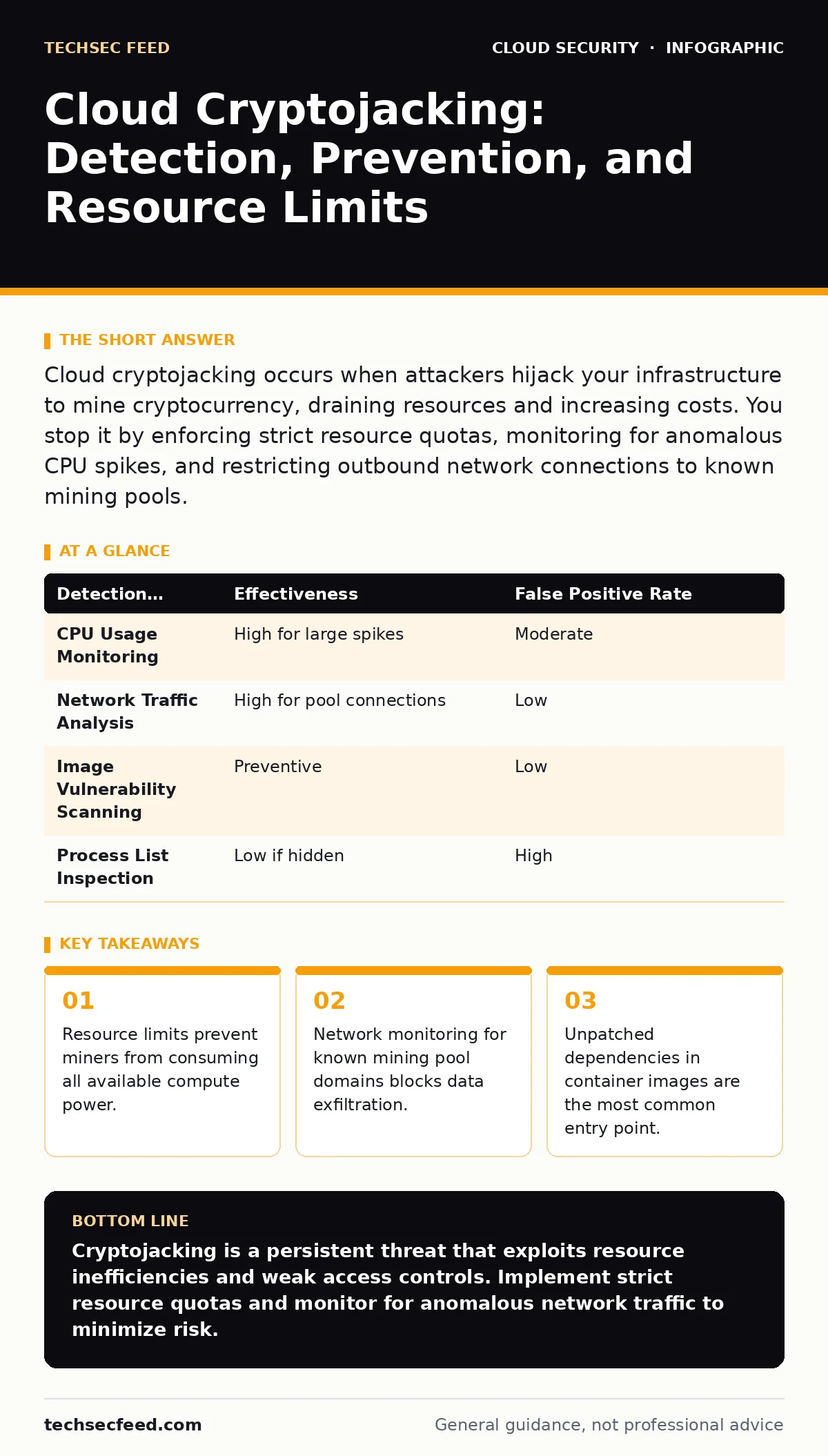
Cloud cryptojacking occurs when attackers hijack your infrastructure to mine cryptocurrency, draining resources and increasing costs. You stop it by enforcing strict resource quotas, monitoring for anomalous CPU spikes, and restricting outbound network connections to known mining pools.
How does cryptojacking differ from traditional malware?
Traditional malware often aims to steal data or disrupt services, whereas cryptojacking aims to consume computational resources for financial gain. The attacker wants your system to remain stable and connected, allowing the mining process to run continuously. This subtle difference means that many standard intrusion detection systems miss the activity because the system does not crash or leak sensitive files. The primary indicator is a sustained increase in resource consumption rather than a sudden failure.
What are the most common entry points in cloud environments?
Attackers typically exploit vulnerable container images, misconfigured storage buckets, or weak access keys. A public-facing storage bucket containing sensitive configuration files can reveal credentials that grant access to compute instances. Once inside, the attacker uses those credentials to deploy a mining script on a high-performance instance. This method bypasses perimeter defenses entirely because the attacker is using legitimate, albeit compromised, credentials.
Why is resource consumption the primary detection signal?
Cryptocurrency mining algorithms require significant processing power, leading to a noticeable spike in CPU or GPU utilization. This spike often occurs during off-hours when legitimate traffic is low, creating a distinct pattern. Monitoring these baseline deviations allows you to identify the intrusion before the financial impact becomes severe.
Can network monitoring stop the mining process?
Mining requires constant communication with a mining pool to submit work and receive rewards. By inspecting outbound traffic for connections to known mining pool domains or IP addresses, you can block the communication channel. Even if the malware is running on your instance, it cannot generate profit if it cannot talk to the pool. This method is effective because mining pools are centralized targets that are easier to identify than individual infected hosts.
How do attackers hide their activity from administrators?
Sophisticated miners use techniques to blend in with normal application traffic. They may throttle their resource usage to stay below alert thresholds or only run during specific time windows. Some malware checks for the presence of virtualization tools and stops running if it detects a forensic analysis environment. This evasion makes manual inspection difficult, as the system appears normal when you are actively looking at it.
See also: What Is Data Residency: How Location Rules Protect Your Cloud · Cloud Disaster Recovery: How to Restore Services Without Downtime
What role do container images play in infections?
Container images often contain third-party libraries and dependencies that may have known vulnerabilities. If you pull an image with an outdated library, an attacker can exploit that flaw to execute arbitrary code. This is a supply chain attack where the compromise happens before the container is even deployed. Regularly scanning images for vulnerabilities reduces the attack surface significantly.
| Detection Method | Effectiveness | False Positive Rate |
|---|---|---|
| CPU Usage Monitoring | High for large spikes | Moderate |
| Network Traffic Analysis | High for pool connections | Low |
| Image Vulnerability Scanning | Preventive | Low |
| Process List Inspection | Low if hidden | High |
Why do resource limits matter more than you think?
Setting hard limits on CPU and memory usage for containers prevents a single compromised instance from consuming all available resources. This technique, known as resource quota enforcement, ensures that even if an attacker gains access, they cannot monopolize the compute budget. It also prevents the cryptojacker from crashing other critical services on the same host. This defensive layer is cheap to implement and provides immediate protection against resource exhaustion.
How do overprivileged identities facilitate this attack?
If a service account has more permissions than necessary, an attacker who compromises it can pivot to other resources. They might use those elevated privileges to launch larger instances or access sensitive data stores. Reducing permissions to the minimum required level limits the blast radius of any single compromise. This principle applies to all cloud identities, not just those used for deployment.
What is the financial impact beyond electricity costs?
The direct cost is the increased bill for compute resources, but the indirect costs are often higher. Incident response teams must spend time investigating and remediating the infection, pulling resources from other tasks. There is also the risk of reputation damage if customers suspect their data was exposed. The downtime required to patch and redeploy affected services can disrupt business operations significantly.
How does cloud-native application protection platforms (CNAPP) help?
CNAPP solutions provide a unified view of security across the cloud environment, integrating vulnerability scanning, runtime protection, and policy enforcement. They can detect anomalies in container behavior and automatically enforce security policies. This holistic approach reduces the complexity of managing multiple security tools. By correlating data from different sources, CNAPPs can identify subtle patterns that individual tools might miss.
What steps should you take if you suspect an infection?
Isolate the affected instance immediately to prevent lateral movement to other systems. Capture memory and process information before terminating the instance to aid in forensic analysis. Review access logs to determine how the attacker gained entry and what other resources they may have touched. Then, patch the vulnerability and rotate any compromised credentials before redeploying a clean instance.
How does this relate to denial-of-wallet attacks?
Denial-of-wallet attacks aim to exhaust an attacker's or victim's cloud budget by triggering expensive services. Cryptojacking is a form of resource exhaustion that directly increases costs. Both attacks leverage the pay-as-you-go model of cloud computing to inflict financial damage. Understanding this connection helps you design better budget alerts and resource limits that protect against both types of threats.
Key takeaways
- Resource limits prevent miners from consuming all available compute power.
- Network monitoring for known mining pool domains blocks data exfiltration.
- Unpatched dependencies in container images are the most common entry point.
Cryptojacking is a persistent threat that exploits resource inefficiencies and weak access controls. Implement strict resource quotas and monitor for anomalous network traffic to minimize risk.
Frequently asked questions
Can serverless functions be used for cryptojacking?
Yes, but the time limits and resource constraints of serverless environments make large-scale mining difficult and less profitable for attackers.
How do I know if my container image is compromised?
Regularly scan your images for known vulnerabilities and compare their hashes against trusted registries to detect unauthorized changes.
Should I block all outbound traffic from my containers?
Blocking all outbound traffic is a strong security practice, but you must carefully whitelist the specific connections your applications need to function.
Is cryptojacking illegal?
Yes, unauthorized use of computing resources is illegal in most jurisdictions, and victims can pursue legal action against perpetrators.
How this guide was produced: written by the TechSec Feed editorial team with AI assistance, checked against the public references listed below, and reviewed when the facts change. See our editorial policy or report an error.