
How Hybrid Cloud Security Works: Mechanisms and Limits
Hybrid cloud security relies on identity as the perimeter, where access policies follow the user across distinct infrastructure boundaries without relying on network topology.
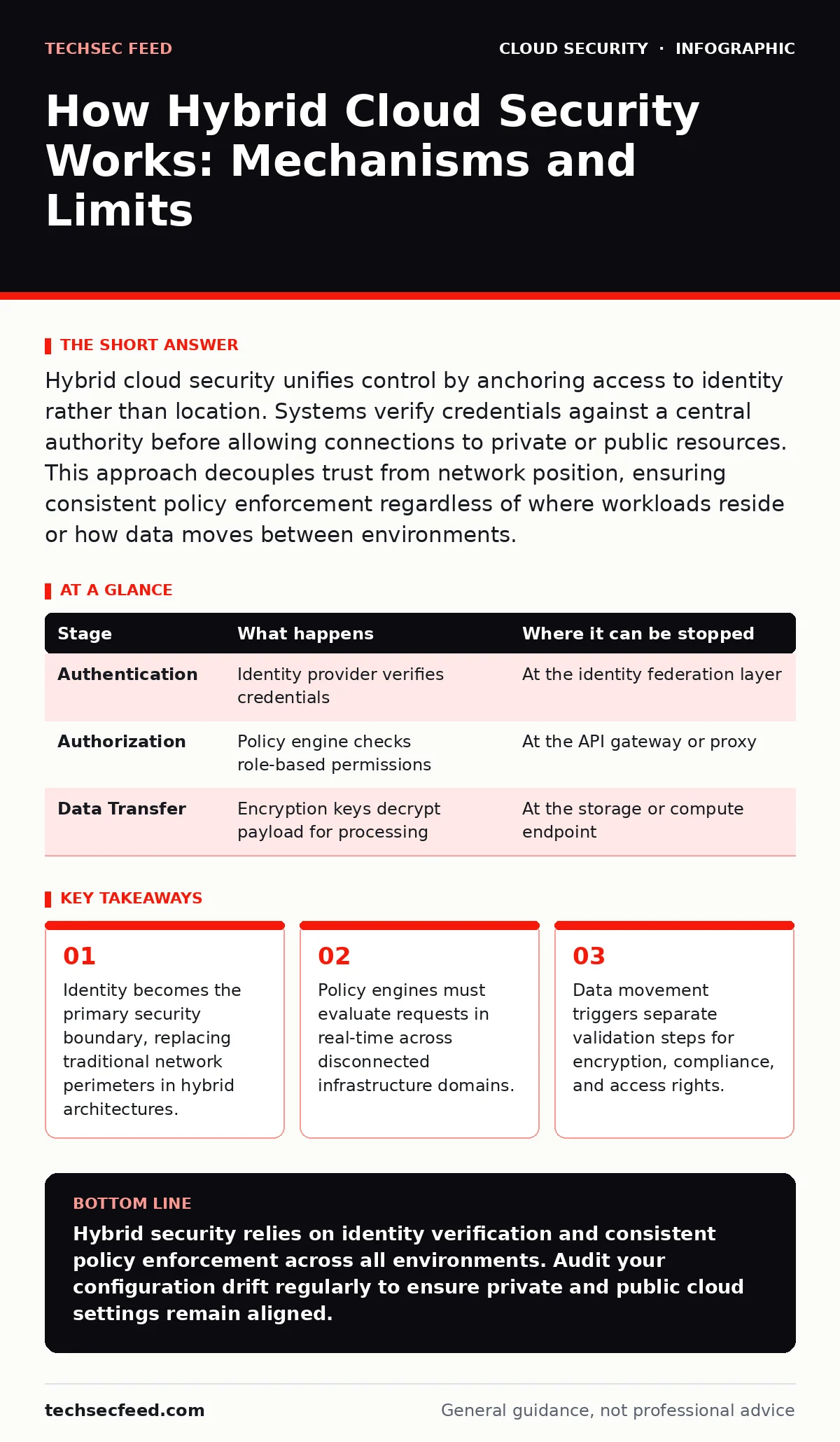
Hybrid cloud security unifies control by anchoring access to identity rather than location. Systems verify credentials against a central authority before allowing connections to private or public resources. This approach decouples trust from network position, ensuring consistent policy enforcement regardless of where workloads reside or how data moves between environments.
Identity as the Anchor Point
The foundation of hybrid cloud security rests on identity management rather than network location. Traditional security models assumed that users inside a corporate firewall were trustworthy. That assumption fails when workloads span on-premises data centers and multiple public cloud providers. The system must verify who is requesting access before granting any capability.
Centralized identity providers issue tokens that carry authorization claims. These tokens travel with the user or service across environment boundaries. The verification process does not depend on the source IP address or the physical location of the server. This decoupling allows security policies to remain consistent even when the underlying infrastructure changes dynamically.
Policy Decision and Enforcement
Once identity is established, the system evaluates the request against current security policies. Policy decision points consult rule sets that define what actions are permitted for specific roles. These rules often include constraints on time, location, and device health. The decision point returns an allow or deny response to the policy enforcement point.
Enforcement points sit at critical junctions within the infrastructure. They intercept API calls, network connections, and data access requests. In a hybrid setup, these enforcement points must operate consistently across different platforms. A denial in the private cloud must carry the same weight as a denial in the public cloud. Inconsistencies here create exploitable gaps where attackers can pivot between environments.
Cross-Environment Data Movement
Data rarely stays static in a hybrid architecture. Workloads often read data from on-premises storage and process it in cloud compute instances. Each movement of data triggers a new set of security checks. The system must verify that the destination environment is authorized to receive the data. Encryption keys must be available to decrypt the payload only if the access context remains valid.
This movement creates a hidden cost in latency and complexity. Every hop requires re-validation of access rights. If the session token expires during a long-running data transfer, the connection breaks. Systems must handle these interruptions gracefully without exposing partial data or leaving resources in an inconsistent state. Proper key management ensures that compromised tokens cannot decrypt data in transit.
| Stage | What happens | Where it can be stopped |
|---|---|---|
| Authentication | Identity provider verifies credentials | At the identity federation layer |
| Authorization | Policy engine checks role-based permissions | At the API gateway or proxy |
| Data Transfer | Encryption keys decrypt payload for processing | At the storage or compute endpoint |
Unified Visibility and Logging
Security teams need a single view of activity across disparate environments. Without unified logging, investigators must correlate events from separate systems manually. This fragmentation delays response times and obscures attack patterns. Modern hybrid security architectures aggregate logs into a central repository or security information and event management system.
The challenge lies in normalizing data formats. Private cloud servers and public cloud services use different log structures and timestamps. Normalization tools translate these differences into a common schema. This allows correlation engines to detect sequences of events that span multiple environments. For instance, a login in the private cloud followed by unusual API calls in the public cloud can indicate a compromised account.
Dynamic Trust and Zero Trust Principles
Static trust relationships fail in hybrid environments because infrastructure changes frequently. Containers spin up and down, servers scale automatically, and users move between locations. Zero trust principles address this by requiring continuous verification. Every request is authenticated and authorized as if it originates from an untrusted network.
This approach eliminates the concept of a safe internal zone. Access rights are granted on a just-in-time basis, reducing the window of opportunity for attackers. If a user's behavior changes or their device shows signs of compromise, the system revokes access immediately. This dynamic adjustment prevents lateral movement across the hybrid boundary. It ensures that compromised credentials cannot persist in the environment.
Refer to guides on just-in-time access for deeper implementation details on temporary privilege escalation. Understanding shift-left security helps teams integrate these checks earlier in the development lifecycle.
See also: Remote Access Control System: How It Works and What You Miss
Infrastructure Segmentation and Isolation
Even with strong identity controls, infrastructure segmentation provides a necessary layer of defense. Hybrid environments often contain sensitive workloads that require isolation from less critical systems. Micro-segmentation divides the network into small, controlled zones. Traffic between zones is explicitly allowed or denied based on strict policies.
This segmentation limits the blast radius of a breach. If an attacker compromises a workload in one segment, they cannot easily move to adjacent segments. In a hybrid setup, this means isolating on-premises legacy systems from cloud-native applications. Network policies must enforce these boundaries consistently, regardless of the underlying provider or hardware.
Key Management and Cryptography
Data at rest and in transit requires strong encryption. In hybrid environments, key management becomes complex because keys must be accessible to authorized services across different platforms. Centralized key management systems store encryption keys separately from the data they protect. Services request access to keys through secure APIs, never holding the keys themselves.
This separation ensures that compromising a storage volume does not expose the plaintext data. However, it introduces dependency on the key management service availability. If the key service is unreachable, legitimate operations halt. Teams must design for high availability and failover scenarios to prevent operational disruption. Understanding data residency requirements also influences where keys and data can legally reside.
Operational Limits and Blind Spots
No security architecture provides complete protection. Hybrid cloud security faces inherent limitations due to the complexity of integrating multiple systems. Configuration drift occurs when settings in the private cloud diverge from those in the public cloud. This drift creates inconsistencies that automated tools may miss.
Monitoring tools often struggle with the scale and variety of hybrid telemetry. Alert fatigue can lead teams to ignore genuine threats buried in noise. Additionally, third-party vendors managing parts of the infrastructure may have different security postures. You cannot fully control the security of external providers, only your use of their services. Recognizing these limits helps teams focus on high-risk areas rather than chasing impossible perfection.
Review cloud logging gaps to ensure your monitoring covers all critical data flows. Be aware of serverless security risks when using managed functions, as traditional perimeter controls do not apply. Finally, plan for cloud disaster recovery to maintain operations during significant security incidents.
Key takeaways
- Identity becomes the primary security boundary, replacing traditional network perimeters in hybrid architectures.
- Policy engines must evaluate requests in real-time across disconnected infrastructure domains.
- Data movement triggers separate validation steps for encryption, compliance, and access rights.
Hybrid security relies on identity verification and consistent policy enforcement across all environments. Audit your configuration drift regularly to ensure private and public cloud settings remain aligned.
Frequently asked questions
Does hybrid cloud security replace the need for a firewall?
No, firewalls still filter network traffic, but they no longer serve as the primary security boundary. Identity and policy enforcement become the main controls, while firewalls provide additional defense in depth.
How do you handle legacy systems that cannot support modern authentication?
Use protocol translation or proxy servers to wrap legacy protocols in secure wrappers. These intermediaries handle authentication and apply security policies before passing traffic to the legacy systems.
What is the biggest risk in hybrid cloud data transfer?
The primary risk is misconfigured encryption keys or unauthorized access during transit. Ensure keys are managed centrally and never exposed to the services processing the data.
Can automation fully manage hybrid security policies?
Automation helps enforce consistency, but it requires accurate policy definitions. Human oversight remains necessary to review complex decisions and update policies as business requirements change.
How this guide was produced: written by the TechSec Feed editorial team with AI assistance, checked against the public references listed below, and reviewed when the facts change. See our editorial policy or report an error.