
Shift Left Security: Moving Defenses to the Source Code
Fixing flaws during code authoring costs less and prevents deployment, unlike scanning artifacts after they are built and stored.
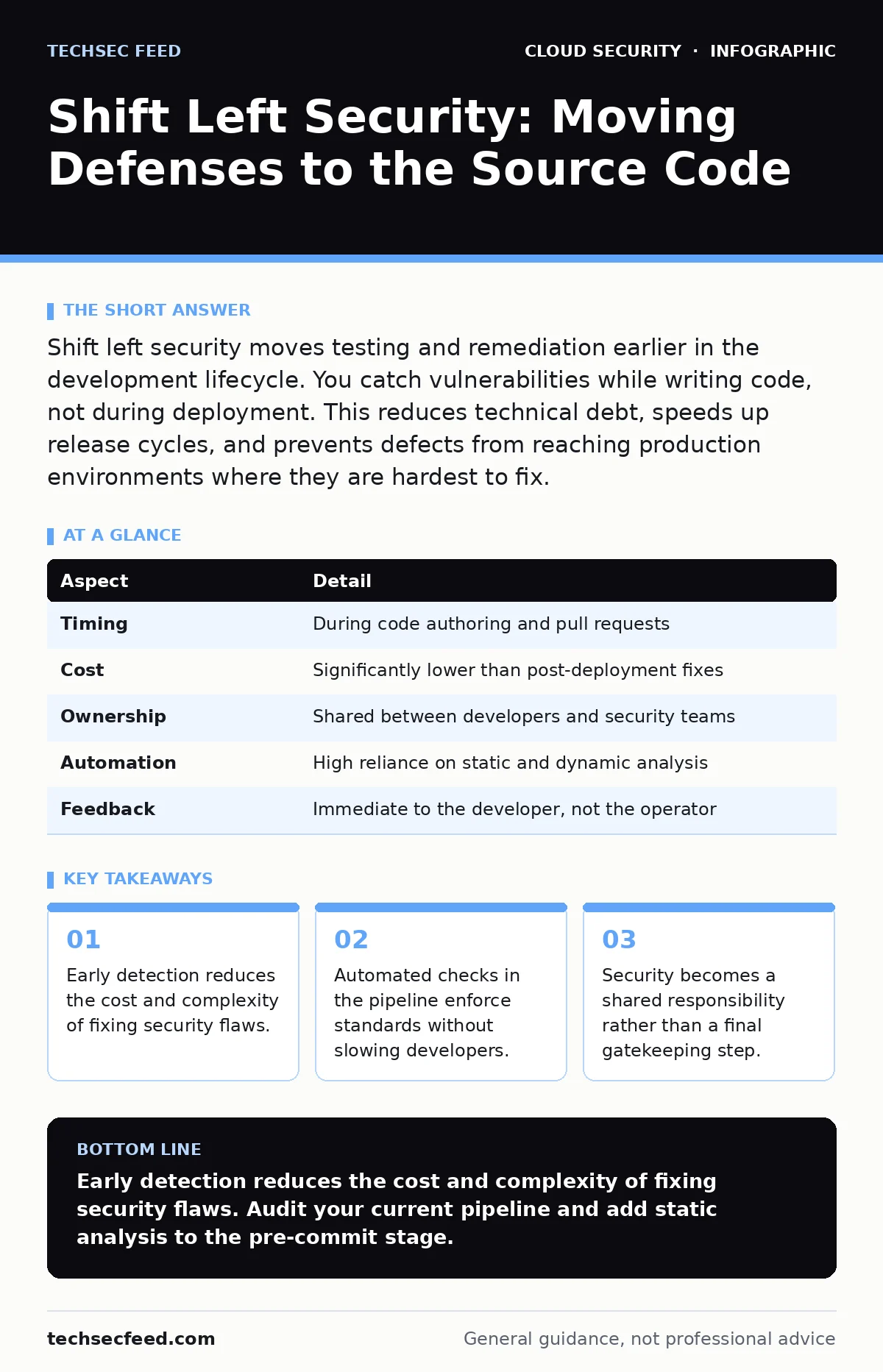
Shift left security moves testing and remediation earlier in the development lifecycle. You catch vulnerabilities while writing code, not during deployment. This reduces technical debt, speeds up release cycles, and prevents defects from reaching production environments where they are hardest to fix.
Everyday Analogy for Early Detection
Imagine constructing a house. Traditional security acts like a final inspection after the roof is on and the drywall is up. You find a structural flaw in the foundation, but correcting it now requires tearing down walls and removing fixtures. Shift left security is like checking the blueprints and inspecting the concrete mix before pouring. You fix the error when the cost is negligible and the effort is minimal.
What Is Shift Left Security
Shift left security is the practice of integrating security checks and controls at the earliest possible stages of the software development lifecycle. The term "left" refers to the left side of a timeline, where planning and coding occur. By moving defenses to the source code, you identify weaknesses before they become embedded in the final product. This approach contrasts with traditional models that treat security as a final gate before release.
| Aspect | Detail |
|---|---|
| Timing | During code authoring and pull requests |
| Cost | Significantly lower than post-deployment fixes |
| Ownership | Shared between developers and security teams |
| Automation | High reliance on static and dynamic analysis |
| Feedback | Immediate to the developer, not the operator |
How the Mechanism Works
The process relies on automated tools running within the development environment. Static Application Security Testing (SAST) analyzes source code for known vulnerability patterns without executing the program. It flags issues like unescaped inputs or hard-coded secrets. Dynamic Application Security Testing (DAST) runs against a deployed test instance to find runtime errors. Software Composition Analysis (SCA) scans third-party libraries for known vulnerabilities. These tools feed results directly to the developer via their code editor or version control system.
Developers receive feedback before merging code into the main branch. This prevents vulnerable code from entering the shared repository. The pipeline blocks the build if critical thresholds are breached. This enforcement ensures that security is not an optional step. It becomes a mandatory part of the definition of done. The integration requires configuration of rulesets that balance security needs with development speed.
Who It Affects
This practice changes the daily workflow for software engineers. They must understand basic security concepts to interpret scan results. They need to distinguish between true positives and false positives. Security engineers shift from manual pen-testing to tooling maintenance and policy definition. They create the rules that the automated systems enforce. DevOps engineers configure the pipeline stages to run these checks efficiently. Product managers adjust timelines to account for early remediation.
The cultural shift is significant. Security is no longer a separate department that says no. It is a function embedded in the creation process. Teams must agree on acceptable risk levels. They must define which vulnerabilities block a release and which can be tracked as technical debt. This alignment prevents friction between development velocity and security posture. It requires clear communication channels and shared metrics.
Common Misconceptions and Pitfalls
Many organizations confuse shift left with simply adding more scanners. Buying tools does not create a secure culture. If developers ignore scan results because they are noisy or irrelevant, the system fails. False positives erode trust in the tooling. Teams may disable checks to meet deadlines, defeating the purpose. Another mistake is assuming shift left eliminates all risks. It reduces the likelihood of certain flaws but does not replace runtime protection or incident response.
You must tune the tools to your specific technology stack. Generic rulesets generate too much noise. Context-aware scanning reduces false positives. You must also provide training. Developers need to know how to fix the issues they find. Without remediation guidance, the feedback loop is broken. The goal is continuous improvement, not just detection.
See also: Secure Software Development: Building Code That Resists Attack · Detect Cloud Data Exfiltration: Logs, Signals and Blind Spots
Practical Implementation Steps
Start by identifying the most critical assets. Not every project needs the same level of scrutiny. Focus on applications that handle sensitive data or face the internet. Implement SAST in the pre-commit phase. This gives developers the fastest feedback. Configure the tool to fail the build only on high-severity issues. Low-severity findings can be reported for later review.
Next, integrate SCA into the dependency management process. Third-party libraries are a major attack surface. Ensure your pipeline checks for known vulnerabilities in these components. Update dependencies regularly. Avoid pinning versions indefinitely. Use container scanning for infrastructure code. This checks the base images and configurations for misconfigurations. Finally, establish a feedback loop. Review scan results weekly. Adjust rules based on team input and emerging threats.
Integration with Broader Strategy
Shift left security does not operate in isolation. It works best when combined with other controls. You must still monitor production for anomalies. Runtime protection catches issues that static analysis misses. Secrets management prevents credentials from being leaked in code. Identity and access management ensures only authorized users can trigger builds.
Consider the impact on data residency requirements. Code repositories may store sensitive configuration data. Ensure your tools comply with local regulations. Address overprivileged cloud identities that might access the build environment. Limit permissions to the minimum necessary. Review cloud logging gaps to ensure build activities are recorded. These measures support the shift left effort by securing the surrounding infrastructure.
Balancing Speed and Safety
The primary challenge is maintaining velocity. Developers resist tools that slow them down. Optimize scan times. Run lightweight checks locally. Reserve heavier scans for the pull request stage. Provide clear documentation. Explain why certain rules exist. Help developers understand the risk they are preventing. When the value is clear, adoption becomes easier.
Security is a continuous process. New vulnerabilities emerge daily. Tools must be updated regularly. Policies must evolve with the technology stack. Regular audits ensure the process remains effective. Do not assume that initial configuration is sufficient. Review and refine your approach periodically. Stay informed about new attack vectors. Adapt your defenses accordingly.
Key takeaways
- Early detection reduces the cost and complexity of fixing security flaws.
- Automated checks in the pipeline enforce standards without slowing developers.
- Security becomes a shared responsibility rather than a final gatekeeping step.
Early detection reduces the cost and complexity of fixing security flaws. Audit your current pipeline and add static analysis to the pre-commit stage.
Frequently asked questions
Does shift left security replace penetration testing?
No. Shift left catches common coding errors early. Penetration testing finds complex logic flaws and configuration issues that automated tools miss. Both are necessary for a complete defense.
How do I handle false positives in scans?
Tune your rulesets to match your codebase. Suppress known safe patterns. Engage developers to validate findings. Continuous refinement reduces noise and increases trust in the tooling.
Can small teams implement shift left security?
Yes. Start with one tool, such as SCA or SAST. Integrate it into your existing workflow. Gradually add more checks as you gain experience. Focus on high-risk areas first.
What is the difference between SAST and DAST?
SAST analyzes source code without running it. DAST tests the running application. SAST finds issues early in development. DAST finds issues in the deployed environment. Use both for coverage.
How this guide was produced: written by the TechSec Feed editorial team with AI assistance, checked against the public references listed below, and reviewed when the facts change. See our editorial policy or report an error.