
AI Usage Policies at Work: How to Prevent Data Leakage
Your organization's AI policy is not a list of banned apps, but a structural barrier that stops internal data from becoming public training material.
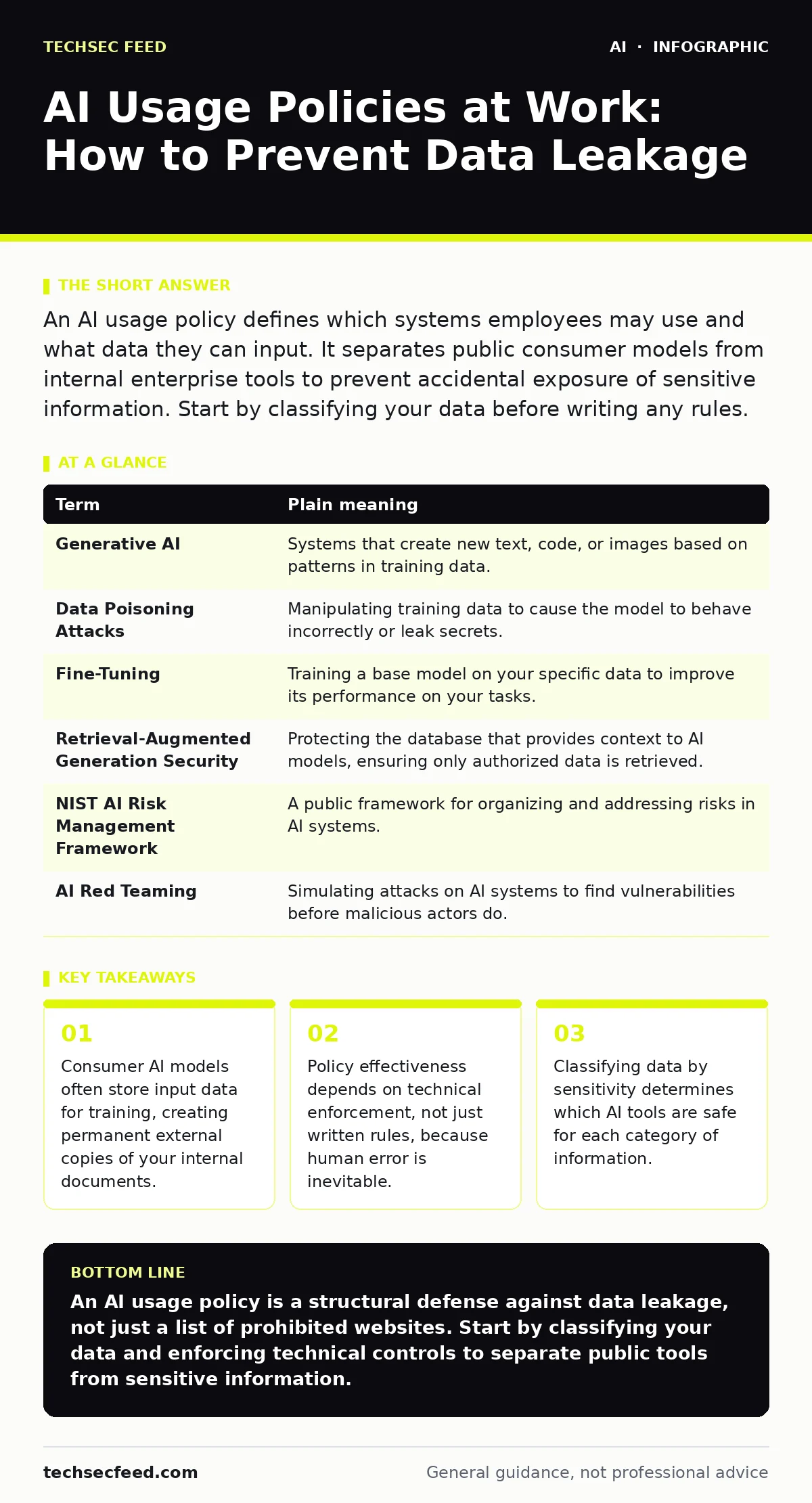
An AI usage policy defines which systems employees may use and what data they can input. It separates public consumer models from internal enterprise tools to prevent accidental exposure of sensitive information. Start by classifying your data before writing any rules.
The Library Analogy for Data Flow
Imagine your organization is a private library with rare, unpublished manuscripts. You allow patrons to read these texts in the reading room, but you strictly forbid them from copying pages and handing them to a public printer down the street. That public printer uses every page it receives to create generic reference books for the whole world. If a patron hands over a manuscript, the printer learns its content. Later, anyone else can ask the printer to summarize that specific manuscript, and the printer will reveal the secret because it memorized it during training. Your policy is the rule that keeps the manuscripts inside the library.
Defining the Boundaries of Safe Use
Most organizations treat AI as a single monolithic technology, which leads to vague rules that employees ignore. You must distinguish between public generative AI and private enterprise AI. Public models are accessible to anyone and often use user inputs to improve their future outputs. Private models run on your infrastructure or use encryption that prevents the vendor from accessing your raw data. The policy must explicitly name which category is allowed for which tasks. Using a public model for code review is different from using it to summarize customer support tickets. The risk profile changes based on the data sensitivity, not the tool itself.
The Hidden Cost of Convenience
When you allow unrestricted access to public AI tools, you gain speed but lose control over your intellectual property. The hidden cost is not just immediate data theft, but the gradual erosion of your competitive advantage. Every email, contract, or design document you paste into a public model becomes part of the training data for that model. This means competitors or malicious actors can eventually query the model to reconstruct your private processes. This is a form of data poisoning attacks in reverse, where your data poisons the public model with your secrets. The convenience of instant answers is outweighed by the permanent exposure of your internal knowledge.
Classifying Data Before Writing Rules
You cannot write an effective policy without first understanding what data you are trying to protect. Start by categorizing your information into tiers based on sensitivity. Public information can go anywhere. Internal information, such as meeting notes, should only go to approved enterprise tools. Confidential information, like source code or customer data, must never leave your secure environment. This classification drives the technical controls you implement. If you do not know which data is sensitive, you cannot build the right barriers. This approach aligns with responsible AI practices by prioritizing data minimization.
Technical Enforcement Over Written Rules
A written policy is useless if it relies solely on employee memory. You must enforce the policy through technical controls. This includes blocking access to unauthorized AI websites on corporate networks and providing approved alternatives for common tasks. For example, if your team uses AI for coding, provide an enterprise-grade tool that runs locally or uses private endpoints. This ensures that code snippets do not leave your network. Technical enforcement removes the burden of compliance from the individual and places it on the system. It also provides audit logs that show what data was processed and by whom.
See also: What Is Data Leakage in Machine Learning: The Hidden Risk · vector embeddings example: how numeric maps hide data risks
Mini Glossary for AI Policy Terms
| Term | Plain meaning |
|---|---|
| Generative AI | Systems that create new text, code, or images based on patterns in training data. |
| Data Poisoning Attacks | Manipulating training data to cause the model to behave incorrectly or leak secrets. |
| Fine-Tuning | Training a base model on your specific data to improve its performance on your tasks. |
| Retrieval-Augmented Generation Security | Protecting the database that provides context to AI models, ensuring only authorized data is retrieved. |
| NIST AI Risk Management Framework | A public framework for organizing and addressing risks in AI systems. |
| AI Red Teaming | Simulating attacks on AI systems to find vulnerabilities before malicious actors do. |
First Practical Steps for Implementation
You do not need a perfect policy on day one. You need a functional baseline that stops the most obvious leaks. Follow these steps to establish immediate control.
- Map Your Data Flow: Identify where sensitive data currently resides and how employees interact with it daily. Look for places where copying and pasting is common.
- Define Approved Tools: Select one or two enterprise-grade AI tools that meet your security requirements. Configure them to block data retention and ensure no training on user inputs.
- Communicate the "Why": Explain to your staff that the restriction is about protecting their work from public exposure, not about monitoring their productivity. Clarity reduces resistance.
Addressing Edge Cases and Exceptions
Not all AI use fits neatly into standard categories. Suppose an employee needs to analyze a small sample of public data using a powerful public model that offers better accuracy than your internal tools. Your policy should have a clear exception process. This might involve a temporary waiver with specific conditions, such as masking any identifiable information before input. This flexibility ensures that security does not stifle innovation. However, every exception must be documented and time-bound. This creates an audit trail and allows you to assess if the exception becomes a permanent need.
Key takeaways
- Consumer AI models often store input data for training, creating permanent external copies of your internal documents.
- Policy effectiveness depends on technical enforcement, not just written rules, because human error is inevitable.
- Classifying data by sensitivity determines which AI tools are safe for each category of information.
An AI usage policy is a structural defense against data leakage, not just a list of prohibited websites. Start by classifying your data and enforcing technical controls to separate public tools from sensitive information.
Frequently asked questions
Can I use personal AI accounts for work tasks?
No, personal accounts lack the security controls and audit trails required for enterprise data, increasing the risk of accidental exposure.
Does blocking public AI sites stop all leaks?
No, employees may use mobile data or personal devices to bypass network blocks, so technical enforcement must include endpoint controls.
How often should I update the policy?
Review the policy whenever new AI tools are adopted or when vendors change their data retention practices to ensure continued protection.
Is AI red teaming part of the usage policy?
AI red teaming is a separate security process that tests the models themselves, while the usage policy governs how employees interact with those models.
How this guide was produced: written by the TechSec Feed editorial team with AI assistance, checked against the public references listed below, and reviewed when the facts change. See our editorial policy or report an error.