Data Breach Response Plans: Real Value vs Operational Limits
A response plan reduces chaos but cannot prevent the initial compromise or guarantee regulatory compliance without prior architectural controls.
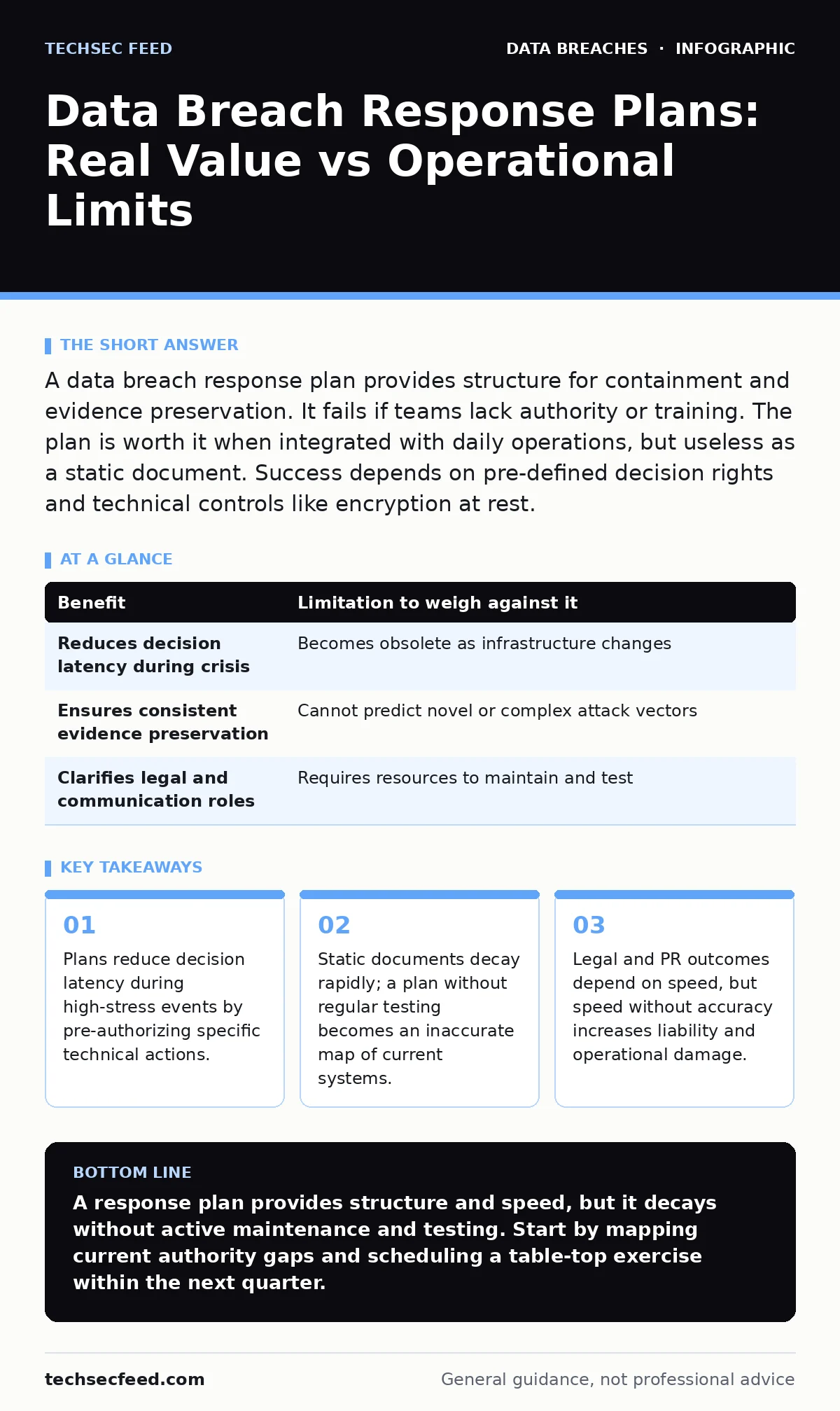
A data breach response plan provides structure for containment and evidence preservation. It fails if teams lack authority or training. The plan is worth it when integrated with daily operations, but useless as a static document. Success depends on pre-defined decision rights and technical controls like encryption at rest.
The Structural Benefit of Pre-Defined Actions
A data breach response plan removes the need for consensus during a crisis. When an intrusion is detected, every second spent debating who has authority to shut down a server is a second the attacker uses to exfiltrate data. The plan assigns clear roles. It defines who can isolate network segments, who contacts legal counsel, and who preserves forensic logs. This structure prevents the paralysis that often accompanies unexpected security events.
The plan also ensures evidence preservation. Without a predefined procedure, responders might overwrite critical logs or alter file timestamps while trying to fix the problem. The plan mandates specific preservation steps before remediation begins. This protects the organization’s ability to understand the scope of the breach later. It also supports any subsequent legal or regulatory requirements for demonstrating due care.
The Limitation of Static Documentation
A response plan is a snapshot of an organization’s state at the time of writing. Infrastructure changes, new applications, and personnel turnover render static documents inaccurate within months. If the plan references a server that no longer exists or a process that has been automated, responders will ignore the document. They will rely on instinct, which introduces inconsistency and error.
The plan cannot account for novel attack vectors. It provides templates for known scenarios, such as ransomware or phishing, but it cannot predict zero-day exploits or complex supply chain compromises. Responders must adapt the plan to the specific threat. This adaptation requires deep technical expertise that the plan itself does not provide. The document is a starting point, not a solution.
| Benefit | Limitation to weigh against it |
|---|---|
| Reduces decision latency during crisis | Becomes obsolete as infrastructure changes |
| Ensures consistent evidence preservation | Cannot predict novel or complex attack vectors |
| Clarifies legal and communication roles | Requires resources to maintain and test |
When It Is Worth It
A response plan is worth the investment when the organization handles sensitive data. If you process payment information, health records, or proprietary intellectual property, the cost of a breach is high. The plan ensures that the response minimizes damage to these assets. It also demonstrates to regulators and partners that the organization has prepared for worst-case scenarios.
It is also worth it when the organization has complex dependencies. Large networks with multiple cloud providers, third-party vendors, and legacy systems require coordinated action. A plan defines how these entities interact during an incident. It prevents conflicting actions, such as one team restoring a system while another is isolating it. This coordination reduces the total downtime and prevents accidental data loss.
Suppose a company uses encryption in transit but neglects encryption at rest. A response plan can help manage the fallout if data is stolen from unencrypted storage. It guides the notification process and remediation steps. However, the plan does not fix the underlying weakness. It manages the consequence, not the cause.
When It Is Not
A response plan is not worth it if the organization lacks the resources to maintain it. Writing a document is easy. Keeping it accurate is hard. If there is no budget for regular updates, table-top exercises, or training, the plan will decay. It becomes a liability. Responders who trust an outdated plan may take incorrect actions, worsening the breach. In these cases, investing in basic hygiene is more effective.
It is also not worth it if the organization has no sensitive data. If a breach would only expose public information or non-critical operational data, the cost of a formal plan may exceed the potential damage. Simple monitoring and basic logging are sufficient. A formal response plan adds complexity without proportional benefit. The organization should focus on preventing the initial compromise rather than planning for the aftermath.
The Hidden Cost of Authority Gaps
Many plans fail because they assume authority that does not exist. The document may state that the security team can shut down production servers. In reality, this decision requires approval from the CFO or CTO. During a breach, waiting for this approval allows the attacker to expand. The plan must include pre-signed authorization letters or clear escalation paths that bypass normal bureaucracy.
This authority gap is a hidden cost. It requires political capital to establish. Security leaders must negotiate with executive management to grant emergency powers. If this negotiation does not happen before an incident, the plan is useless. The technical steps may be correct, but the organizational structure prevents their execution.
See also: AS-REP Roasting Response: Containment, Recovery and Prevention Steps · Incident Communication Plans: How to Stop Chaos When Systems Fail
Integrating with Incident Communication Plans
A technical response is only half the battle. The other half is managing perception and legal liability. A data breach response plan must link to an incident communication plan. This separate document handles messaging to customers, regulators, and the media. It ensures that technical findings are translated into clear, accurate statements.
Without this integration, technical teams may leak inaccurate details or contradict public statements. This inconsistency erodes trust and increases legal risk. The response plan should trigger the communication plan at specific milestones, such as when data exfiltration is confirmed. This coordination ensures that all stakeholders receive consistent information.
Testing and Maintenance Requirements
A plan is only as good as its last test. Regular table-top exercises simulate breaches and reveal gaps in the document. These exercises should involve all stakeholders, including legal, HR, and executive management. They test not just the technical steps, but the decision-making process. They reveal where authority gaps exist and where communication breaks down.
Maintenance is ongoing. The plan must be reviewed after every significant infrastructure change. New cloud services, acquisitions, or mergers require updates to the response procedures. If the plan is not updated, it will mislead responders. Regular reviews ensure that the document reflects the current reality of the organization’s security posture.
Key takeaways
- Plans reduce decision latency during high-stress events by pre-authorizing specific technical actions.
- Static documents decay rapidly; a plan without regular testing becomes an inaccurate map of current systems.
- Legal and PR outcomes depend on speed, but speed without accuracy increases liability and operational damage.
A response plan provides structure and speed, but it decays without active maintenance and testing. Start by mapping current authority gaps and scheduling a table-top exercise within the next quarter.
Frequently asked questions
Does a response plan prevent data breaches?
No, a response plan does not prevent breaches. It only manages the impact and recovery after a breach has occurred. Prevention requires technical controls like encryption at rest and strong access management.
How often should I update the response plan?
Update the plan after any major infrastructure change or personnel shift. At minimum, review it annually. Regular table-top exercises help identify outdated sections.
Can I use a generic template for my plan?
Generic templates provide a starting point but lack specific details about your environment. You must customize every section to reflect your actual systems, people, and legal requirements.
What if my team is too small for a formal plan?
Even small teams need a basic plan. Focus on clear roles, contact lists, and simple containment steps. Complexity is not required; clarity is.
How this guide was produced: written by the TechSec Feed editorial team with AI assistance, checked against the public references listed below, and reviewed when the facts change. See our editorial policy or report an error.