
Encryption in Transit Best Practices for Secure Data Flow
Transport layer security alone fails to prevent data theft when endpoint validation is skipped, allowing attackers to intercept decrypted traffic at the network edge.
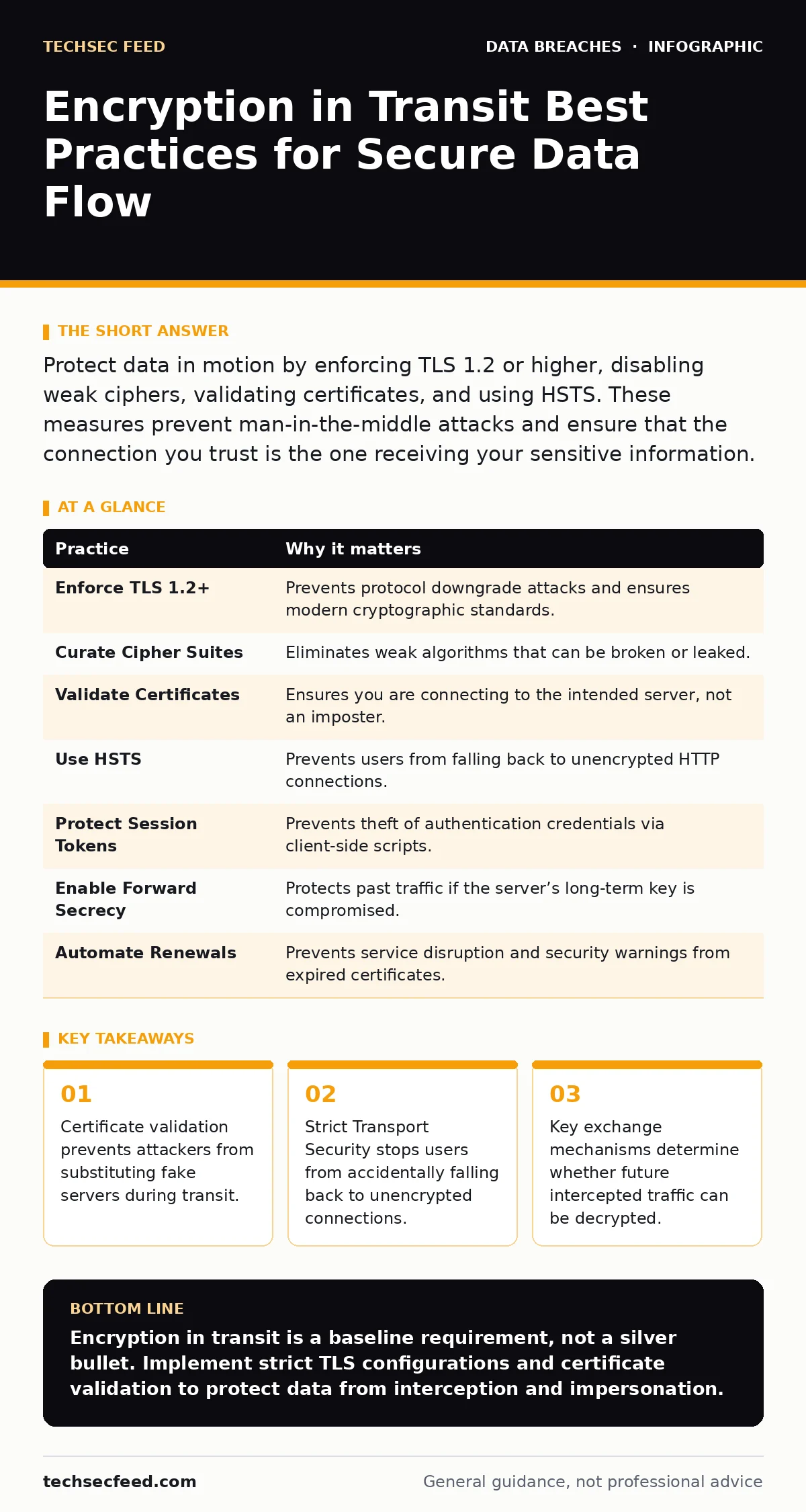
Protect data in motion by enforcing TLS 1.2 or higher, disabling weak ciphers, validating certificates, and using HSTS. These measures prevent man-in-the-middle attacks and ensure that the connection you trust is the one receiving your sensitive information.
Enforcing Modern Protocol Versions
Older versions of the Transport Layer Security protocol contain known vulnerabilities that allow attackers to downgrade connections or decrypt payloads. TLS 1.0 and 1.1 are no longer considered secure because they rely on cryptographic primitives that modern computing power can break. You must configure your servers and clients to reject any negotiation attempt below TLS 1.2. This ensures that every handshake uses algorithms with sufficient entropy to resist brute-force analysis.
Imagine a legacy device that only supports TLS 1.0. If your server accepts this connection, an attacker on the same network can force a downgrade attack. The traffic appears encrypted to the user, but the cryptographic integrity is compromised. The practical tip is to set the minimum protocol version in your web server configuration and test with a scanner that verifies downgrade resistance.
Disabling Weak Cipher Suites
Not all encryption algorithms are created equal. Some cipher suites use key lengths that are too short or modes of operation that leak information about the plaintext. When a server offers a wide range of ciphers, it may negotiate with a client using the weakest common denominator. This creates a soft spot in your security posture that automated tools can exploit. You should curate a list of preferred ciphers that prioritize authenticated encryption with associated data.
Avoid cipher suites that use electronic codebook mode or stream ciphers with weak initialization vectors. These can reveal patterns in the data even if the key remains secret. The practical tip is to order your cipher preferences by strength and force the server’s preference during the handshake. This removes the client’s ability to choose a weaker algorithm, ensuring the highest available standard of protection.
Validating Server Certificates
A digital certificate proves the identity of the server you are connecting to. Without proper validation, you are sending data to a server you do not know, which could be an attacker pretending to be your bank or email provider. Many applications and libraries have default settings that skip certificate validation for debugging purposes. If these defaults persist in production, they render encryption useless because the attacker controls the decryption key.
You must ensure that your application verifies the certificate chain up to a trusted root authority. This includes checking the expiration date and the domain name match. The practical tip is to enable strict hostname verification in your network stack and never use wildcard certificates for internal services that require mutual authentication. This prevents a certificate for a public domain from being used to impersonate an internal server.
Implementing HTTP Strict Transport Security
Users can accidentally type "http" instead of "https" or click on an old bookmark that points to an unencrypted link. This exposes the initial request, which might contain session tokens or cookies, to eavesdroppers. HTTP Strict Transport Security, or HSTS, tells the browser to always use HTTPS for a specific domain. Once a browser receives this header, it refuses to connect to the site over plain HTTP.
This mechanism protects against downgrade attacks where an attacker intercepts the initial unencrypted request and redirects the user to a fake site. The practical tip is to issue HSTS headers with a long max-age and include the preload directive. Submitting your domain to the browser preload list ensures that browsers enforce HTTPS from the very first visit, even before the server sends the header.
Preventing Session Token Leakage
Encrypted channels protect data in transit, but they do not protect the tokens that grant access to systems. If an attacker steals a session token, they can impersonate the user without needing the password. This is why protection against stolen session tokens is a critical aspect of transit security. Tokens must be marked as secure and HTTP-only to prevent client-side scripts from accessing them.
Imagine an attacker injecting a script into a webpage. If the session cookie is not HTTP-only, the script can read it and send it to the attacker. The practical tip is to set the Secure and SameSite flags on all session cookies. This ensures that cookies are only sent over encrypted connections and are not sent with cross-site requests, reducing the risk of cross-site request forgery.
See also: Data Breach Response Plans: Real Value vs Operational Limits · What is Hard Disk Encryption and How It Protects Data
Using Perfect Forward Secrecy
Perfect Forward Secrecy ensures that the compromise of a long-term server key does not compromise past session keys. Without it, an attacker who records encrypted traffic can decrypt it later if they obtain the server’s private key. This is a significant risk because private keys are often stored on disks or in memory where they can be exfiltrated.
You should configure your server to use ephemeral key exchange algorithms, such as Diffie-Hellman. This generates a unique key for each session that is discarded after the connection closes. The practical tip is to disable static RSA key exchange and prefer elliptic curve Diffie-Hellman variants. This adds a layer of protection that limits the damage of a key compromise to only the sessions occurring at the time of the breach.
Monitoring Certificate Expiration
An expired certificate causes the browser to display a security warning, which users often ignore. This leads to a degraded user experience and potential service disruption. More importantly, an expired certificate indicates a failure in the certificate management process. You need a system that automatically renews certificates before they expire.
The practical tip is to use an automated certificate management protocol like ACME. This allows your server to request and renew certificates without manual intervention. Integrate this with your deployment pipeline so that a failed renewal triggers an alert. This prevents the embarrassment and security risk of serving an invalid certificate to users.
| Practice | Why it matters |
|---|---|
| Enforce TLS 1.2+ | Prevents protocol downgrade attacks and ensures modern cryptographic standards. |
| Curate Cipher Suites | Eliminates weak algorithms that can be broken or leaked. |
| Validate Certificates | Ensures you are connecting to the intended server, not an imposter. |
| Use HSTS | Prevents users from falling back to unencrypted HTTP connections. |
| Protect Session Tokens | Prevents theft of authentication credentials via client-side scripts. |
| Enable Forward Secrecy | Protects past traffic if the server’s long-term key is compromised. |
| Automate Renewals | Prevents service disruption and security warnings from expired certificates. |
Segmenting Internal Traffic
Encryption is often applied only to external-facing services, leaving internal traffic unencrypted. This creates a blind spot where an attacker who breaches the perimeter can move laterally without detection. Internal services often contain sensitive data that is just as valuable as external data. You should encrypt traffic between internal servers and microservices.
The practical tip is to implement a zero-trust network model where all traffic, regardless of location, is authenticated and encrypted. Use mutual TLS for service-to-service communication. This ensures that even if an attacker gains access to one server, they cannot easily intercept data flowing to other servers.
Key takeaways
- Certificate validation prevents attackers from substituting fake servers during transit.
- Strict Transport Security stops users from accidentally falling back to unencrypted connections.
- Key exchange mechanisms determine whether future intercepted traffic can be decrypted.
Encryption in transit is a baseline requirement, not a silver bullet. Implement strict TLS configurations and certificate validation to protect data from interception and impersonation.
Frequently asked questions
Does encryption in transit prevent data breaches?
No, encryption in transit only protects data while it is moving between systems. It does not protect data at rest or from breaches caused by insider threats or application vulnerabilities.
How do I know if my TLS configuration is secure?
Use automated scanning tools to test your server for weak ciphers, outdated protocols, and missing security headers. Regular audits ensure that your configuration remains aligned with current best practices.
What is the difference between encryption in transit and encryption at rest?
Encryption in transit protects data as it moves across networks, while encryption at rest protects data stored on disks or databases. Both are necessary for a complete data protection strategy.
Can I use self-signed certificates for internal services?
You can, but you must distribute the root certificate to all clients. This adds management overhead and increases the risk of misconfiguration. Using a private certificate authority is a better practice for internal environments.
How this guide was produced: written by the TechSec Feed editorial team with AI assistance, checked against the public references listed below, and reviewed when the facts change. See our editorial policy or report an error.