
Why the CIA Triad Matters for Security Decisions
The CIA triad prevents teams from optimizing for one security property while accidentally destroying another, ensuring balanced protection.
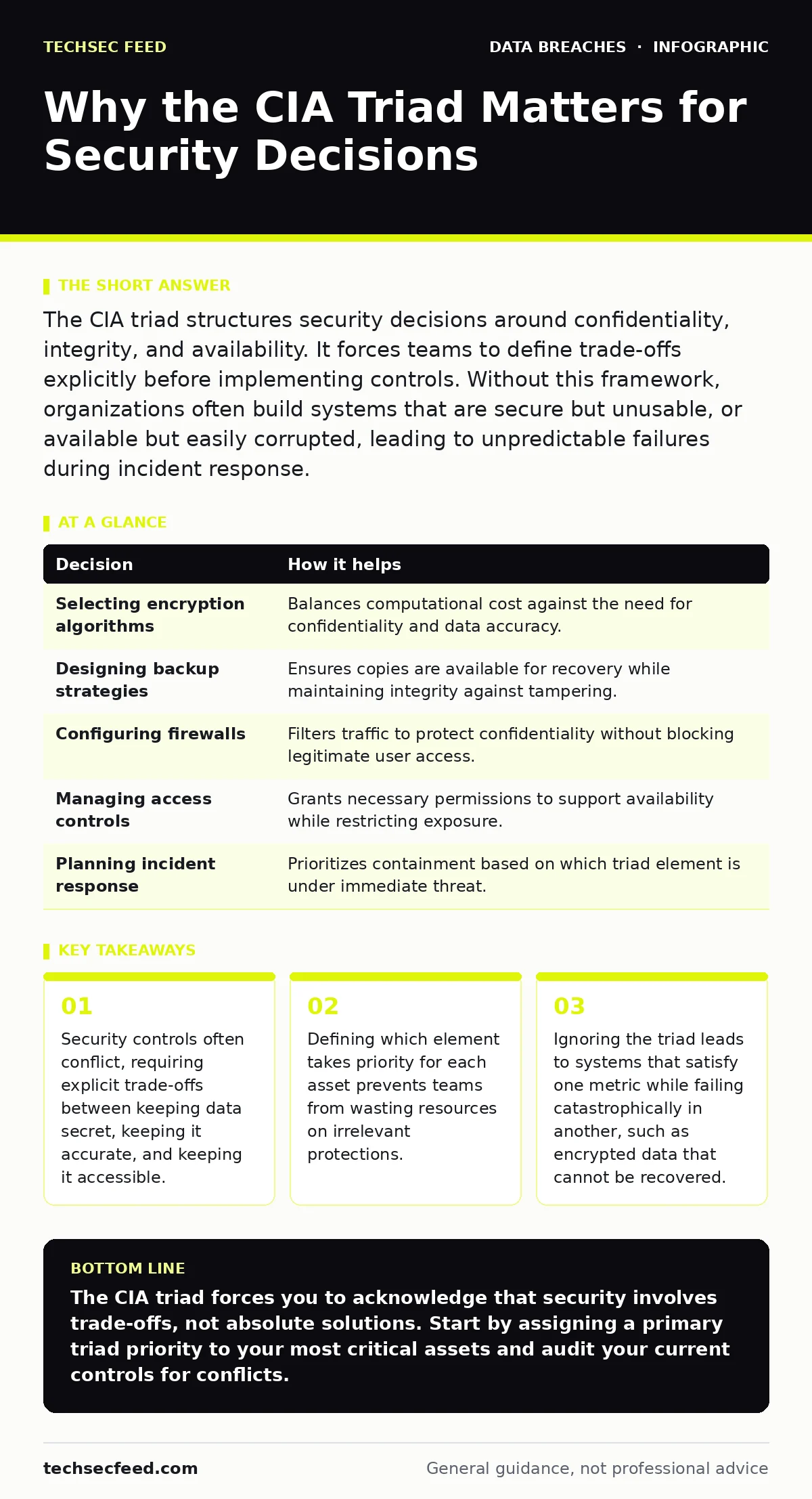
The CIA triad structures security decisions around confidentiality, integrity, and availability. It forces teams to define trade-offs explicitly before implementing controls. Without this framework, organizations often build systems that are secure but unusable, or available but easily corrupted, leading to unpredictable failures during incident response.
Defining the Core Security Objectives
The CIA triad consists of three foundational principles: confidentiality, integrity, and availability. Confidentiality ensures that information is accessible only to those authorized to have access. Integrity guarantees that data remains accurate, complete, and unaltered by unauthorized parties. Availability ensures that authorized users can access data and associated assets when required. These three properties form the basis of information security strategy. They are not mutually exclusive, but they often compete for resources and design choices. Understanding this tension is the first step in building effective defenses.
The Cost of Ignoring the Framework
Imagine a team that prioritizes confidentiality above all other concerns. They implement aggressive encryption and strict access controls to prevent data leakage. This approach seems secure on the surface. However, they neglect availability. When a routine maintenance window occurs, the complex encryption keys are stored in a way that makes recovery difficult. The system becomes inaccessible for hours. The business suffers because legitimate users cannot perform their work. The data is safe from thieves, but it is useless to the organization. This imbalance creates a single point of failure that undermines the entire security posture.
Imagine another team that prioritizes availability. They design a system that is always online and easily accessible. They skip complex authentication steps to reduce friction. This approach supports business continuity but ignores integrity. An attacker modifies a small configuration file. The system continues to run, but it now behaves incorrectly. It processes transactions with wrong values. The data is available, but it is no longer trustworthy. The team fails to detect the corruption because they did not implement integrity checks. The system is up, but the business is operating on false information.
How Teams Use the Triad Daily
Security operations teams use the CIA triad to evaluate every control they implement. Before deploying a new firewall rule, they ask how it affects these three properties. Does the rule block legitimate traffic, harming availability? Does it allow malicious payloads, harming integrity? Does it leak information through error messages, harming confidentiality?
This evaluation happens before code is written and before policies are published. It forces a disciplined approach to risk management. Teams document which property is most critical for each specific asset. A public website prioritizes availability. A database of medical records prioritizes confidentiality. A financial ledger prioritizes integrity.
Decisions Informed by the Framework
The triad informs technical and operational decisions across the organization. It helps teams choose between competing security features. For example, encryption at rest protects confidentiality but adds latency, which may impact availability. Teams must decide if the speed reduction is acceptable for the security gain. Similarly, full disk encryption protects data on lost laptops but requires key management that, if failed, renders the disk unreadable. These are not technical bugs; they are design trade-offs. The triad makes these trade-offs visible and deliberate. It prevents accidental misalignment between security goals and business needs.
| Decision | How it helps |
|---|---|
| Selecting encryption algorithms | Balances computational cost against the need for confidentiality and data accuracy. |
| Designing backup strategies | Ensures copies are available for recovery while maintaining integrity against tampering. |
| Configuring firewalls | Filters traffic to protect confidentiality without blocking legitimate user access. |
| Managing access controls | Grants necessary permissions to support availability while restricting exposure. |
| Planning incident response | Prioritizes containment based on which triad element is under immediate threat. |
What Goes Wrong Without It
Without the CIA triad, teams often apply generic security advice that does not fit their context. They might implement exposed API keys protections without considering how key rotation affects system availability. They might focus on preventing data scraping without ensuring that the anti-scraping measures do not break legitimate user functionality.
The result is a patchwork of controls that conflict with each other. One team locks down a server so tightly that the application cannot start. Another team leaves a database open so that users can access it, but an attacker modifies the data. These failures are not due to a lack of tools, but a lack of structured thinking.
See also: Small Business AI Governance: Practical Controls for Limited Teams · Encryption in Transit Best Practices for Secure Data Flow
Hidden Costs and Edge Cases
A common misconception is that maximizing all three properties is possible. In reality, increasing one often decreases another. High confidentiality measures, such as complex multi-factor authentication, can reduce availability by adding friction. High integrity measures, such as strict version control, can reduce availability by slowing down deployments. Teams must accept that they cannot have maximum security in all three areas simultaneously. They must choose a baseline. For most internal tools, availability is king. For external-facing customer data, confidentiality is paramount. Ignoring this hierarchy leads to over-engineering in some areas and under-protection in others.
Integrating with Broader Security Plans
The triad works best when integrated into broader operational plans. It informs data breach response plans by helping teams prioritize actions. If confidentiality is breached, containment is the first step. If integrity is compromised, verification is the priority. If availability is lost, restoration is the goal.
It also shapes incident communication plans. Teams must communicate clearly about which aspect of the triad was affected. Users react differently to data leaks than they do to service outages. Understanding the specific impact allows for more accurate and calm communication. This clarity reduces panic and helps stakeholders understand the real risk.
Practical Application for Operations
Start by inventorying your critical assets. For each asset, assign a primary priority from the CIA triad. Document why that priority was chosen. Review your existing controls against this priority. Identify any controls that conflict with the primary goal. For example, if availability is the priority, remove unnecessary authentication steps that cause delays. If integrity is the priority, implement checksums and digital signatures. This process turns abstract security concepts into actionable engineering requirements. It ensures that every security decision has a clear rationale. It also makes it easier to explain security choices to non-technical stakeholders.
Key takeaways
- Security controls often conflict, requiring explicit trade-offs between keeping data secret, keeping it accurate, and keeping it accessible.
- Defining which element takes priority for each asset prevents teams from wasting resources on irrelevant protections.
- Ignoring the triad leads to systems that satisfy one metric while failing catastrophically in another, such as encrypted data that cannot be recovered.
The CIA triad forces you to acknowledge that security involves trade-offs, not absolute solutions. Start by assigning a primary triad priority to your most critical assets and audit your current controls for conflicts.
Frequently asked questions
Can I prioritize all three CIA elements equally?
No, maximizing all three simultaneously is rarely possible due to resource constraints and technical trade-offs. You must choose a primary focus based on the asset's purpose and risk profile.
How does the CIA triad relate to compliance requirements?
Most compliance frameworks, such as GDPR or HIPAA, map directly to the triad. They require confidentiality for personal data, integrity for records, and availability for business continuity.
What is the first step in applying the triad to a new project?
Identify the primary security goal for the system during the design phase. Determine whether confidentiality, integrity, or availability is most critical to the business function.
Does the CIA triad cover physical security?
Yes, the principles apply to physical assets as well. Confidentiality means restricting access to server rooms. Integrity means preventing physical tampering with hardware. Availability means ensuring power and cooling.
How this guide was produced: written by the TechSec Feed editorial team with AI assistance, checked against the public references listed below, and reviewed when the facts change. See our editorial policy or report an error.