
Small Business Certificate Management: Avoid Downtime
Automated renewal prevents silent failures that expose traffic to interception, while manual tracking introduces operational risk disproportionate to the cost of the certificate.
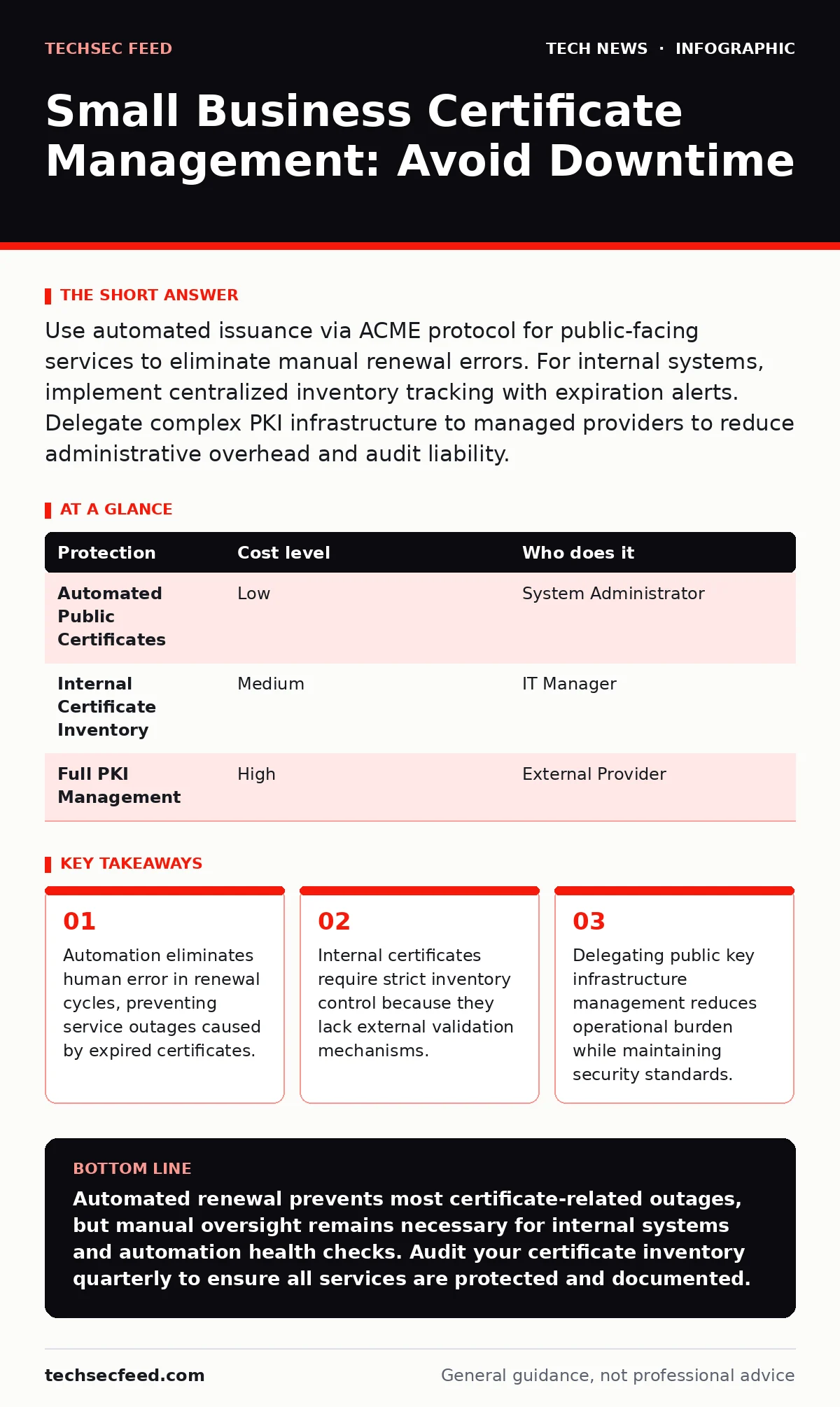
Use automated issuance via ACME protocol for public-facing services to eliminate manual renewal errors. For internal systems, implement centralized inventory tracking with expiration alerts. Delegate complex PKI infrastructure to managed providers to reduce administrative overhead and audit liability.
The Silent Failure of Small Teams
Small organizations often treat digital certificates as a one-time configuration task. This approach fails because certificates have a finite lifespan. When that lifespan ends, the service stops working or becomes insecure. The failure is rarely dramatic; it is a silent break in trust that users notice only when they attempt to connect.
The risk is not just downtime. An expired certificate may cause clients to bypass security warnings, exposing them to man-in-the-middle attacks. In a small team, the person who configured the system is often the only one who knows where the certificate files are stored. If that person is unavailable, the organization is paralyzed.
Why Scale Changes the Risk Profile
In large enterprises, certificate management is a distributed problem with dedicated teams. In small businesses, it is a concentrated risk. The cost of a breach or outage is higher relative to resources. There is less redundancy in personnel and processes.
You must recognize that the complexity of certificate management does not scale linearly with company size. A ten-person company faces similar technical challenges as a thousand-person company, but with fewer tools to mitigate them. The margin for error is thinner.
This is where HTTPS becomes more than a protocol; it becomes a business continuity requirement. Without valid certificates, encrypted connections fail. Your customers lose trust, and your data protection mechanisms disengage. The technical failure translates directly into business risk.
Affordable Automation Strategies
Automation is the most effective control for certificate management. It removes the human element from renewal cycles. The ACME protocol allows servers to automatically request and renew certificates from certificate authorities without manual intervention.
This method is cost-effective because many providers offer free certificates. The trade-off is that you must maintain a stable DNS configuration and ensure your server can communicate with the issuer. If your DNS settings change, the automation may fail.
For services that cannot use automated issuance, such as internal applications behind a firewall, you must implement manual tracking. Use a centralized inventory system to log every certificate, its expiration date, and its location. Set alerts for thirty days before expiration. This creates a buffer for renewal actions.
| Protection | Cost level | Who does it |
|---|---|---|
| Automated Public Certificates | Low | System Administrator |
| Internal Certificate Inventory | Medium | IT Manager |
| Full PKI Management | High | External Provider |
The Hidden Cost of Manual Tracking
Manual management introduces cognitive load. You must remember to check, verify, and update. This distracts from higher-value tasks. The hidden cost is not just time; it is the risk of oversight.
When you manage certificates manually, you rely on memory and spreadsheets. Spreadsheets are not reliable for security operations. They do not alert you when a date passes. They do not verify the actual state of the certificate on the server.
Imagine an administrator who updates a spreadsheet but forgets to restart the web server. The certificate is renewed in the file system, but the service continues to serve the old, expired certificate. The inventory says everything is fine, but the traffic is insecure. This gap between record and reality is where failures occur.
What to Delegate to Providers
Not every organization needs to build its own Public Key Infrastructure. PKI is the set of roles, policies, hardware, software, and procedures needed to create, manage, distribute, use, store, and revoke digital certificates. It is complex and resource-intensive.
For small businesses, building an internal CA is rarely justified. The maintenance burden outweighs the control benefits. Instead, delegate the issuance and management of certificates to a managed service provider. They handle the technical complexity, while you retain oversight.
This delegation extends to monitoring. A provider can offer dashboards that show the status of all certificates across your environment. This gives you visibility without the operational overhead. You pay for expertise and reliability, which is often cheaper than the cost of an outage.
See also: Child Identity Theft: Why Small Businesses Are Targets and How to Stop It
Questions for IT Providers
When evaluating a provider for certificate management, ask specific questions. Vague answers indicate a lack of depth in their service. You need to know how they handle failures and edge cases.
- How do you notify us of upcoming expirations?
- What is the process for renewing certificates that fail automated checks?
- Do you support wildcard certificates for subdomains?
- How do you handle certificate revocation if a key is compromised?
- Can you provide a historical audit log of all certificate actions?
These questions reveal the provider’s operational maturity. A good provider will have clear procedures for each scenario. They will not rely on manual checks or ad-hoc solutions.
Integrating with Broader Security
Certificate management does not exist in isolation. It intersects with other security domains. For example, browser security settings may reject certificates that are not properly chained or that use weak algorithms. You must ensure your certificates meet modern standards.
Similarly, API key security often relies on certificates for mutual authentication. If your API endpoints require client certificates, the management complexity increases. You must manage both server and client certificates. This requires a more robust inventory system.
Consider the OSI model when troubleshooting certificate issues. Problems can occur at the transport layer (TLS) or the application layer (HTTP headers). Understanding where the failure occurs helps you diagnose the root cause. Is it a network issue, a configuration error, or a certificate problem?
Maintaining Operational Discipline
Automation reduces risk, but it does not eliminate it. You must still monitor the health of your automation systems. If the ACME client fails, you need to know. Set up alerts for failed renewal attempts.
Regular audits are necessary. Review your certificate inventory quarterly. Verify that all active services have valid certificates. Check for any certificates that are not in use but still consume resources. This cleanup prevents clutter and reduces the attack surface.
The goal is not perfect security, which is impossible. The goal is resilience. You want systems that continue to function even when errors occur. Certificate management is a small part of this, but it is a critical one. A single expired certificate can disrupt your entire operation.
Key takeaways
- Automation eliminates human error in renewal cycles, preventing service outages caused by expired certificates.
- Internal certificates require strict inventory control because they lack external validation mechanisms.
- Delegating public key infrastructure management reduces operational burden while maintaining security standards.
Automated renewal prevents most certificate-related outages, but manual oversight remains necessary for internal systems and automation health checks. Audit your certificate inventory quarterly to ensure all services are protected and documented.
Frequently asked questions
How often should I renew my SSL certificates?
Most certificates are valid for one year, but automated systems often renew them every ninety days to provide a buffer for failures.
Can I use the same certificate for multiple domains?
Yes, Subject Alternative Name certificates allow one certificate to secure multiple domains or subdomains, simplifying management.
What happens if a certificate is compromised?
The certificate must be revoked immediately through the certificate authority, and a new one must be issued and deployed to prevent unauthorized use.
Do internal networks need certificate management?
Yes, internal services often use certificates for encryption and authentication. Expired internal certificates can disrupt business operations and expose data.
How this guide was produced: written by the TechSec Feed editorial team with AI assistance, checked against the public references listed below, and reviewed when the facts change. See our editorial policy or report an error.