
Certificate Authorities: The Hidden Gatekeeper of Digital Trust
Certificate authorities enforce a chain of trust that prevents attackers from impersonating your services, even when they control the underlying network infrastructure.
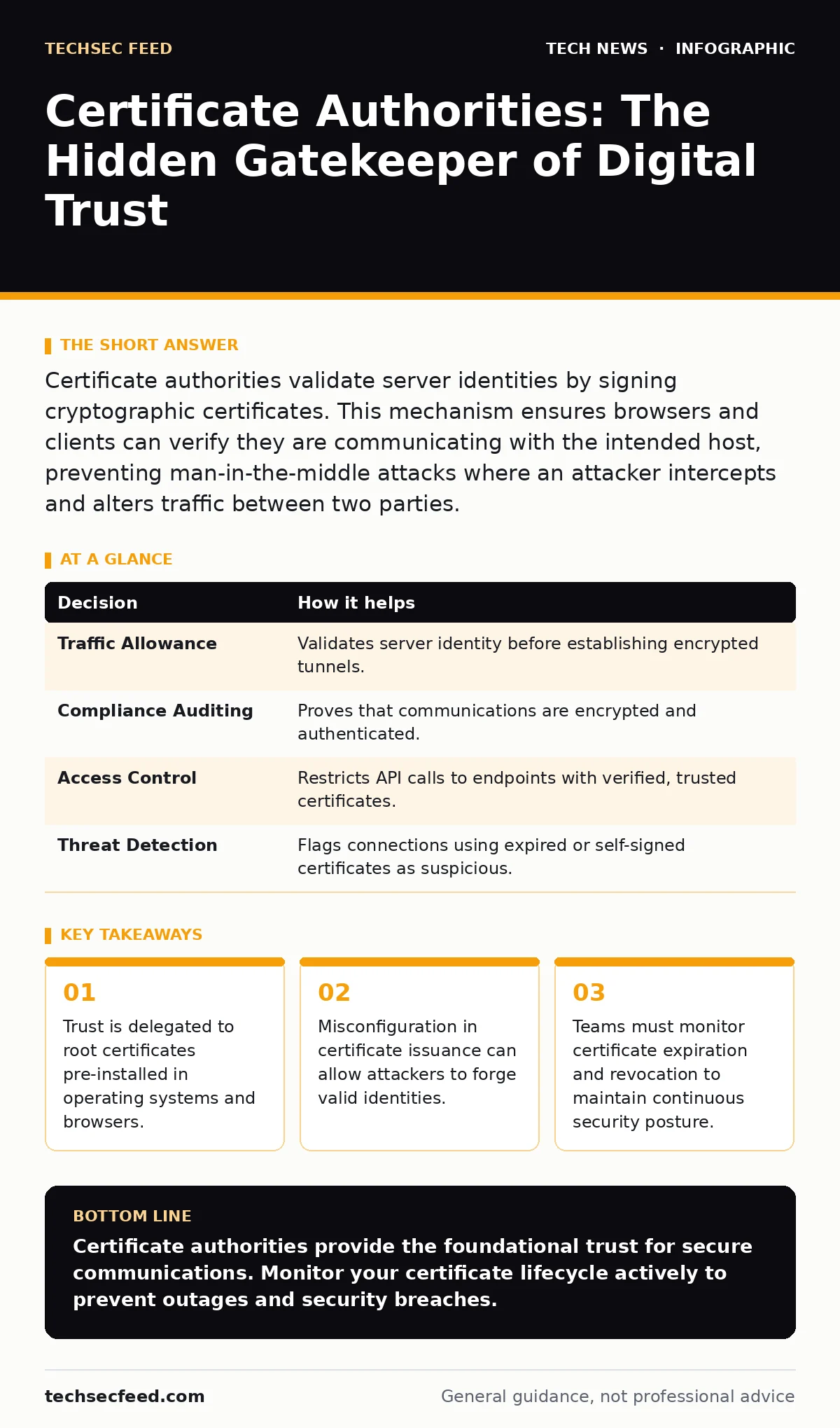
Certificate authorities validate server identities by signing cryptographic certificates. This mechanism ensures browsers and clients can verify they are communicating with the intended host, preventing man-in-the-middle attacks where an attacker intercepts and alters traffic between two parties.
The Architecture of Implicit Trust
You rely on certificate authorities to establish identity without meeting the other party. This system works because your device trusts a small set of root certificates installed by the operating system vendor. When a server presents a certificate signed by one of these trusted roots, your browser accepts it as valid. This process happens automatically in the background during every secure connection.
The security model depends on the authority verifying the server’s identity before signing the certificate. If the authority fails this verification, an attacker can obtain a valid certificate for a domain they do not own. This breaks the fundamental promise of encryption: that the other end is who it claims to be.
Decisions Informed by Trust Anchors
Your security operations rely on these certificates to make automated decisions. The presence or absence of a valid certificate determines whether traffic is allowed, blocked, or flagged for inspection. These decisions extend beyond simple connectivity to include compliance and access control.
| Decision | How it helps |
|---|---|
| Traffic Allowance | Validates server identity before establishing encrypted tunnels. |
| Compliance Auditing | Proves that communications are encrypted and authenticated. |
| Access Control | Restricts API calls to endpoints with verified, trusted certificates. |
| Threat Detection | Flags connections using expired or self-signed certificates as suspicious. |
The Cost of Bypassing Validation
Suppose a team disables certificate validation to simplify internal tooling. They argue that their private network is isolated and safe from external threats. This decision removes the ability to detect if an attacker has compromised the internal network infrastructure. An attacker on the same network can now impersonate any internal service.
Without validation, the team loses the distinction between the real service and a rogue server. They cannot detect if an attacker is intercepting credentials or sensitive data. The convenience of skipping validation introduces a blind spot that monitoring tools cannot fill.
Operational Friction and Hidden Costs
Managing certificates is not a one-time setup. Teams must track expiration dates, rotate keys, and handle revocations. If a certificate expires, services fail silently. Users see errors, and automated systems break. This operational burden is often underestimated.
The hidden cost lies in the lack of visibility. When certificates are managed manually, it is easy to miss an expiration. Teams often discover the issue only when users report outages. This reactive approach wastes resources and damages trust. Integrating with existing certificate management workflows reduces this risk.
Edge Cases in Trust Chains
Not all certificates are created equal. Some services use intermediate certificates that may not be properly chained to the root. If the chain is broken, clients may reject the connection. This often happens when certificates are generated incorrectly or when intermediate certificates are not included in the server configuration.
Another edge case involves wildcard certificates. These cover multiple subdomains, which simplifies management but increases risk. If the private key for a wildcard certificate is compromised, an attacker can impersonate any subdomain. This broadens the attack surface significantly.
Integrating with Modern Infrastructure
Modern infrastructure relies on automation. Manual certificate management does not scale. Teams use automated tools to request, deploy, and renew certificates. This integration ensures that certificates are always valid and up to date.
This automation must be secured. The tools that manage certificates become high-value targets. If an attacker gains access to the automation system, they can generate valid certificates for any domain. Securing these systems is as critical as securing the servers themselves. Consider DevOps security practices to protect these pipelines.
The Human Element in Security
Technology alone cannot solve trust issues. Teams must understand the implications of their choices. They must know why they are using certain certificates and what happens if they fail. Training staff on the basics of HTTPS and browser security settings helps them recognize signs of compromise.
Users often ignore browser warnings. These warnings exist for a reason. Ignoring them bypasses the security controls put in place by the certificate authority. Educating users on the importance of these warnings reduces the risk of successful phishing attacks.
Conclusion of Trust Mechanics
The certificate authority model is fragile but effective. It relies on the assumption that the authorities act honestly and securely. When this assumption holds, it provides a reliable basis for digital trust. When it fails, the consequences are severe.
You must treat certificate management as a core security function. It is not an afterthought. By understanding the mechanics, the costs, and the edge cases, you can build a more resilient security posture.
Key takeaways
- Trust is delegated to root certificates pre-installed in operating systems and browsers.
- Misconfiguration in certificate issuance can allow attackers to forge valid identities.
- Teams must monitor certificate expiration and revocation to maintain continuous security posture.
Certificate authorities provide the foundational trust for secure communications. Monitor your certificate lifecycle actively to prevent outages and security breaches.
Frequently asked questions
What happens if a certificate authority is compromised?
If a certificate authority is compromised, attackers can issue valid certificates for any domain. This allows them to impersonate legitimate services and intercept traffic. Affected certificates are revoked, and trust in that authority is removed from browsers and operating systems.
How do I know if a certificate is valid?
Your browser or operating system validates the certificate automatically. It checks the signature, expiration date, and revocation status. If the certificate is invalid, the browser displays a warning. Never ignore these warnings, as they indicate a potential security risk.
Can I use my own certificate authority?
Yes, you can run your own certificate authority. This is common in internal networks. However, you must install your root certificate on every device that needs to trust it. This adds operational complexity and does not protect external users.
Why do certificates expire?
Certificates expire to limit the damage if a private key is compromised. Shorter validity periods mean that compromised keys are useful for a shorter time. It also encourages regular rotation of keys and updates to security practices.
How this guide was produced: written by the TechSec Feed editorial team with AI assistance, checked against the public references listed below, and reviewed when the facts change. See our editorial policy or report an error.