
How Small Businesses Use ISACs for Threat Intelligence
Industry-specific threat groups provide structured intelligence feeds that small teams can parse without hiring dedicated analysts or buying expensive platforms.
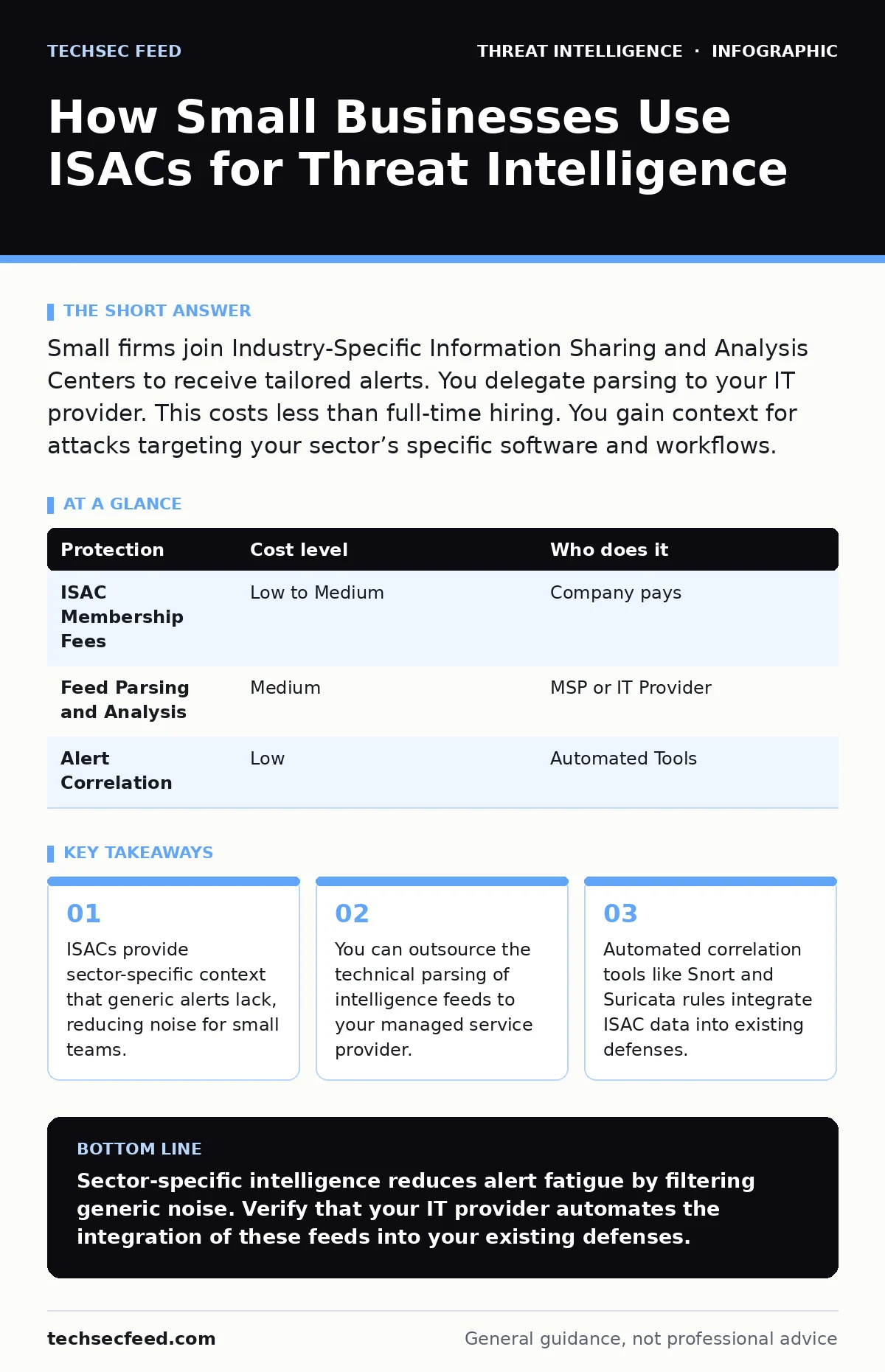
Small firms join Industry-Specific Information Sharing and Analysis Centers to receive tailored alerts. You delegate parsing to your IT provider. This costs less than full-time hiring. You gain context for attacks targeting your sector’s specific software and workflows.
The Problem of Generic Noise
Threat intelligence feeds are often too broad for small operations. Generic alerts flag every anomaly, regardless of relevance. Your team spends hours investigating false positives. This drains resources from actual security work.
ISACs solve this by focusing on your industry. They track attackers who target your specific software stack. This reduces the volume of irrelevant alerts. You see only what matters to your sector.
The trade-off is membership. You must contribute some data or pay fees. However, the signal-to-noise ratio improves dramatically. You stop chasing ghosts and start blocking real threats.
Why Sector Context Matters
Attackers often reuse tools across industries. But they tailor initial access methods to sector norms. A healthcare ISAC knows which medical devices are vulnerable. A finance ISAC tracks phishing kits targeting payroll software.
This context helps you prioritize patches. Not all vulnerabilities are equal. Some are actively exploited in your industry. Others are theoretical. ISACs highlight the active ones.
This approach complements frameworks like the MITRE ATT&CK Navigator. You map ISAC alerts to techniques. You see where your defenses are weak. You fix the gaps that matter most.
Affordable Participation Models
Joining an ISAC does not require a large budget. Many centers offer tiered membership. Small businesses can join at lower levels. These tiers often include read-only access to alerts.
You do not need to hire a full-time analyst. You can use a managed service provider (MSP). They parse the feeds for you. They translate technical data into action items.
This delegation is key. You pay for expertise, not headcount. The MSP integrates the intelligence into your monitoring tools. You get professional analysis without the salary.
| Protection | Cost level | Who does it |
|---|---|---|
| ISAC Membership Fees | Low to Medium | Company pays |
| Feed Parsing and Analysis | Medium | MSP or IT Provider |
| Alert Correlation | Low | Automated Tools |
Delegating to Your IT Provider
Your IT provider must understand threat intelligence. Ask them how they use external feeds. Do they just download reports? Or do they automate the response?
Look for providers who use automation. They should feed ISAC data into your SIEM. This allows for real-time correlation. You get faster detection and response.
Ask about their experience with your sector. Have they joined an ISAC before? Do they understand the specific risks? Their expertise matters as much as their tools.
Integrating with Existing Tools
You must integrate ISAC data with your current stack. This ensures alerts are actionable. Standalone reports are easy to ignore. Integrated alerts trigger workflows.
Use tools that support open standards. Snort and Suricata rules can be updated based on ISAC findings. This blocks known malicious patterns at the network edge.
You can also use canary tokens. Place them in sensitive areas. If an attacker touches them, the ISAC feed may provide context. This helps you understand the attack chain.
See also: Small Business Certificate Management: Avoid Downtime · Sysmon for Small Teams: Low-Cost Monitoring That Actually Works
The Hidden Cost of Data Sharing
ISACs rely on shared data. Members contribute anonymized indicators of compromise. This collective intelligence is powerful. But it requires trust.
You must ensure your data is sanitized. Remove identifying information before sharing. This protects your privacy. It also maintains the integrity of the feed.
Your IT provider should handle this. They know how to strip metadata. They ensure compliance with privacy laws. This step is often overlooked but critical.
Beyond Traditional Defense
ISACs help you anticipate new tactics. Attackers evolve quickly. New techniques emerge regularly. ISACs track these shifts early.
For example, you might learn about scheduled task abuse in your sector. This allows you to harden those mechanisms. You stay ahead of the curve.
This proactive stance is valuable. You are not just reacting. You are preparing. This reduces the impact of future attacks.
Questions for Your Provider
Before delegating, verify capabilities. Ask specific questions. Do not accept vague answers. You need clarity on their process.
- How do you ingest ISAC feeds?
- Do you automate rule updates?
- How do you prioritize alerts?
- Can you demonstrate past successes?
- What is your data sanitization process?
These questions reveal their maturity. A good provider has clear answers. They show you how they work. This builds confidence in the partnership.
Maintaining Operational Security
Using ISACs changes your workflow. You must balance visibility with security. Do not expose too much data. Protect your internal networks.
Ensure your endpoints are monitored. Tools like Sysmon can log detailed activity. This helps you investigate alerts from ISACs. You get a full picture of the incident.
Regular reviews are necessary. Check your integration monthly. Update your rules as needed. This keeps your defenses sharp.
The Role of Community
ISACs are communities. They share more than just data. They share best practices. You learn from peers. This knowledge transfer is invaluable.
Attend webinars and workshops. Engage with other members. Ask questions. Learn from their mistakes. This collaborative approach strengthens everyone.
You are not alone in this fight. The community supports you. Use this resource wisely. It enhances your security posture significantly.
Key takeaways
- ISACs provide sector-specific context that generic alerts lack, reducing noise for small teams.
- You can outsource the technical parsing of intelligence feeds to your managed service provider.
- Automated correlation tools like Snort and Suricata rules integrate ISAC data into existing defenses.
Sector-specific intelligence reduces alert fatigue by filtering generic noise. Verify that your IT provider automates the integration of these feeds into your existing defenses.
Frequently asked questions
Do I need to be a large enterprise to join an ISAC?
No, many ISACs have membership tiers for small and mid-sized businesses. They often provide scaled-down access that fits smaller budgets and operational needs.
How much does ISAC membership typically cost?
Costs vary widely by industry and membership level. Some charge annual fees, while others operate on a cost-sharing model. Always check the specific center’s pricing structure.
Can my IT provider handle ISAC integration alone?
Yes, if they have the expertise. They should manage data ingestion, sanitization, and rule automation. You must still provide oversight and strategic direction.
What if my industry does not have an ISAC?
You can join a related sector’s ISAC or use general threat intelligence platforms. Look for centers that cover adjacent technologies or business functions.
How this guide was produced: written by the TechSec Feed editorial team with AI assistance, checked against the public references listed below, and reviewed when the facts change. See our editorial policy or report an error.